Unecumenical Saints: St. Peter Canisius

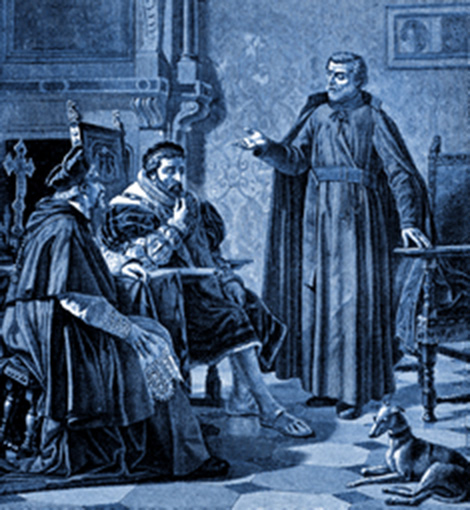
saint_peter_canisiusSt. Peter Canisius is perhaps one of the more neglected doctors of the Church. Amongst the names of the great saints in his era, of Borromeo, Ignatius, Philip Neri, Francis Xavier, John of the Cross, Teresa of Avila, St. Pius V, etc., his name tends to get lost. In Germany and Switzerland, however, his name was once synonymous with Catholic orthodoxy. St. Peter Canisius is almost unparallelled in his output, and even Protestant theologians praised and admired him for his holiness and learning.

One of the things Canisius could not brook was heresy. Here is an excerpt from a letter he wrote  which is quoted in “A Champion of the Church: The Life of St. Peter Canisius”, which is going to be reprinted by next week, by Mediatrix press, so watch for that. In this letter, he is writing on the miserable state of Catholic universities.

“The masters of good and solid doctrine are few in number here and are not anxious to make their students better. Most of the professors have little standing from the point of view of science. In their teaching they are less concerned with the truths of the Gospel than with doctrines favoring the passions. Among them are secret or open heretics, who spread, more or less openly, the poison of error in the minds of their students. Left to themselves and without guidance, young men have no love for study and no desire to advance in science. False doctrine and immorality have been spread among the people. The faithful are no longer Catholics except in name; they live without giving a thought to their souls and a future life; they despise the authority of their pastors and of the Church. I write this in order to arouse your charity to pray that grace may abound more where sin has already abounded.”
Peter Canisius and his companions undertook this work of reforming morals and thought which was to be the great endeavor of his life. Not content with giving his lectures in theology, he endeavored by special lessons to make good the lack of preparation of many of his students. He was especially concerned with their souls, and succeeded in leading many back to the practice of piety. Having been appointed Rector of the University, he displayed great zeal in introducing necessary reforms. Thus he forbade the sale of works which were dangerous for faith or morals. The position of Vice-Chancellor was offered to him after his tenure of the office of Rector. He accepted it only for a specified time and on condition of not benefitting by the emoluments attached to the same.”

champion_of_the_churchToday, he would be said to be too rigorist, which is not very merciful.
Shameless plug moment: The book from which this quote is taken from, A Champion of the Church, has just come back into print, courtesy of Mediatrix press (which I run). Consider buying a copy.


A further look at the Instrumentum Laboris

Here I am continuing the discussion of the Instrumentum Laboris for the 2014 Synod. You can see my first post on that here.
After finishing this document I can only conclude there will be bad things coming out of this synod. Let’s have a look at some of the problematic passages.

In various ways, the responses refer to many instances of the break-up and breakdown of families, the first and foremost being a couple’s divorce and separation which is sometimes caused by poverty. Other critical situations include many relationships which do not coincide with the idea of a traditional nuclear family, i.e., mother, father and children: single parenthood (a mother only or a teen mother), de facto unions and homosexual unions and parenting (specifically mentioned in Europe and North America). (IS no. 65)

Poverty? Has anyone noticed the divorces in Europe and America are primarily amongst the rich? Yes, the poor sometimes do divorce over property. Even there, however, is it really poverty that causes divorce? Or is it selfishness among one or both spouses? The language of poverty entering into this document is rather a feature of the Francis Papacy. Now poverty is a problem in this world, particularly the crippling poverty that western policies have brought to a number of African and Latin American countries. But what does it seriously have to do with divorce? I don’t know enough about Latin America to form any opinion about what their situation is with divorce and remarriage, but I would put good money down it is higher amongst the wealthy than among the poor. Nevertheless, the language of poverty in Francis’ statements and interviews is disturbing for two reasons. One is that he is usually treating it from the Marxist view (i.e. liberation theology), treating only on the poor’s material well-being. The second is his solutions to poverty are not sustainable. These statements range from “redistribute the wealth” (another Marxist concept) to more government programs (guaranteed failure). Now, I like that he has been attacking finance capital, and the high rollers of the west, but he is not making that attack from the standpoint of Catholic social teaching. The fact is we will never eliminate poverty. However, we can alleviate the suffering of the poor in 3 ways: a) beautiful liturgy and true doctrine b) charity offered by religious houses, wealthy Catholics etc. c) getting property for the poor and the means for them to produce. The last is the answer to the crippling poverty we have all over the world. If Francis is expecting a government program to fix it, well, I don’t know what to tell him. They’ll be working up yet another one of these documents in 20 years lamenting the same problem I bet.
Back to Divorce. The root of divorce is materialism, individualism, lack of support for the family, and frankly the spirit of atheistic capitalism that inspires men and women to trade in their spouses like used cars looking for a better deal. It is also the root of fornication and adultery. The Instrumentum, however, does make note of this, but in one of those statements that is just not going anywhere. It is not applying this observation to any one problem. (I.S. n. 74) Another problem with divorce is the problem of faith and what families get in Church, although, as I mentioned above, no one involved in this document thinks there is anything wrong with clown masses.

Later, describing the apparent shortcomings of marriage preparation, the document notes:

According to a large number of responses and a greater number of observations from various parts of the world, preparation for a religious ceremony of marriage should not be limited to catechesis only but also serve as an opportunity to get better acquainted and engage in conversation, something pastors could encourage more. On the other hand, various responses from both East and West mention that some of the clergy experience a certain frustration at often witnessing a failure in their pastoral endeavours, when only a very small number of couples continue some kind of relationship with the parish after the celebration of marriage… The majority of responses see an absolute need for a follow-up programme for couples after marriage with meetings aimed at offering them assistance. (IS 106 and 108)

Are these guys serious? I wouldn’t want some follow up with the priest to have to sit down and “talk” about marriage. Besides, we know how it really goes. Husband says everything is great (because he really thinks it is), wife is silent, so priest concludes everything is okay, when in reality at home the wife won’t say anything until she absolutely melts down. This isn’t going to make anyone who is not going to Church start going back. No, if you want to keep people in Church you need to have liturgy that men can intellectually as well as spiritually respect, and provide good preaching. Moreover the lack of depth in “Church” communities needs to be addressed. There are a combination of things that cause young married couples to simply not participate in Church. Liturgy we mentioned, but also, most people’s friends are made at school and work, not at Church. Most people’s lives revolve around working for the man in order to earn the increasingly decreased necessities, and their friends and acquaintances are made in this activity, rather than in going to Church for an hour for silly hymns and nutty liturgies, or preaching about the weather. Moreover for all the people who attend a given Church, the people who go there lived in diverse areas. The question of making the Church more relevant is an issue that goes to the center of our entire social living. The point of reference for ay Western Society, and it would appear any urban center in Eastern society, is not our eternal end, not our spiritual needs. It is material. Any time these discconects are addressed in this document, it is also treated with respect to the material. What about with regard to the spiritual?

In cases where a couple does not seem to understand or does not agree with the basic teachings of the Church on the benefits of marriage and its related responsibilities, the bishops’ conferences of northern Europe and North America say that the more appropriate course of action would be to postpone the celebration of marriage, fully cognizant beforehand that this proposal could lead to misunderstanding and resentment. Inherent in such a solution, however, would be the danger of a rigorism which is not very merciful. (IS n. 108).

What exactly is rigorism? The Oxford dictionary defines it thus: “extreme strictness in interpreting or enforcing a law or principle. (the Roman Catholic doctrine that in doubtful cases of conscience the strict course is always to be followed.)” !
There we go. The world has already set its preconceived definition, and for 50 years the Church has fallen into it, as we see here, it “is not very merciful.” So if people demonstrate that they are not prepared for the sacraments, we can’t postpone it because it isn’t merciful? Is it merciful to let people who obviously shouldn’t get married, to be married anyway? One thing lacking here is a discussion of the pre-marriage investigation prescribed by Canon Law. Are priests making it? One thing that might be useful would be talking again about publishing the “marriage bans”. This was a process that entailed the Church announcing from the pulpit in the Church where the couple gets married that this couple is going to get married, if anyone knows of a reason why they couldn’t (one or the other has been married before without an annulment) he should see the priest immediately. In fact, it used to be considered before the Council that couples getting married without the bans having been read had an invalid marriage absent some very grave reason. There is another thing here. It is proposed that dealing with people, who are not merely lacking in maturity, but who actually actively dissent from formal Church teachings, should be given the sacrament anyway because to not do so would be rigorist. There are some things that need to be distinguished here:
a) The faithful have the right to the Sacraments, and in the case of marriage, grave cause has to be shown and given to the Bishop in order to postpone a marriage. This is because the Church historically has recognized the danger of being the cause of young people to sin if they are in good standing. If there is no impediment to the marriage, the faithful have a right to get married irrespective of the judgment of the priest. Now, that doesn’t give them a right to be married on their own time-table, but whatever the normal policies are (e.g. 6 months notice) should be followed. He could, if he saw serious problems in two people who otherwise have no impediments and have right faith, bring these concerns to the prospective spouses, or their parents. But if they persist, the law of the Church is he must marry them.
If couples do not believe in Church teachings (and come on, we know which ones, no one is sitting there disputing with the priest whether Christ had three natures or just one), they are essentially public heretics, i.e. they don’t have right faith. This becomes very serious if we are talking about things which will in fact affect the validity of the marriage, such as the intention to use contraception. In a true sense, nobody really understands marriage until they are married, it is a learning curve that lasts,…. well, forever. Those issues will be learned and addressed. If someone intends to use contraception, then what is really going on is that they don’t intend to do what marriage does. The primary end of marriage is the procreation and education of children, to which the union of spouses is subordinated. If they automatically intend to not have children, then they don’t intend to be married, speaking sacramentally and theologically. It is, in such cases, incumbent upon the priest, for the sake of mercy, to not marry them. Otherwise you are feeding more annulments into the mill.

You see, the document does highlight many true problems with the world, and even explicates them well in many points. But as one gets through this document, especially to nos. 135 to the end, we see why this Synod is going to fail before it even gets off the ground (like every other one!). They prescribe more programs, more training, more education. They talk frequently about using Catholic Schools to transmit the knowledge of Church teaching. Have they ever seen the Catholic schools in action? There are some good ones, or at least ones where their kids will not lose their soul. But in general, if you send your kids to Catholic school, you are sending them to a public school with crucifixes on the wall. They are mixed in with kids who likewise only rarely have faith, who are awash in the sexual perversity of modern culture, who are not going to learn an openness to life but the same individualism they learn in the state school. Catechesis programs are often run by lay people with no training that haven’t the faintest idea of what they are talking about. Altogether, nothing is presented here about living a spiritual life, about living in the world but not of the world. All the “solutions” or points for discussion concern merely material needs. Forgetting something as simple as what we read in Psalm 126 (127): Nisi Dominus aedificaverit domum, in vanum laboraverunt qui aedificant eam. “Unless the Lord will have built the house, those who labor on her do so in vain.”

The Growth and Decline of the Roman Economy

Originally Published on the Distributist Review, 7 March 2011

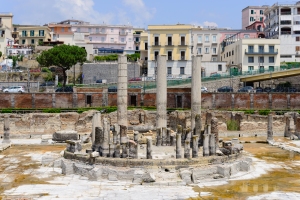
Ancient_Roman_market_place_and_Serapis_temple_-_Pozzuoli_-_Campania_-_Italy_-_July_11th_2013_-_02When one harkens back to Rome he is usually met with consistent comparisons to political ideals, military glory, or the decadence and immorality of the upper classes in the late republican and imperial periods. Very rarely however, is the economy that made the wealth of the Roman Republic possible in the third century B.C.
Rome is traditionally said to have been founded approximately in 753 B.C. by Romulus, its first king. It was essentially a collection of farmers who had consolidated their lands and resources around the Tiber river, and defended it with fortified hills called an arx.[1] The entire basis of the city (which was little more than a backwater at this time) was its agricultural output. As the city grew it found a major benefit in being by the Tiber allowed it to trade by river with Magna Graecia to the south, and the Etruscan and Gallic tribes to the north. Trade by roads was scarcely possible over long distances even when the roads themselves were built in the later period. Trade by boat was much easier. Yet the wealth which enabled trade in various goods came not from military conquest or a city of shopkeepers, but rather a city of farmers whose lands gave them goods worth trading.

The importance of agriculture to the foundation of the Roman state is seen also in their mythology and calendar. In Roman mythology Saturn was the god who ruled heaven, until his son Jupiter displaced him. Saturn was cast onto the earth where he found uncultured nomads living in Italy, and taught them how to farm and was thus the god of all farmers and fields. The Roman calendar with its timetable of festivals, was originally a marker of agricultural seasons and agricultural gods. Juno was the goddess of the moon, by which the Roman calendar before Julius Caesar was based. In fact, most of the festivals of Mars fall within March, which the Romans counted as the first month of the year because it prepared for spring and the agricultural cycle. The Calendar being denoted not by sequential days but rather by the Kalendae, nonae and idus, were based on the phases of the moon by which the field was regulated. As Stuart Perowne notes “The calendar thus shows the agenda, as it were, of a state still founded on agriculture, but already developing into a community which has legal and political business to transact and wars to wage.”[2]

Sometime in the early period of the Republic, after the expulsion of the last King Tarquin the proud, the Romans adopted a Greek style Hoplite army, the name coming from the shield they carried: the o`plon. In Greece this consisted of tenant farmers, who tilled their fields and when they were called to battle would take up whatever arms their wealth allowed them to afford to fight for the city state. Rome would adopt this same model and maintain it even to the end of the conflict with Carthage in spite of the change face of its military design. These farmers who grew crops for themselves and sold them to the cities were also the milita which would defend the state, so that, as their forerunners in the Greek city-state, they had a vested interest in victory in order to preserve their families and lands.

As Rome fought numerous conflicts in Italy with various Italian tribes, their cities were absorbed into a network of alliances, whose population continued to till its fields and then would take up arms for the Republic when called. This militia army had been able to overcome a far superior modern Hellenistic army lead by Pyrrhus from Epirus in the early third century B.C. Again they returned to their fields. The victory was won not even so much by particular tactics, but by the overwhelming manpower which Rome had. Pyrrhus was supposed to have said: “With soldiers such as these, in a short time I could have conquered the whole world.”[3] This would later be true, but not under his leadership.

Nevertheless, the first strain on this agricultural system came during the Punic wars. The three separate Punic wars fought more or less from 261 B.C. until 147 B.C. and were the bloodiest and longest lasting conflicts in the ancient world. The first war, caused when the city of Messina in Sicily called for aid from both Rome and Carthage, lasted over 20 years. This was a new kind of war for Rome, not only because it had to copy Carthage’s naval technology to challenge it at sea, but because it meant soldiers campaigning outside of Italy, something which the legions had never done before. As a result of this, the citizens of Rome and her allies were away from their fields for a very long time. Yet, most of the casualties were at sea, of which the Romans only lost one major battle in spite of Carthage’s long standing naval dominance, and on land it only had two significant defeats, one in Sicily and one in North Africa. The overall casualties were among rowers in the fleets, not so much among the citizen class, so the effects of lengthy campaigning were not felt on the agrarian economy. This changed dramatically during the Second Punic war. In this conflict, Hannibal, who had consolidated his father’s victories in Spain and formed one of the best armies of the day, decided the only way to defeat Rome was to do it on her own soil. He resolved to break up the network of alliances which made up the Roman Republic. The best way to do this was to burn the fields. Apart from foraging, which was necessary to feed his army, Hannibal burnt a massive portion of northern and central Italy, to the point, as the Romans watched almost helplessly. Hannibal campaigned in Italy from 218-202 B.C., undefeated on Italian soil, and at last was recalled to Carthage where he was defeated at the battle of Zama. Interestingly, Hannibal would later be elected the suffete (king, or in Punic, a judge) of Carthage and focused on rebuilding the city’s agricultural foundations in order to provide the money and prosperity to pay the war debt imposed by the Romans.

After nearly twenty years of constant skirmishing, raids and battles, Italy’s agricultural economy was in shambles. It would not be rebuilt. Instead Rome continued to levy more troops and fight abroad, getting involved with Greek politics, fighting in Macedonia as revenge for their alliance with Hannibal, even in Asia Minor (modern Turkey) with the Hellenistic kingdoms of the east which employed Hannibal as a mercenary. Also in Spain, where significant territory had been taken from Carthage, Rome now went to war with the Spanish Celts to attain more territory. The result furthered the damage done by Hannibal’s campaign. Farms fell to disrepair, woman and children could not manage farms with the fathers away at constant war, so to manage the dearth of farmers, the upper crust of Roman society bought up the land. The conquests abroad between North Africa, Greece and Spain had flooded the market with slaves, and they could be bought for nearly nothing. With more and more land becoming available, large farming estates could be set up, called latifundia, the agribusiness of its day. Marcus Porcius Cato, who pushed for Carthage’s destruction and uttered the famous phrase “Delenda est Cathago,” wrote several books which summarize the attitude of the new owners of the fields: “Sell worn out oxen, blemished cattle, blemished sheep, wool, old tools, and old slaves, sickly slaves and whatever else is superfluous.”

The continuing consolidation of estates lead to decreasing opportunities for Roman citizens fighting for the Republic, who fled to the cities and found no work. This is the first major appearance of a proletariat in Rome, which could not provide anything other than their proles (children) to the state. According to Plutarch, the reformer Tiberius Gracchus noticed the level of change in the countryside on his way to Spain with an army, noting that barbarian slave and beast has a place to lay its head, but not a Roman citizen. When Gracchus returned from Spain, a treaty he made with a local people, the Numantines, was shamefully broken by the Senate. The economic situation was hitting a boiling point with the average Roman citizen who had no means of attaining land, especially with such massive estates to compete against, and land not being available. Gracchus proposed to run as a tribune well below his class and in contempt of the Senate, drawing much support from the families of the 20,000 citizens in his army he saved in Spain. He pushed for a new law to open up opportunities for Roman citizens to own land, the lex sempronia. Falsely characterized as Communism, the lex sempronia called for enforcement of an ancient law limiting the amount of land any one person could possess. The state would then provide land, which technically belonged to it anyway by tradition. Far from socialist legislation, the proposal of Tiberius Gracchus was meant to open the way for enfranchising the large proletariat which flooded the cities and especially Rome. The Senate however, filled with upper and lesser nobility who had benefited largely from the land grab, paid one of the tribunes to oppose the legislation. Gracchus was eventually successful in passing it by removing the tribune and forcing the law passed. The story of Gracchus and his brother Gaius is a fascinating one, but takes us too far afield. Tiberius Gracchus’ reforms were necessary, but he tried to enact them by breaking not the letter, but the spirit and tradition of the Roman constitution. He was eventually killed, as his brother who also took up the same reform. At this point Rome divided itself into two factions, the optimates (great ones) and the populares. The optimates annulled the lex sempronia, leading the two factions to entrench themselves over the issues of agricultural reform and finally they fought each other at different periods through different politicians, who used them for their own ends. Thus began the civil wars which culminated in the victory of Augustus over Mark Antony in 31 B.C. and the beginning of the Principate, otherwise known as the Imperial period. The Principate would last until Diocletian set up the Tetrarchy in 293 A.D.

In the series of wars and reforms leading up to Julius and later Augustus Caesar, there was a reform of the Roman army which helped alleviate employment problems. Gaius Marius, a famous general in the early first century B.C., reformed the army eliminating the property requirement, and forcing the state to supply weapons and armor to the legions. The troops would also be paid regular wages for their service. This meant that the army changed from a militia army to a paid professional army. This had significant consequences for the later empire with respect to loyalty, but that is for another place. In the long run what Marius’ reform of the army did accomplish was the crystallizing of the latifundia, the massive landed agricultural estate worked by slaves as the norm. These were not only in Italy, but established likewise by coloni in North Africa, and later Egypt. By the time of Augustus, North Africa and Egypt were supplying most of the grain that the empire consumed, with farms in Italy selling only a marginal amount. In other words, instead of a fertile citizen population tilling the fields and sustaining the state locally, the Romans outsourced their agricultural production to feed their cities across the Mediterranean. Agriculture was truly the center of the Roman economy in this period as it was in the early Republic, but now it depended not on its citizens, but on trade ships constantly sailing through the Mediterranean with crops harvested from slaves and sometimes tenants of rich estate holders. It is important to understand that production in this period of the empire was not a mark of private enterprise, but was largely a state affair. Currency, which in reality is only a symbol of wealth, was dependent upon the most important things it represented: food, clothing, and raw materials. Agriculture provided not only food but also the cloth used to make the garments, the olives for oil and the vineyards for the wine which was such a highly consumed commodity. At least three quarters of all of the goods of Roman trade had something to do with agricultural output. Yet a good portion of the city of Rome could not afford to feed itself, which is why a dole of grain (possibly equivalent to today’s food stamps) was provided by the state.

The consequences for the later empire could not be any more grave. The personality of the emperor was what held the empire together, but after Marcus Aurelius in 180A.D., this began to wane. Soldiers were now more loyal to their commanders than to the state or the emperor. Commodus, the son of Marcus Aurelius, and the next emperor Pertinax were murdered. After Septemius Severus not a single emperor would die again of natural causes until Diocletian. Severus made the famous plea to his sons Caracalla and Geta “Live in harmony, enrich the soldiers, and despise everyone else.”[4] The constant civil war which afflicted the empire did not affect the agricultural seen very much, but it did strain the resources available as well as the increased costs of paying soldiers to keep them loyal.

What did this do for the agricultural state? Apart from putting strain on the system it did not do much. The life of cities began to break down. With more troops drawn away for civil wars, raids of tribes across the Rhine increased deep into Gaul and occasionally to Italy, so that cities which were once sprawling and without walls were now contracted and made defensible. The civic life started to evaporate, as governors and prefects were no longer wealthy enough to endow a city with entertainment, games, civic works and the like. The cities became a hole for starving masses, disease and death as early as the 3rd century. In fact, we have this glowing image of everyone living in stone marble apartments, with mosaic tiles, but that was only the social elite. In reality, even in the golden age of Augustus, most people lived in stinking hovels with no plumbing that could easily fall apart and were prone to fire. This was little different in the 3rd century. Thus the wealthy permanently retired to their villas, paying their own troops to protect them from raids, with walls, and depending upon the mass of slaves to work in their fields. By commanding troops, many of these lords would take the military title of dux.[5] Thus early in the breakdown of the empire the origins of medieval feudalism were already being laid, since many of these arrangements would be taken up and honored by the Goths and Franks when they would come into possession of large swaths of the former empire. Yet so long as Rome and Constantinople would maintain control of the shipping from Carthage and Egypt, they could still remain fed. This changed after Alaric’s sack of Rome in 410 A.D. Though he died a few years later, the Vandals would continue moving to North Africa, and eventually took over Carthage, ending the supply of grain being shipped to Rome. This meant functionally that the city could scarcely feed itself, and it began emptying out. The same became true for much of Italy. Grain would be requisitioned from the Latifundia, which began producing more since the prices went up, yet again it was insufficient. People still had few occupations or ownership over the means of production. Technologies that the medievals would develop to great affect such as water power and horsepower were known in the Roman world but not used because the large number of slaves meant there was no market for the technology.

In the end, the thing that hastened the fall of the Western Empire was the loss of its outsourced grain production in Carthage. It was already dying a slow death from increasing bureaucracies, inflation from the devaluation of the currency, mutual distrust in government, civil war, the Goths, Persians and Huns, as well as declining birth rates. Yet the empire had survived this for some time because it had not come to the end of its resources. The loss of its supply of food is the very thing that brought the western empire to the end of its resources. The Eastern Empire by contrast, with its capitol in Constantinople received its grain from Egypt which was by and large still safe, and by the time of the Arab conquest, the land in Greece and Asia Minor had become populated with farming communities which could now support the agricultural needs, something that did not take place in the Western Empire. This enabled it to last for nearly another thousand years.

In the classical world, agriculture was indeed the center of all economy, it was the source of wealth since, no matter what, people need to eat. It also produced rents and income from tenants, it produced commodity and luxury goods. When these things were more widely diffused and held more commonly, it was at that point that the Roman Republic had the population of hardy citizens which defeated the professional armies of the greatest general of the age (Hannibal) and the greatest empires of the age (Macedon and the Seleukeis). It was the army of farmers that won what would become the Roman Empire, it was the professional troops loyal to their generals and not the state who eventually lead to its disintegration. The loss of the land and the greater concentration into cities lead to a decline in the births of Roman citizens, while the slave class and foreign tenants continued to grow. The Roman Empire in the 3rd century could never have survived a defeat the scale of which Hannibal inflicted at Cannae, where he surrounded a superior force with an inferior force and annihilated 70,000 Romans. Yet the Romans of the 3rd century had a vast supply of men to draw on for their armies, as farming families tend to produce more children by greater health and greater need for helping hands. What we see in this is that culture, society and civilization are necessarily tied not merely to the land, but the stability of the land. The stability of the land is achieved when numerous people till it, somewhere between 35% and 45% of the population. In that way there is more security against a dearth of crops, but there are also smaller individual family units that not only provide for the state, but also for themselves. This ensures the stability of a polity which has direct control over its food supply. Disastrous examples as the loss of Carthage to the Vandals should be a reminder to a nation which today depends on food traveling on trucks for thousands of miles before hitting a store shelf.

[1] arx, arcis (f) essentially means “box”, and hence our term in English for such things as Noah’s “ark” and the “ark” of the covenant.

[2] Perowne, Roman Mythology, pg. 39.

[3] “Ego, talibus militibus brevi orbem terrarum subigere potuissem.” –Liber de Viris Illustribus Urbis Romae.

[4] Dio, 77. 15. 2-4; quoted in A. Goldsworthy, How Rome Fell, pg. 68.

[5] Dux, ducis (m), a leader, or a commander of troops, hence the word “Duke” in medieval parlance.

Dissecting the Instrumentum Laboris for the October 2014 Synod

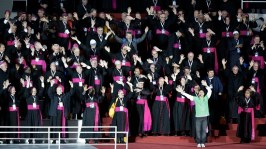
Bishops participate in a musical number on stage before Pope Francis arrives for mass in an all-night vigil for those attending World Youth Day, in Rio de JaneiroThe Instrumentum Laboris, or working document (in Latin literally, the device of the work) was issued last month, and it foretells essentially more of the same.
The Document is riddled with programs, programs, and more programs! More this and more that! Change! Yet the only things useful for a constructive discussion on how to meet the challenges to the Family in the modern world are not surprisingly absent from the working document.

There is, as in most documents since the Council, a good deal of wishy-washy niceties, but not a lot of real content. We must bear in mind, however, that it is a document compiling the reactions of various Episcopal conferences to the issues raised as problems. It is not designed to lay down a clear teaching or instruction. What it should be doing, if it were to be effective, is to lay out the directions all discussions will go toward in order to attain a more practical solution. Instead, it just puts together what everyone is saying and says yeah, this is what’s going on, and this is what our top-guys say will fix it. That of course is what the Bishops’ conferences have said, which themselves utilized committees of talking heads to look at the problems, who themselves talked to committees of “experts” to explain the problem.

As always, not everything expressed here is bad, but is put together with a lot of things that are, and then looks to make a unity out of it, like good Hegelian dialectic which draws together the synthesis from placing together the Thesis, and the Antithesis, and boom! We have the solution.

Unfortunately, reality doesn’t work in the same way. Let’s have a look at some key passages.

The People of God’s knowledge of conciliar and post-conciliar documents on the Magisterium of the family seems to be rather wanting, though a certain knowledge of them is clearly evident in those working in the field of theology. The documents, however, do not seem to have taken a foothold in the faithful’s mentality. Some responses clearly state that the faithful have no knowledge of these documents, while others mention that they are viewed, especially by lay people with no prior preparation, as rather “exclusive” or “limited to a few” and require some effort to take them up and study them. Oftentimes, people without due preparation find difficulty reading these documents. Nevertheless, the responses see a need to show the essential character of the truth affirmed in these documents.(Instrumentum Laboris [hereafter IS], #11)

One might reckon, the difficulty in reading the documents is they are simply not clear! They introduce with tons of flowery language, they say some poorly worded propositions, often using traditional theological terms to mean something totally different, and leave one bewildered as to what is actually being taught. That is not the only problem here. The real problem is that not everyone can be a Theologian, and not everyone should. Not merely before the Council, but even in the preceding generations of thousands of years, the faithful did not by and large know the bulk of Church teachings, and they could scarcely name an encyclical. Yet, they did not have a crisis in the family as we do today. In past generations people knew what was right and wrong, even if they acted contrary to it, they still knew it was wrong. It didn’t take a pastoral program or a new encyclical for people to know in the 18th century that abortion was wrong, or that contraceptive potions and techniques, such as they were, are contrary to the Church. Why is this a problem when most Catholics are more educated in general than they were in the 18th century? The answer is you had a culture and society that itself embodied Catholic values, even Protestant societies, and had the support needed for families to survive. You do not have that today.

Moreover, there is a difference between religion and theology. Every Catholic needs to have an understanding of religion to get to heaven, but not every Catholic needs to understand theology. Religio is a Latin word, it comes from the same word as legio, as in Roman Legion. It actually means the “yoke”, like the yoke that tied oxen together. Soldiers in the legion were “yoked” by the bond of discipline, legionary laws, far more harsh than the laws of civil society, and the structure of obedience. In Latin, the prefix re- either means again, back, or it strengthens the meaning of the word. In the case of religio, it strengthens the meaning of the word. Thus religio refers to the common bond of teachings, practices and laws that every Catholic is under, high or low, great and small, clerical or Lay. By contrast, Theology, which comes from the Greek Θεός (Theos=God) and λογία (logia=saying), although some dogmatic theologians, notably Tanquery, traces the root to λόγος (logos= word), means more or less the Study of God. It is the study of revealed truths, and the truths which follow from them logically and are connected with them (i.e. the secondary object of infallibility, whereas revealed truths are the primary object). This is a fully developed science, employing a scientific language that is carried out (until recently) with precision. It has a wide breadth of subjects, disciplines, and areas of study. Theology also includes detailed study of the documents of the magisterium, the truths they contain and the consequences that affect other disciplines. Documents of the magisterium in the field of religion, on the other hand, only pertain to those issues which the faithful need to be aware of. Thus, theology informs and confirms religion, as the Church has always held, in as much as the work of theologians becomes the basis for future decisions of the Extraordinary Magisterium and the Ordinary Magisterium. The constructing and informing of their consciences takes place in the overall formation of Christian life, as we shall develop more fully.

Some episcopal conferences argue that the reason for much resistance to the Church’s teaching on moral issues related to the family is a want of an authentic Christian experience, namely, an encounter with Christ on a personal and communal level, for which no doctrinal presentation, no matter how accurate, can substitute. In this regard, some responses point to the insufficiency of pastoral activity which is concerned only with dispensing the sacraments without a truly engaging Christian experience. Moreover, a vast majority of responses highlight the growing conflict between the values on marriage and the family as proposed by the Church and the globally diversified social and cultural situations. The responses are also in agreement on the underlying reasons for the difficulty in accepting Church teaching, namely, the pervasive and invasive new technologies; the influence of the mass media; the hedonistic culture; relativism; materialism; individualism; the growing secularism; the prevalence of ideas that lead to an excessive, selfish liberalization of morals; the fragility of interpersonal relationships; a culture which rejects making permanent choices, because it is conditioned by uncertainty and transiency, a veritable “liquid society” and one with a “throw away” mentality and one seeking “immediate gratification”; and, finally, values reinforced by the so-called “culture of waste” and a “culture of the moment,” as frequently noted by Pope Francis. (IS #15)

Now, on the one hand, the faults of secular society do contribute to less religiosity, on the other we cannot lay all the fault at secular society. The strange thing here, is that the Vatican for 50 years has praised these same “secular societies” as a source of new riches, as a wonderful fruit of the French Revolution, as a realization of Vatican II, as… need I go on? And now they are complaining of the direction it is going! They can’t have it both ways. They want the modern conception of separation of Church and State, they want the secularized society, then it complains when a secularized society does what it is naturally going to do!

There is another fundamental disconnect here. Look at my emphasis. What are the Sacraments, except a direct personal encounter with Jesus Christ and his grace, preeminently in the Eucharist? What are the sacraments? Certificates? Status symbols? The person who wrote this point seems to think so. What kind of personal encounter can you have with Christ that is more powerful than the frequent exercise of the Sacraments? Is Penance not an encounter with Jesus Christ, where the priest in Christ’s very person and power forgives your sins, provided you have true contrition? Is not receiving his very body and blood an encounter? People need words to encounter them? The sacraments, and living the life of faith, exercising the virtue of faith with true charity, are connected. Moreover, so is the liturgy. Is the Liturgy a place where people have a true encounter with Christ? Or is it a place where people have a silly ceremony with absurd hymns, poor symbols and bad ritual to celebrate themselves? For most Catholics it is clearly the latter, in spite of the number of times that there have been “documents to end all abuses”, the “abuses” continue to exist. The reason of course is that the new liturgy is a man centered liturgy. There is in this whole document almost no mention of liturgy, which is a telling factor. Liturgical reform is nowhere on the radar of the Francis pontificate, let alone for the Bishops. The only reform for them is eliminating the Traditional Mass and restoring the primacy of the 1970’s liturgy, which is dying, and they can’t understand why. Hence the attack on the FI’s.

This “lived experience with Christ” is presented as a sort of dualism, as if this is something that happens independent of a man’s existence in Church and society. Proper doctrinal formation is a means, beautiful liturgy which hastens the senses to God is a means, Catholic society and families are a means, the will of the individual aided by grace and utilizing these means effects it. This document seems to think another army of pastoral lay workers will somehow bring this about!

We’ll close today with the following issue of Natural Law:

In light of what the Church has maintained over the centuries, an examination of the relation of the Gospel of the Family to the experience common to every person can now consider the many problems highlighted in the responses concerning the question of the natural law. In a vast majority of responses and observations, the concept of natural law today turns out to be, in different cultural contexts, highly problematic, if not completely incomprehensible. The expression is understood in a variety of ways, or simply not understood at all. Many bishops’ conferences, in many different places, say that, although the spousal aspect of the relationship between man and woman might be generally accepted as an experiential reality, this idea is not interpreted according to a universally given law. Very few responses and observations demonstrated an adequate, popular understanding of the natural law. (IS #21)

A lot of people have decried this section, and for good reason, nevertheless I think the working document is actually getting at something that is quite true and important, they are just drawing the wrong conclusions. Now, Natural Law in the Catholic Tradition is largely Aristotelian and Thomistic in its conception. In fact, St. Thomas says on this subject:

Sicut supra dictum est, ad legem naturae pertinent ea ad quae homo naturaliter inclinatur; inter quae homini proprium est ut inclinetur ad agendum secundum rationem. Ad rationem autem pertinet ex communibus ad propria procedere, ut patet ex I Physic. Aliter tamen circa hoc se habet ratio speculativa, et aliter ratio practica. Quia enim ratio speculativa praecipue negotiatur circa necessaria, quae impossibile est aliter se habere, absque aliquo defectu invenitur veritas in conclusionibus propriis, sicut et in principiis communibus. Sed ratio practica negotiatur circa contingentia, in quibus sunt operationes humanae, et ideo, etsi in communibus sit aliqua necessitas, quanto magis ad propria descenditur, tanto magis invenitur defectus. Sic igitur in speculativis est eadem veritas apud omnes tam in principiis quam in conclusionibus, licet veritas non apud omnes cognoscatur in conclusionibus, sed solum in principiis, quae dicuntur communes conceptiones. In operativis autem non est eadem veritas vel rectitudo practica apud omnes quantum ad propria, sed solum quantum ad communia, et apud illos apud quos est eadem rectitudo in propriis, non est aequaliter omnibus nota. Sic igitur patet quod, quantum ad communia principia rationis sive speculativae sive practicae, est eadem veritas seu rectitudo apud omnes, et aequaliter nota. (I-II, Q 94 A4, resp.)

As stated above (2,3), those things pertain to the natural law which a man is inclined naturally: and among these what is proper for man that he might be inclined to act according to reason. Now it pertains to reason to proceed from the common to the proper, as stated in Phys. i. The speculative reason, however, is considered one way in this matter, and the practical reason another. For, since the speculative reason is busied chiefly with the necessary things, which cannot be otherwise than they are, its proper conclusions, like the universal principles, contain the truth without fail. The practical reason, on the other hand, is busied with contingent matters, about which human actions are concerned: and consequently, although there is necessity in the general principles, the more we descend to matters of detail, the more frequently we encounter defects. Accordingly then in speculative matters truth is the same in all men, both as to principles and as to conclusions: although the truth is not known to all as regards the conclusions, but only as regards the principles which are called common notions. But in matters of action, truth or practical rectitude is not the same for all, as to matters of detail, but only as to the general principles: and where there is the same rectitude in matters of detail, it is not equally known to all. It is therefore evident that, as regards the general principles whether of speculative or of practical reason, truth or rectitude is the same for all, and is equally known by all.

What this means, is that while the natural law is written on our hearts, or, as St. Thomas says in a different question of the same article, “The rational creature’s participation with the eternal law”, it is the same always and everywhere, but how it is applied and deduced in individual matters will differ according to culture. For example almost all cultures have the sense that pre-marital sex and adultery are wrong, but how that is realized differed for many classical cultures. The principle is still true, but men can act contrary to their reason; additionally the passions move people to act contrary to reason.

Now, all references to the natural law, even by John Paul II, who was not a Thomist, refer to the Aristotelian-Thomistic Tradition in Natural Law. Now, the modern western world, on the other hand, works on a mostly empiricist view of natural law. What this means is that what is natural is not based on utility, or reason, but what we objectively feel about it. So, people go out for wine and cheese tastings. The object, it would appear, is the delight in company and the pleasure gained from drinking good wine and eating good cheese. I could just as well satisfy my belly with bread and water, but I don’t get pleasure. Therefore food is not about nourishment but pleasure. Likewise with sex, it is pleasurable, but children don’t actually result all the time, and can be prevented, therefore sex is about pleasure rather than procreation. Add to this the evolutionary frame work, the idea that we have “evolved” beyond an instinct for self preservation, therefore we have evolved sex to be about the individuals. In such a framework, what could be against nature in same-sex coitus, since it is about pleasure with respect to the individuals?

Obviously such reasoning is fallacious, because food is pleasurable, or sex is pleasurable, it doesn’t follow that its only end is pleasure. Yet this is a problem of first principles with respect to natural law. Modern society is based on the Empiricist viewpoint, modified by evolutionary philosophy, whereas the Catholic explication of teachings with reference to Natural Law are based on the Thomistic. The Instrumentum Laboris correctly identifies at least some element of this, when it says:

The responses and observations also show that the adjective “natural” often is understood by people as meaning “spontaneous” or “what comes naturally.” Today, people tend to place a high value on personal feelings and emotions, aspects which appear “genuine” and “fundamental” and, therefore, to be followed “simply according to one’s nature.” The underlying anthropological concepts, on the one hand, look to an autonomy in human freedom which is not necessarily tied to an objective order in the nature of things, and, on the other hand, every human being’s aspiration to happiness, which is simply understood as the realization of personal desires. Consequently, the natural law is perceived as an outdated legacy. (IS #22)

Therefore the solution would be to engage the modern dialectic as concerns Natural Law, right? Not according to this document. The reason is the modern Vatican has completely surrendered the fight on false ideologies like Evolution, and even at times the very notion of man which is its consequent, and therefore can’t, without contradicting 50 years of mis-steps, attempt to engage that fight. Instead it proposes another surrender, which, as noted in my last post, I first saw on Rorate Caeli:

The language traditionally used in explaining the term “natural law” should be improved so that the values of the Gospel can be communicated to people today in a more intelligible manner. In particular, the vast majority of responses and an even greater part of the observations request that more emphasis be placed on the role of the Word of God as a privileged instrument in the conception of married life and the family, and recommend greater reference to the Bible, its language and narratives. In this regard, respondents propose bringing the issue to public discussion and developing the idea of biblical inspiration and the “order in creation,” which could permit a re-reading of the concept of the natural law in a more meaningful manner in today’s world. (IS #30)

It is one thing to use Divine Revelation (e.g. Scripture) to assist with and illuminate the concept of natural law, however, the problem is that natural law as such is something discernible to reason, that does not need the aid of divine revelation. What this statement says, if one reads between the lines, is to eviscerate the concept and tradition of Natural Law, and reduce everything to Scripture, which the modernists have worked so hard to neuter by rendering it all allegorical, and thus to be interpreted in any way possible. Thus the closing statement of that paragraph. Re-read therefore, means surrender.

We will have more on this document to come in the future.

The Feast of Sts. Peter and Paul, and the Instrumentum Laboris

Caravaggio-The_Conversion_on_the_Way_to_Damascus

The Conversion of St. Paul -Caravaggio

640px-Michelangelo_Caravaggio_038

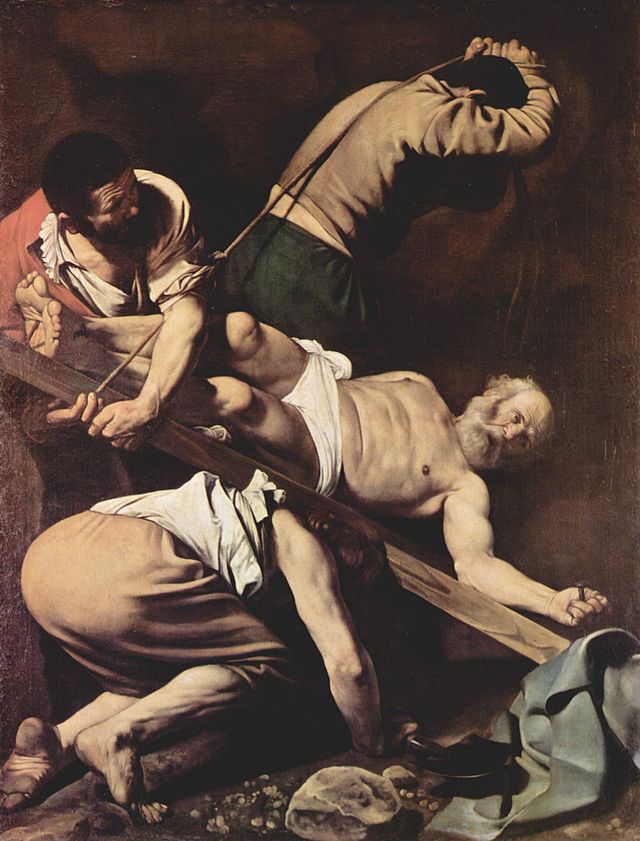
The Crucifixion of St. Peter -Caravaggio


We, just yesterday, had the feast of Sts. Peter and Paul, which is a holy day of obligation in most of the world, but for some reason not here in the USofA. Not sure why, apart from the general trend to not disturb people’s comfortable lives by the spectre of going to Mass on a weekday. This year of course that was not a problem.

One of the things I find fascinating is that the very same feast is celebrated in all the Eastern Rites of the Church as well, according to their own liturgical customs and traditions, which is to say they did not copy it from the Roman Rite, the same feast developed organically in their own traditions. Thus, the feast of St. Peter and Paul is also a feast for the unity of the whole Church with its head, which is why it is a holy day of obligation (again, except here).

There is another reason why the Church specifically honors these two saints together in one feast day. In the Neronian persecution they in fact died separately, but nevertheless, together sanctified Rome by their blood. Rome was a great persecutor, and would continue to lay up many martyrs to the faith. Yet, the blood of the two Apostles firmly established the Church in Rome, and provided strength to it while under siege for the next 250 years. The bones of St. Peter and St. Paul were cherished by Christians, and moved into the catacombs to protect them from desecration.

The two paintings above, hang in the Church of Santa Maria del Populo, in Rome, right as pilgrims would traditionally enter the city from the north. They are in a side chapel which has an interesting history. The paintings there were part of a challenge between Caravaggio and a rival artist, Caracci, who painted in what is called the “Mannerist” style, generally loathed by art historians, though it in fact has many good points, especially for faith. Caravaggio was temperamental (to say the least), and annoyed that Caracci got the altar piece, decided to show his displeasure by painting the horse so that its rear end would be facing Carraci’s painting. Nevertheless, he provides a great image, the blinding light. Paul is off of his horse and his eyes are blinded, as the light shines upon him. A light that is too pure to be perceived without an interior light, namely the light of faith.

Now, St. Thomas makes the observation, that a single heresy is sufficient to corrupt the virtue of faith, when he says:

…qui discredit unum articulum fidei non habet habitum fidei neque formatae neque informis.

…one who disbelieves [even] one article of faith does not have the habitus of faith, either formed or unformed.

-Summa Theologiae II-II Q.5 a.3

Now St. Paul, who preached the faith everywhere, was martyred at a place which is now called Tre Fontane, or the Three Fountains. When his head rolled down the hill, three fountains sprang up in the places where it had rolled. Now, I was just in Rome in February, and the fountains were not flowing. You could see clearly that at one time they were because of the moisture in the rock in that part of the Church where the fountains are preserved. I asked a priest who was knowledgeable of it, what happened to the fountains? He said that he was told they stopped flowing in [surprise] 1965.

If true, this is significant because Paul represents the age of the gentiles, but the apostasy of the end times both in the book of the Apocalypse and in private revelation is that the gentiles will give up the faith. Thus we come to the Instrumentum Laboris for yet another synod of bishops. The many issues being discussed center around some pretty serious moral issues, which constitute part of the great upheaval of Western culture, namely divorce and remarriage, or, put another way, using your spouses like used cars, trying to trade them in for a better deal. There are many who would like to see a change in the Church’s praxis to allow for the sanctioning of divorce and remarriage by saying that people who have done this, without a judgment of the Church with respect to the validity of their first marriage, may come to communion. Notably Cardnal Kasper, who demonstrated yet again he hasn’t the faintest idea of what the Orthodox actually teach. This provoked a reaction, even in the curia, with many clarifying what the issue actually is. Nevertheless, going into this synod we have an Instrumentum Laboris, which proposes to give place to those advocating these very things. I haven’t finished the whole document, but certain things stand out as particularly troubling. This first I read yesterday:

Finally, the observations insist that catechesis on marriage and family, in these times, cannot be limited exclusively to the preparation of couples for marriage. Instead, a dynamic catechetical programme is needed — experiential in character — which, through personal testimony, shows the beauty of the family as transmitted by the Gospel and the documents of the Magisterium of the Church. Long before they present themselves for marriage, young people need assistance in coming to know what the Church teaches and why she teaches it. Many responses emphasize the role of parents in the catechesis on the family. As afar as the Gospel of the Family is concerned, they have an irreplaceable role to play in the Christian formation of their children. This task calls for a thorough understanding of their vocation in passing on the Church’s teaching. Their witness in married life is already a living catechesis in not only the Church but society as well. (Instrumentum Laboris, n.19)

There is a big problem here. What is proposed is “more catechesis!” This is ultimately like throwing more money at a problem. The crisis of family is not just a question of shifting values, and false ideologies. The problem of families in the modern western world is that world was built by atheistic capitalism, which has no notion of the common good and scoffs at the traditional resources large families had to support mothers. It overlooks entirely the crisis of fatherhood. It overlooks the fact that authentic Church life requires an authentically Catholic society to function. The atheistic societies that the Vatican has been praising for 50 years cannot support the family, but only tear them down. It doesn’t address that many people actively reject what the Church teaches, and as such don’t have the virtue of faith. What is needed, is more prayer and sacrifice, a liturgy that renews people’s lives, and building holy people to merit grace for the errant. This however will not be found in the document.

The most troubling thing, however, is what I saw quoted on Rorate Caeli, directly from the document:

The difficulties that arise in relation to natural law can be overcome through more attentive reference to the biblical world, to its language and narrative forms, and to “propose bringing the issue to public discussion and developing the idea of biblical inspiration and the ‘order in creation,’ which could permit a re-reading of the concept of the natural law in a more meaningful manner in today’s world.” [Instrumentum laboris, 30]

In other words, the natural law, written on man’s heart, is going to be re-read. This is the type of progressive language that is typical of modernism. Re-read, rediscover, so that something contrary to what came before is now a “harmonious development”, a new fruit of “spiritual riches” to contemplate. In other words, this is more of the same.

The blinding light Caravaggio so powerfully paints cannot be seen by those who are spiritually blind. Yet it seems those are the ones writing these documents!


Aude Sapere Podcast 001 – Re-introduction and Canonization

 Download        Play in new window
Mideast Pope

Today on this first Aude Sapere podcast I re-introduce myself and launch into the issue of the infallibility of canonizations. The double-canonization of John Paul II and John XXIII has left a lot of Traditional Catholics dismayed, as the obvious message is that they are trying to canonize Vatican II. Join us for a discussion of this issue, as well as a few other tidbits.

Source Notes:
Pope suggests celibacy may be optional
Church struggles with financial management
Dioceses having difficulty paying for priests’ health insurance
Infallibility of Canonizations

Works on sedevacantism

Many have asked about my old works on Sedevacantism, which have been a source of aid for many people, God be praised.

I am currently re-working them, and when I’m ready to put them back up they I will add a “Sedevacantism” tab to the menu bar.

Thanks to all who have inquired.

New Pentecost?

pentecost+2+detail

Often one will hear the phrase “Vatican II is a new Pentecost in the Church today”, or there is a new springtime that “will bring a new Pentecost”, and some other such thing. Here, I wish to differentiate between those attempting to draw a comparison to an outpouring of grace. Even at that, the comparison is inept, but at least those making it are not proposing the absurd.

No, what I mean to address is the tendency, since Vatican II, to continually talk about a “new Pentecost”. Not only do we find this to describe Vatican II, but we continually find dioceses praying for a New Pentecost, as we see the Archdiocese of Detroit even this year. Firstly, when we hear anyone say that anything is a new Pentecost, whoever the author is, that book ought to be burned, the website turned off and never revisited, or the radio turned off. Why? The reason is because it is blasphemous, plain and simple. To compare a non-infallible pastoral council, or a modern movement, or the confessions of a sex therapist and amateur catechist to the event which founded the Church and established the reign of grace on earth is sheer blasphemy worthy of condemnation from all the Fathers and Doctors of the Church. The fruits are nothing like it.

Pentecost was a one time only event in the Church, it is not something that can be repeated. Even if the Traditional Mass were restored in every Church of the Latin rite throughout the world, and traditional Catholics all acted like real Catholics and practiced faith, hope and charity, praying and being a model of every good work, even then we should consider it quite the blasphemy to compare a grace filled event later with the foundation of the Church.

The gifts of Pentecost are not repeatable, and were gifts specifically intended for the founding of the Church. Msgr. George Agius, in his book on Tradition in 1928, declared:

“The power and authority of their successors must not be confused with the prerogatives and gifts which the Apostles had received through God’s special intervention. Such were the gifts of tongues and of new revelations, of infallibility, and the prerogative to have authority over the Universal Church, which they received on the Great Day of Pentecost. For there was only one such Pentecost. The Great day was the birth of the Church, the birth of the first spiritual Fathers who were to have a long generation of spiritual children until the End of Time.” (pg. 48)

Our Lord had already made the Apostles priests and bishops at the Last Supper, and given them jurisdiction (Receive ye the Holy Ghost), the gifts at Pentecost were something different, something specific to the Apostles, and something which ended with them. Prior to the coming of the Apostles, they were in confusion, even after being given the sacrament of Order by Our Lord. Pentecost ended that error, by giving the Apostles a perfect understanding of revelation, which was necessary since if they were going to explain the deposit of faith they had to know it. On the contrary, today we have confusion, and we today find Bishops teaching contradictory things, and things contradictory to the tradition, even the Popes have said things or appeared to have taught things which are in some way contrary to the faith. Unlike Pentecost, Vatican II has decreased the number of practicing Catholics in the Church. This is one of the reasons that the comparison is blasphemous, for it is comparing clarity to confusion and disorder, and claiming parity between the two.

The 1994 Catechism, speaking of the day of Pentecost teaches:

On that day, the Holy Trinity is fully revealed. Since that day, the Kingdom announced by Christ has been open to those who believe in him: in the humility of the flesh and in faith, they already share in the communion of the Holy Trinity. By his coming, which never ceases, the Holy Spirit causes the world to enter into the “last days,” the time of the Church, the Kingdom already inherited though not yet consummated. (CCC 732)

If it does not cease, how can we have a new one, unless the old one ceased? Moreover, if there is a new one this suggests that it is somehow better than the first. Now even taken strictly as an event Vatican II has done grave harm to the visible Church by confusing the faithful about the nature of hierarchy, let alone the ambiguity in its documents. There has been endless disunity caused by the event of the council, regardless of the question of whether the liberals hijacked it or the good intentions of those prelates. It is blasphemous to suggest that this is somehow better than the founding event of the Church.

More importantly, the fallacy at work in the concept of a “new Pentecost” is that the actual event imparted gifts and powers to us, or to empower a group of “believers”. It is not the case, rather the event was chiefly for the Apostles only, both extraordinary powers (which ended with their deaths), and ordinary powers which passed to all the Bishops of the world. Thus the idea that we are living in some kind of new Pentecost is a surrealistic dream world at best, and a blasphemous denial of the continued support of the Holy Ghost within the Church, since to suggest we have a new Pentecost is to suggest the one and only Pentecost of the Church ceased somehow.

This great feast of the Church completes the revelation of Jesus Christ, and the worship of the Holy Trinity, which is why the Church celebrates the feast of the Trinity one Sunday from Pentecost, because now that revelation is completed true worship can take place before God as He truly is.

So when people start suggesting they have special gifts, or their ministry is a “new Pentecost for the Church”, or this council and this liturgy is a new Pentecost, we need not engage them any further. This type of thinking is to make oneself in particular, and modern man in general the standard of judgment for the whole Church, of every age and for every spirituality, or for teaching the faith. By saying “we have a new Pentecost” people are attempting to remake the Church and God in their own image. Some claim “tongues”, “prophecy” and “discernment of spirits” which is dubious at best, and demonic at worst, and result in a search for “consolations” and “spiritual delights” which leave the soul seeking its own good and not God’s, and cause one to not attempt the arduous way of moral and spiritual perfection. This is by and large because of the collapse of the moral life in the Church. Most people think they are doing okay if they stay out of mortal sin. Spiritual writers tell us that the end of sin is the beginning of the way to sainthood, not the end.

This is another reason the term “new Pentecost” is used. It allows one to cast out the spiritual and moral patrimony of the Church with the label of “outdated Ecclesiology” while people’s particular interpretation of the faith can be aired on radio and tv, in books and on the Internet. That is the real work behind the “New Pentecost” nonsense, which does nothing more than pollute the imperishable deposit of Church teaching with human thought. It is a way to package novelty and replace monumental and apostolic tradition, and then tell Catholics that this is traditional. The grace of the only and true Pentecost is always in the Church, and always moving the faithful who seek the truth, as well as protecting the magisterium from teaching error ex cathedra. New movements, lay or otherwise can scarcely be compared to the event which empowered the Apostles.

We do not need a new Pentecost in the Church, we need authentic worship and faithfulness to the true Pentecost of 33 A.D. on the part of the Church militant, that is the hierarchy, the priests and the laity. St. Robert Bellarmine draws this point, noting that the effect that abides with us from Pentecost is Charity, yet, he says:


But perfect charity casts fear out of doors. How often do you go to the sacraments of penance and Eucharist? Oh, once or twice a year. And how often do you eat? Three or four times a day. And your soul will not eat, except twice a year? What if you were to go to the Lord’s Mass on the eighth day? O, lest I be called a hypocrite by men, I pass it by. Alas, poor wretch! Perfect charity casts fear out of doors. How often do you go to concerts, or games, to dinner parties where there are drunkards, and the indulgent companions of drunkenness reign, where you know for certain, whatever it might be, you will gravely sin against your God.  How often, I say, being invited to these you have not gone, and with fortitude refused gifts of this sort? I know the answer, never. Why is that so? Les I offend my friends. Alas, O blind man! Therefore you fear more to offend man than God? But perfect charity casts fear out of doors. Did you not go to visit the sick, needy, or afflicted and console them? Hardly. Why? ‘O I am ashamed to treat with men of this sort.'” (De Controversiis, 5b, Conciones, de Die Pentecostes).

Indeed, that was the situation in the 1600s, when we tend to think everything was great because the ’60s hadn’t happened yet, how much more true is it today? I think it doesn’t take much soul searching to realize it is worse if anything. Interestingly, Bellarmine doesn’t begin with asking if you have visited the sick, he asks if you have gone to confession and to Mass. This is because they are the source of all true charity. What is needed is a renewal of liturgical life, out of the dead self-centered culture of the 1960s, back to the immemorial tradition of the Church. For what we need are not new things but in fact old things, even as old as 33 A.D. The Holy Ghost has never left the Church, and He has never needed renewing. The graces which flow today, which flowed prior to the council, which flowed at the time of the Counter-Reformation or at Nicaea all flow from the one event of Pentecost.

The Binding Force of Tradition, by Fr. Chad Ripperger, SMD

Originally Published on Rorate Caeli, July 2013.

Didn’t you know, Vatican II got rid of that! Or so you thought. How many countless times, more than what space in this journal could recount, have traditional Catholics along with conservative minded faithful been told such and such by priests and even bishops, by “habitless” nuns running a parish office, and self-annointed apologists even. How many times have we sent our children to a “catholic” school and they came back saying that the we just need to follow the Bible and not what the Church says, or that everything can change? And on the other side when we look squarely at the real source of the problem, namely the Council and its ambiguities, we are told no, the council is great and beautiful, it is just the implementation that caused all these problems. Yet the above mentioned, even members of the magisterium1 have not gotten the memo. 


The average faithful of a conservative or traditional mind, who has the goal of recouping and restoring the tradition of the Church not only in liturgy or in devotion but also in theology, often feels assaulted on all fronts by theologians and clergy who have forgotten that Jesus Christ is pre-Vatican II. Yet most books written by and for traditionalists on current miscellanea address effects of the problems in the Church today, or various facets of the problems around liturgy, doctrine, ecumenism and the like. None of the works out there go back to the very core of the problem, they do state the effects, namely the prior magisterium universally taught “x”, but today clergy, prelates and even members of the magisterium at least appear to be saying the opposite. The real question is what is the “Tradition”, and what principles have been deviated from that we should see the crisis in the Church not only unfold but continue?

Thankfully, we have at last, a clear and concise statement of principles on the tradition and our duties toward it in Fr. Ripperger’s brief but exacting The Binding Force of Tradition (BFT). At 55 pages it is not a lengthy read, but page after page is a clear laying out of principles. In fact, it could be rightly said that the strength of the work is in the very fact that it does not attempt to take up specific examples of teaching or practice which are, or at least appear, at variance with the universal Tradition. Instead, Fr. Ripperger lays out exactly what it is, where it comes from, what authority it has, what the misconceptions are, and what the duty not only of the lay faithful, but even more of the clergy is toward it. Better still, for the lay reader who does not have the benefit of formal orthodox training in philosophy and theology, is that it is a succinct read, well ordered and to the point. As Fr. James McLucas says in his Foreword to the work, “Father Ripperger utilizes the exacting scalpel of Thomistic precision to explain the problem and its solution.”

The work is broken up into three sections, the first chapter on the Rule of Faith, the second on The Tradition as Precept, and thirdly on Sins against the Tradition. In the first chapter, Fr. Ripperger begins by explaining what the rule of Faith is from the Fathers, theologians and formal definitions, and then the misconception of Tradition as being merely Scripture. He does this by focusing on one of the main expositors of confusion, namely Yves Congar, OP. There are several figures that could be discussed, yet by focusing on Congar he is able to take the main principle which is opposed to Tradition and thus take in all the rest who are under that umbrella. Better still, he does not turn Congar into a whipping post for all that is wrong, but fleshes out where Congar had deviated from doctrine on Tradition, and where he was in fact correct.

In the first place, the Rule of Faith is God. This is important because God is immutable, the same yesterday and today. If God is the rule of Faith, then the rule is not able to change. Moreover that rule is something outside of ourselves, thus we, individually or as a community, cannot determine it. Yet how does the rule of faith get to us? This is why there must be a secondary rule, subordinated to the first. For this there can be several rules which constitute “a rule” but not “the” rule, for God alone is “the” rule of faith. From here, Fr. Ripperger begins exploring the historical usages of the term rule of faith (regula fidei), namely, what in the past Fathers and doctors have proposed as the rule subordinated to the primary rule, which is God.

The first rule he gives is whether the virtue of faith should be considered the rule. That is, the rule is the theological virtue of Faith, since this has God as its proper object. Yet, while this is so extrinsically, intrinsically the believer may not have the virtue of faith in the same degree as others, or, “[he] can say he gives assent to the proposition but he may not understand the same thing by that proposition as the Church understands. For this reason, we are forced to seek a different rule by which we can know whether what we believe is true or not.”2 This is the fundamental distinction between Catholics and Protestants, at least conservative ones. The latter hold that faith is the only rule, (sola fide) and Scripture is the only means of knowing what the rule is (sola Scriptura). On the other hand, how is this mediated to us? For Luther, the principle is that God teaches each man inwardly, yet as Cardinal Franzelin shows in his theological classic De Divina Traditione, immediate revelation, that is the grace of internal illustration by God, while theoretically possible is not what Christ promised us, and does not in fact exist:


“Yet, in the first place, the grace of internal illustration is rightly and necessarily joined with the proposition of external faith, which is also especially suited to it, in order that one is able to have assented supernaturally; grace truly ought to supply that very external proposition. Yet, there will either be nothing, or the very thing will fall away entirely, if there is one with insufficient knowledge, and therefore each man is unable to use it, because as I said the grace of illustration is immediate revelation, whether simply or equivalently. To be given illustrations of this sort in the present economy [i.e. the Catholic understanding of the magisterium to safeguard and conserve doctrine] would be an extraordinary charism as it were, which whenever God concedes it in the supernatural-psychological order there is no doubt; and we do not contend, that the economy is absolutely disagreeable, in which the charism of immediate revelation might be ordinary, where concerning the necessity of an external proposition there would then be no question; but really and historically it is certain that such an order of revelation was never promised, has not existed and does not exist. Moreover, it has never existed at any time nor can it exist.”3


Thus when we consider Revelation, how God, Who is the rule of faith, is made known to us, there is in fact a vehicle, and that is Scripture and Tradition. Before launching into Congar, however, Fr. Ripperger takes time to define what Tradition is. “Here the term “tradition” is being used in its more restrictive sense as referring to those things handed down which are contradistinguished from Scripture and not in the broader sense in which tradition is taken as comprising everything that is passed on, even the Scriptures.”4 The exactitude of laying out what terms and propositions mean before exploring them and their consequents is the very thing one can expect throughout the work.
Next, he brings to the fore that Scripture and Tradition taken together are the rule of faith and this is a dogmatic fact, taught clearly and infallibly by Trent, Vatican I, and even Vatican II. Congar’s approach, as he notes, is more nuanced, namely that everything that is true is contained in Scripture. Yet Fr. Ripperger shows, not only is it not the case since there are doctrines (which Congar himself admits) that are not in Scripture but are necessary for salvation, but even more because “THE rule is God and Scripture is a means of transmission of the Deposit, not the Deposit itself, and therefore the Deposit of Faith would take precedence even over Scripture.Thus, as he notes, Scripture can be “a” rule, but logically it cannot be “THE” rule.

Fr. Ripperger goes on to note that it is in fact Tradition which is the Rule of Faith, as a secondary rule subordinated to the first, which is God, as is clear from the Fathers and Theologians, particularly St. Vincent of Lerins in the Commonitorium. Yet even this must be subdistinguished, for though every aspect of the faith has been handed on to us, it is done so by a certain mode, which is the organ of conservation and propagation of the faith (organum conservandi et propagandi fidem), namely the Magisterium. Thus he moves to the next consideration, the Magisterium as the rule of faith, and this is done considering the whole of the prior magisterium before our time (the remote rule) and the current living magisterium (the proximate rule). This distinction will be very important when considering the question of whether the magisterium can err or be ambiguous to the point where one should question what is being taught. Nevertheless, in either sense “It is not the Magisterium as such that is the rule of faith, but the definitions of the magisterium that are the rule.”6

After laying these out, in summation he notes that Tradition, properly understood is the Rule of Faith. Yet how can this be if we examine what he said above, that Scripture cannot logically be the rule of faith since it is a means of transmission. Isn’t Tradition also a means of transmission? It is, but in a broader sense than Scripture, in as much as it embraces all the teaching of Christ handed down by the Apostles, and summarizing Cardinals Franzelin and Billot, constitutes the object of faith, that is the truth to be believed, while the rule of faith is that which contains the truth to be believed (the object of faith), and to which we must conform our belief, therefore the magisterium, the organ of Tradition, is an authoritative body established by Christ through the apostles to pass on the rule of faith.

Yet, what happens when a member of the magisterium deviates from the rule of faith? Today, most neo-conservative apologists would deny this is even possible. Yet history shows, though it is rare, that this is indeed possible at the level of the ordinary magisterium, while not in the extraordinary magisterium. Essentially, after examining the issues involved, as well as our assent, if a member of the magisterium teaches error, then the faithful should fall back to the remote rule, which is the prior magisterium. This is buttressed with an argument from St. Thomas, and works like this. God is THE rule of faith, and the secondary rule is the tradition, passed on by the living magisterium which is subdivided into the remote rule of faith (the whole prior tradition) and the proximate rule of faith (the current magisterium). Since we cannot get to God directly we need this secondary rule, so that if the proximate rule has some error in it, the remote rule should be followed since the whole Church could not have erred century after century, and the very notion of tradition is adherence to what has been passed down by the authentic magisterium. This does not make one judge of the magisterium, but rather, allows us to rest safe on the judgments of the prior magisterium for those things necessary for salvation.

One of the most important distinction to come out in the first chapter is that the Magisterium has limits, it is bound to the tradition and, as St. Thomas teaches, obligated to pass on the tradition because that is the very purpose for which Christ founded it.

From this it follows in chapter 2, that the Magisterium is bound to pass on the tradition, it may not block the passing on of doctrine or only pass on its particular alterations in the Tradition. With this, Fr. Ripperger examines how it is that the Tradition actually binds us as a precept, in what way and what degrees of the tradition do in fact bind us irrespective of what we may be told today. On the other hand, some view tradition through the lens of the Hegelian dialectic, which holds that change must necessarily creep in, whereas the nature of Tradition in the Church is completely opposed to this idea. In the history of the Church novelty is equivalent with heresy, at least until the 20th century. Moreover, today there is an attempt to distinguish Tradition in a novel fashion, between “big ‘T’ Tradition” (doctrine) and “small ‘t’ tradition” (not only rites, ceremonies, devotions, but even the older formulations of teachings) the former being matters of faith and morals passed down by the Apostles which, as we saw above, broadly considered take up all teaching both apart from and contained in Scripture; whereas the latter are things that can change, which in themselves are not important for the faith, good for one generation but not another.

This division is so broad as to be erroneous, though it is frequent today amongst pop-apologists. In the first place, small “t” traditions so called, cannot be defined merely as “changeable things”, because in the first place, many of them are connected with the Church’s doctrine. Secondly, changing them (when it is theoretically possible to do so) can have bad effects, such as suggesting that the teaching is no longer in force. One of the reasons for negative reaction to the 2nd Council of Constantinople was the three chapters controversy, that the Emperor Justinian wanted a condemnation of three dead catholic theologians who had at one time taught heresy but had abjured their errors and died in union with the Church, since he thought it would reconcile the Monophysites (which it didn’t). One of these three, Ibas of Edessa, was closely connected with the formulation at the Council of Ephesus, and to many in both the East and West, the condemnation of the three chapters suggested an affront to the teaching of Ephesus, and consequently many refused to even acknowledge the Council until generations after it was concluded. Little wonder that the summary change of nearly everything connected with doctrines necessary for our salvation, not just the liturgy, but even the mode of expression of the magisterium, gave rise to the idea that the whole Church had completely changed her doctrine. Small “t” traditions are not only connected with truths of faith, but they must be passed down as well and even bind us to varying degrees.

In this vein Fr. Ripperger brings to the fore an excellent quote from St. Robert Bellarmine:

“Indeed, traditions have the same force as divine precepts, either divine doctrines written in the Gospels and similarly the apostolic traditions non-written have the same force as the written apostolic traditions, as the Council of Trent in the fourth session asserts… Moreover ecclesiastical Traditions have that same force as decrees and written constitutions of the Church.”7


As Fr. Ripperger breaks down this important point, he shows that although traditions have a different degree of authority, and therefore a different degree of binding force, they must be passed down both actively, that is on the side of the magisterium, and passively, that is on our side. Furthermore to understand the principles of how a traditional teaching binds under pain of sin, he enters a discussion of the notae theologicae, or theological notes (marks). Theological notes are categories of teaching, both positive and negative, which in the case of the former, declare the status of a doctrine as being at the highest point de fide, or in the least being common teaching, and thus debatable. In the case of negative propositions, they can range from propositions properly heretical and opposed to faith, to things which are not properly heretical in themselves, but are scandalous or rash. These last two, error theologicus and propositio temeraria are the most interesting, because they are or would be readily denied to be valid or useful today. A propositio temeraria for example, the idea that it is rash to oppose the common teaching of theologians without sufficient and substantive reason, goes against the grain of modern theological thinking. Who cares what they said back then, all that matters is…Vatican II! And indeed since Vatican II there has been a constant stream of rash propositions propounded in books and pulpits. Thus, the degree of certitude to how much a prior tradition in teaching or practice binds us morally is based on what type of theological mark it would have. 

Yet, it is even deeper than that, as Cardinal Franzelin notes:

“Let us take for example the question, if one were to reject the sacred ceremonies for the administration of the sacraments and the celebration of the Sacrifice of the Mass, or of the sign of the cross on the forehead, the use of lustral water and other traditions partly apostolic and partly ecclesiastical, he likewise denies the revealed authority of both apostolic and ecclesiastical power, which is to be believed to be infallible from the assistance of the Holy Spirit in these matters pertaining to Christian morals and to the religious cult and intimately connected with revealed faith.”8


From here, he considers the way in which traditions of different degrees bind and to what degree it is sinful based on these principles to deny them, or to refuse to pass them to the next generation.

Lastly, in the 3rd part of the book, Fr. Ripperger widens the discussion of what virtues are violated when one does not pass on the tradition. Perhaps he best summarizes the whole section in his examination of sins against justice:

“Wholesale modifications in the past, would have been considered, by the saints, as an act of impiety because the sweeping modifications block or deny to the subsequent generation the perfection of form of worship and the feasts of the saints that were removed. Our ancestors would have considered the constant drive to change each and every aspect of the Catholic tradition, the inability to leave any aspect of the tradition unchanged, as a sign of moral and spiritual problems and disorders. It is also impious because wholesale modification presumes that prior saints were not adequately directed by the Holy Spirit in the composition of the prayers of the Mass. No saint would dare to presume to affect the liturgy passed to him by his ancestors to such a degree, particularly because of the reverence he would have had regarding the guidance of past saints by the Holy Spirit. To presume to block the passing of a monument, not by perfecting it, which is actually an authentic part of the tradition, but by modifying it in such a way as to deny many of the elements in that monument is to presume that one is greater than one’s ancestors.9


That is precisely the problem with modern man in general, and modern ecclesiastics in particular. Modern man presumes on the basis of technology that we are so much better than those who came before us, even though more people have been murdered and systematically exterminated throughout the world not merely by numbers but also by percentage than in any previous age. Likewise, in spite of the banality and lack of precision in theological expression today, the massive loss of faith around the world, banal liturgies and liturgical abuse that does not get better, and the continual attack on priests by the state and hierarchy alike, some pretend we have a renewal, that everything is better than in bygone ages, when that is manifestly not the case.

What is manifestly brilliant about this work, is that it is not another “traditionalist tract” that will end up being limited to the traditionalist sphere, and by prescinding from critique of particular elements, either of Vatican II or of the subsequent issues, and instead by delineating clear principles, he has produced a work that is a timeless and excellent summary of the relevant principles and teachings on Tradition’s binding force and necessity otherwise contained in lengthy Latin treatises. Therefore, this is a work for everyone, if for no other reason than to raise awareness of how everyone in the Church, including “traditionalists”, are required to recoup and maintain the tradition that has been passed down to us by generations of Catholics, of saints both known and unknown, of theologians and simple laity, through temptation, persecution and the sword.

Fr. Ripperger’s Treatise on the Binding Force of Tradition can be purchased at Amazon.

___________________________
[Notes]

1 For instance, as was reported on Rorate Caeli, an ecclesial authority is reported to have recently called the practice of  counting a certain number of rosary bouquets to present to him “pelagian” and of a bygone age, which suggests to us that he follows the modern idea that grace cannot be quantified, which is contrary to the tradition on Grace, and has a questionable notion of what pelagianism actually is, or he reached for whatever term came to mind to cast aspersions on the prior tradition. Either way, even though Vatican II says nothing on the quantification of rosaries to express devotion and love for the Church, Francis seems to see it in the spirit.
 
2 Ripperger, Binding Force of Tradition, pg. 12.
3FranzelinDe Divina Traditione, Thesis VI pg. 45, (1875 edition, Rome): “At enim gratia in primis internae illustrationis sane necessario coniungitur cum propositione fidei externa etiam maxime accommodata, ut assensus possit esse sicut oportet, supernaturalis; gratia vero, quae suppleat ipsum propositionem externam, quia haec aut nulla est aut, quod eodem fere recidit, non idonea, et qua ideo singuli, uti non possunt, talis inquam gratia illustrationis est revelatio immediata, vel simpliciter vel aequivalenter. Dari huiusmodi illustrationes etiam in praesenti oeconomia tamquam charisma extraordinarium, quod Deus aliquando in ordine psychologico supernaturali concedit, nullum est dubium; nec etiam contendimus absolute repugnare oeconomiam, in qua charisma revelationis immediatae pro singulis esset ordinarium, ubi de propositionis externae necessitate iam nulla esset quaestio; at realiter et historice talem ordinem revelationis nec promissum esse nec umquam exstitisse, nec existere, prorsus constat. All Translations are my own unless noted otherwise.
4 Ripperger, loc. cit.
5 Ibid, pg. 15 (my emphasis).
6 Ibid, pg. 22 (emphasis in the original).
7 Ibid, pg. 34.
8 Franzelinloc. cit., Thesis I pg. 15-16: “[I]ta qui e.g. sacras cerimonias in administratione sacramentorum et celebratione sacrificii, crucis signationem in fronte, usum aquae lustralis aliasque Traditiones partim apostolicas partim ecclesiasticas reiiceret, eo ipso negaret revelatam auctoritatem et potestatem apostolicam et ecclesiasticam, quae ex assistentia Spiritus Sancti in his ad mores christianos et ad religiosum cultum pertinentibus et cum fide revelata intime nexis credenda prorsus est infallibilis. (My emphasis).
9 Ibid, pg. 51-52, my emphasis.