Un-ecumenical Saints: St. Margaret Clitherow

saint-margaret-clitherow-english-martyr

St. Margaret Clitherow

The English persecution produced many martyrs of the true faith, some of which many people are familiar such as St. Thomas Moore, or St. Edmund Campion. In smokers circles I have found that most know who St. John Kemble is, because of the tradition of the “Kemble Pipe”, named after the priest who had the last smoke of his pipe before being hung for the crime of saying Mass.

Yet there is one saint whom many in my estimation would do well to learn from and imitate, that is St. Margaret Clitherow. She was raised in between the restoration of Mary and the persecutions of bloody Elizabeth, as a protestant, and consequently she was not taught to read or write because the suppression of the religious orders had destroyed England’s educational system. The gold and silver gleamed more than the common good of the people for Henry and Elizabeth. According to St. Margaret’s confessor, “she found no substance, truth nor Christian comfort in the ministers of the new church, nor in their doctrine itself, and hearing also many priests and lay people to suffer for the defense of the ancient Catholic Faith.”

In the early Church, the blood of the martyrs had sunk like seeds in the earth and inspired many to seek knowledge about the Church, and to come into it themselves. This is also true of the English persecution. St. Margaret was inspired by the witness, (Grk: μαρτύρεω), and so she came into the Catholic Church. Yet though her husband remained protestant she persevered in charity, so that she had the admiration even of her protestant neighbors. She raised her children Catholic, and did not allow religious dissension in the house even though her husband persisted in the Queen’s religion, and continued to love him dearly. All of her children would later enter religious life.

St. Margaret also aided priests, making her home a hideout where Mass could be said in secret. Bloody Bess had made the immemorial Mass a crime punishable by death and just being a priest in the country was a felony punishable by hanging. We see this later with priests who shipwrecked with no intention of going to England being put to death for the crime of being a priest on English soil. Margaret had chambers built into the home, so that children could learn catechism and Holy Mass could be said in secret. Priests could hide there as they made their way around the country to keep the true faith alive. One day, the sheriffs burst into the Clitherow household, and the priest escaped in one of the chambers, but they did recover, vessels for Mass, vestments, and other things indicating that Mass was said there. Margaret was arrested, her children taken away, and she was put before a judge. She refused to plead, because she had done nothing wrong and because she knew her children would be called to testify against their mother. Many tried to persuade her to change her mind. Even the judge, as the law established by Elizabeth a year earlier declared that those who did not plead should be pressed to death unless they would change their mind. Even he however could not and so ordered her to die by being pressed to death. This involved being placed naked on a stone under the small of your back and having a heavy oak door placed upon you, and then larger stones added to it until the weight had pressed one to death. She was also pregnant, but this did not bother the executioners of bloody Bess.

She cried out “God be praised, I don’t deserve such a death as this!” Which again, the saint is worried about the next world, not this one. Death is a relief to the saint, it means that they will never offend the goodness of God again. Martyrdom moreover, satisfies for all the temporal punishment for sin. There is a justice in that, what more could God ask in payment for sin but that he lay down his life and that he separate himself from his own existence in this world. When hearing a sentence of death we fear, cry out, weep, think of our affairs in this world. The saint thinks of the divine majesty they will soon come into union with.

So when the day came she was led up to the place of execution, and many of those who looked on marveled at her countenance, and in life she had been exalted for her great charity and holiness, so that she was known as the “Good lady of York”. When she reached the place of execution she knelt down to pray, and some of the heretics asked if they could pray with her. “Neither shall you pray with me, or I pray with you. On no account shall you answer Amen to my prayers, and neither shall I answer Amen to your prayers.” Then she prayed aloud for Elizabeth to be converted back to the Catholic faith. She was martyred by the inhumane practice of pressing (by those enlightened Anglicans), and died in 1586, on Good Friday. Her children all entered the religious life.

There are a few good lessons here. The first is that the saint at her death was prepared to meet her heavenly spouse. The first thing on her mind is charity, that is charity for God. To man one has charity for the sake of God, but not for any other reason. Thus when the protestants wanted to pray with her she said no. Why did she say no? Wouldn’t it be a good thing to have the prayers of others? Well not exactly. If the people are in a state of grace due to some kind of ignorance they might merit something, but if not then their prayers are useless (that is, with respect to supernatural merit). God does not hear the prayers of sinners. Even if they were though, they might pray the wrong way because of their lack of right faith, and thus instead of meriting something for God might actually offend Him.

Secondly, she prays for Elizabeth to be converted to the true faith. The queen’s religion was not good enough to save her, or else St. Margaret would not have prayed for her. This is also a sign of charity in the soul of the saint, that she prayed for the tyrannous and bloody queen who everywhere by her edicts was having Catholics put to death, submitted priests to the most gruesome tortures and was responsible for her own death. Yet she forgives her this evil and wills for her the best thing possible, the salvation of her soul.

It is clear that such a saint presents a stark contrast to the life of today, where everyone must “get along”, and dialogue rather than the true work of Christ’s vineyard seems to reign supreme. Granted that the Church has the prudential right to determine if it will go out and evangelize a certain people or not (they couldn’t withhold it from anyone, but they could decide that a certain group for prudential reasons ought not be preached to, such as we see with the Jews in medieval Europe), to solicit prayers from non-Catholics has always been condemned by the Church. Filled with love of God, she would not allow her prayers and martyrdom to be mingled with the prayers of those who either a) were not in a state of grace and could not merit anything or b) due to incorrect faith might pray wrongly and offend God. In this she practiced true love of God and did not fall victim to the vice of human respect.

St. Margaret Clitherow, pray for us!

Sacreligious Communion: The death of civilization

Peter_Paul_Rubens_-_The_Victory_of_Eucharistic_Truth_over_Heresy_-_WGA20433

The Victory of Eucharistic Truth over heresy. -Peter Paul Rubens

Originally published 3 June 2010

I have been told, that several years ago there was a Catholic conference in which a member of the Heritage foundation gave a talk and said the problem with Catholicism today is the Mass. According to most figures, 95% of Catholics contracept (I’m not sure what the margin of error is, but regardless we all know it is pretty high), yet the same people receive communion every Sunday. Whatever one makes of those figures, it is not far wrong to reckon a majority of people are in a state of mortal sin yet receive communion. For a society this has disastrous results.

During the Synod of the Eucharist in 2005, (not that a whole lot has changed) then prefect of the Congregation for Divine Worship, Cardinal Arinze made the same observation:

“The problem we have discussed is that many people don’t go to Mass, and those that come don’t understand — they go to Communion but not to confession, as if they were immaculate.” (source)

Arinze as we know is not a fan of the Traditional Mass. Yet he sees the problem very clearly, and apparently he was not the only one. It is also not the first time the Church has dealt with this problem. To reflect we should look at certain witnesses on the need to be in a state of Grace when receiving Holy Communion.

St. Paul dealt with this question in his time. Writing to the Corinthians, he said:

ἕκαστος γὰρ τὸ ἴδιον δεῖπνον προλαμβάνει ἐν τῷ φαγεῖν, καὶ ὃς μὲν πεινᾷ, ὃς δὲ μεθύει. μὴ γὰρ οἰκίας οὐκ ἔχετε εἰς τὸ ἐσθίειν καὶ πίνειν; τῆς ἐκκλησίας τοῦ θεοῦ καταφρονεῖτε, καὶ καταισχύνετε τοὺς μὴ ἔχοντας; τί εἴπω ὑμῖν; ἐπαινέσω ὑμᾶς; ἐν τούτῳ οὐκ ἐπαινῶ. Ἐγὼ γὰρ παρέλαβον ἀπὸ τοῦ κυρίου, καὶ παρέδωκα ὑμῖν, ὅτι κύριος Ἰησοῦς ἐν τῇ νυκτὶ παρεδίδετο ἔλαβεν ἄρτον καὶ εὐχαριστήσας ἔκλασεν καὶ εἶπεν, Τοῦτό μού ἐστιν τὸ σῶμα τὸ ὑπὲρ ὑμῶν: τοῦτο ποιεῖτε εἰς τὴν ἐμὴν ἀνάμνησιν. ὡσαύτως καὶ τὸ ποτήριον μετὰ τὸ δειπνῆσαι, λέγων, Τοῦτο τὸ ποτήριον καινὴ διαθήκη ἐστὶν ἐν τῷ ἐμῷ αἵματι: τοῦτο ποιεῖτε, ὁσάκις ἐὰν πίνητε, εἰς τὴν ἐμὴν ἀνάμνησιν. ὁσάκις γὰρ ἐὰν ἐσθίητε τὸν ἄρτον τοῦτον καὶ τὸ ποτήριον πίνητε, τὸν θάνατον τοῦ κυρίου καταγγέλλετε, ἄχρις οὗ ἔλθῃ. Ὥστε ὃς ἂν ἐσθίῃ τὸν ἄρτον πίνῃ τὸ ποτήριον τοῦ κυρίου ἀναξίως, ἔνοχος ἔσται τοῦ σώματος καὶ τοῦ αἵματος τοῦ κυρίου.

For in eating, each one goes ahead with his own meal, and one is hungry and another is drunk. What! Do you not have houses to eat and drink in? Or do you despise the church of God and humiliate those who have nothing? What shall I say to you? Shall I commend you in this? No, I will not. For I received from the Lord what I also delivered to you, that the Lord Jesus on the night when he was betrayed took bread, and when he had given thanks, he broke it, and said, “This is my body which is for you. Do this in remembrance of me.” In the same way also the cup, after supper, saying, “This cup is the new covenant in my blood. Do this, as often as you drink it, in remembrance of me.” For as often as you eat this bread and drink the cup, you proclaim the Lord’s death until he comes. Whoever, therefore, eats the bread or drinks the cup of the Lord in an unworthy manner will be guilty of profaning the body and blood of the Lord. (I Cor. XI:21-27)

What does St. Paul mean? The issue at hand was primarily what liturgical scholars call the “Agape” meal, which was the conducting of liturgical rites in the context of a meal such as men normally eat. Due to the fact that eating and drinking was involved, and some became drunk, men were approaching the sacrament unworthily. There is also the question of time and place, which St. Paul addresses when he says “μὴ γὰρ οἰκίας οὐκ ἔχετε εἰς τὸ ἐσθίειν καὶ πίνειν”, Do you not have houses in which you should be eating and drinking? Thus St. Paul is more or less condemning a liturgical abuse which was introduced by the Church of Corinth. The Corinthians are not respecting time and place, and they have departed from the Tradition. How do we see this? St. Paul says, as the Vulgate renders it: accepi a Domino quod et tradidi vobis, what I received from the Lord I have handed down (tradere) to you. The Greek uses the same word, παρέδωκα, which comes from παραδίδωμι, which like tradere refers to handing something over in order that it might be guarded, or taken care of. Thus when St. Paul instituted the Mass in Corinth, he gave them clearly what he received (accepi) yet they did not follow it, and committed sacrilege. Due to this some of them have died (I Cor. XI:30). Why did they die? St. John Chrysostom tells us:

Here he no longer brings his examples from others as he did in the case of the idol-sacrifices, relating the ancient histories and the chastisements in the wilderness, but from the Corinthians themselves; which also made the discourse apt to strike them more keenly. For whereas he was saying, he eats judgment to himself, and, he is guilty; that he might not seem to speak mere words, he points to deeds also and calls themselves to witness; a kind of thing which comes home to men more than threatening, by showing that the threat has issued in some real fact. He was not however content with these things alone, but from these he also introduced and confirmed the argument concerning hell-fire, terrifying them in both ways; and solving an inquiry which is handled everywhere. I mean, since many question one with another, whence arise the untimely deaths, whence the long diseases of men; he tells them that these unexpected events are many of them conditional upon certain sins. What then? They who are in continual health, say you, and come to a green old age, do they not sin? Nay, who dared say this? How then, say you, do they not suffer punishment? Because there they shall suffer a severer one. But we, if we would, neither here nor there need suffer it. (Homily 28 on 1 Corinthians)

In Homily 27, Chrysostom actually compares the one who receives communion unworthily to the Jews who slew Our Lord on the Cross with malice:

Why so? Because he poured it out, and makes the thing appear a slaughter and no longer a sacrifice. Much therefore as they who then pierced Him, pierced Him not that they might drink but that they might shed His blood: so likewise does he that comes for it unworthily and reaps no profit thereby. Do you see how fearful he makes his discourse, and inveighs against them very exceedingly, signifying that if they are thus to drink, they partake unworthily of the elements ? (source)

St. Thomas asks the question, Would the sinner (i.e. one in mortal sin) sin when receiving Christ’s body sacramentally?

In hoc sacramento, sicut in aliis, id quod est sacramentum est signum eius quod est res sacramenti. Duplex autem est res huius sacramenti, sicut supra dictum est, una quidem quae est significata et contenta, scilicet ipse Christus; alia autem est significata et non contenta, scilicet corpus Christi mysticum, quod est societas sanctorum. Quicumque ergo hoc sacramentum sumit, ex hoc ipso significat se esse Christo unitum et membris eius incorporatum. Quod quidem fit per fidem formatam, quam nullus habet cum peccato mortali. Et ideo manifestum est quod quicumque cum peccato mortali hoc sacramentum sumit, falsitatem in hoc sacramento committit. Et ideo incurrit sacrilegium, tanquam sacramenti violator. Et propter hoc mortaliter peccat.

In this sacrament, as in the others, that which is a sacrament is a sign of that which is the matter of the sacrament. There is however a double reality of this sacrament, as has been said above, there is a certain one which is signified and contained, namely, Christ Himself; yet the other is signified and not contained, to be sure the mystical body of Christ, which is the fellowship of the saints. Whoever therefore receives this [sacrament], he signifies himself to be one with Christ and incorporated with his members. This is done by living faith, which no one has when in mortal sin. And therefore it is manifest that whosoever receives this sacrament while in mortal sin, commits falsity in this sacrament. Therefore he incurs [the crime] of sacrilege, because he is a violator of the sacrament as it were and on this account he sins mortally. (III:qLXXX, a4)

St. Thomas also treats an objection which is quite relevant to our modern context, does someone who is ignorant of his sin, commit a sin when receiving communion? St. Thomas says yes:

Ad quintum dicendum quod hoc quod non habet aliquis conscientiam sui peccati, potest contingere dupliciter. Uno modo, per culpam suam, vel quia per ignorantiam iuris, quae non excusat, reputat non esse peccatum quod est peccatum, puta si aliquis fornicator reputaret simplicem fornicationem non esse peccatum mortale; vel quia negligens est in examinatione sui ipsius, contra id quod apostolus dicit, I Cor. XI, probet autem seipsum homo, et sic de pane illo edat et de calice bibat. Et sic nihilominus peccat peccator sumens corpus Christi, licet non habeat conscientiam peccati, quia ipsa ignorantia est ei peccatum.
Alio modo potest contingere sine culpa ipsius, puta, cum doluit de peccato, sed non est sufficienter contritus. Et in tali casu non peccat sumendo corpus Christi, quia homo per certitudinem scire non potest utrum sit vere contritus. Sufficit tamen si in se signa contritionis inveniat, puta ut doleat de praeteritis et proponat cavere de futuris. Si vero ignorat hoc quod fecit esse actum peccati propter ignorantiam facti, quae excusat, puta si accessit ad non suam quam credebat esse suam, non est ex hoc dicendus peccator. Similiter etiam, si totaliter est peccatum oblitus, sufficit ad eius deletionem generalis contritio, ut infra dicetur. Unde iam non est dicendus peccator.

To the fifth: The fact of a man being unconscious of his sin is able to come about in two ways. In the first manner, through his fault, whether because through ignorance of the law, for which ignorance does not excuse him, he reckons something not to be sinful which is a sin, say if one guilty of fornication were to deem simple fornication not to be a mortal sin; or because he neglects to examine his conscience, which is opposed to what the Apostle says (1 Corinthians 11:28): “Let a man prove himself, and so let him eat of that bread, and drink of the chalice.” So nevertheless the sinner sins receiving Christ’s body, although he is not conscious of sin, because the very ignorance is a sin on his part.

In another case, it may happen without his own fault, say, when he has had grief over his sin, but is not sufficiently contrite: and in such a case he does not sin [by] taking the body of Christ, for a man cannot know with certitude whether he is truly contrite. It suffices, however, if he find in himself the marks of contrition, say, if he “grieves over past sins,” and “propose to avoid them in the future”. Yet if he be ignorant that what he did was a sinful act, through ignorance of the fact, which excuses, for instance, if a man approach a woman whom he believed to be his wife whereas she was not, he is not to be called a sinner on that account; in the same way if he has utterly forgotten his sin, general contrition suffices for blotting it out, as will be said hereafter hence he is no longer to be called a sinner. (Ibid, reply to obj. 5)Thus we see a two-fold issue: receiving communion without right belief (perceiving the body and blood of our Lord in the sacrament), and being worthy of the sacrament. In this, ignorance is not enough to excuse one, because it is a question of the moral law which we should know. Moreover who in the modern context, both with media exposure and the access to technology can not know that contraception is a sin? Let alone the many other things for which Catholics are guilty yet go to communion weekly, some even daily! We speak not of complicated issues of bio-ethics, rather of the pill and prophylactics.

There are other considerations to take into account when we speak of sacrilegious communions. St. Paul says that some of the Corinthians had died. There is a story of King Lothaire, the son of Charlemagne, who was the duke of Lorraine. He had become attracted to a woman in his court, and put away his wife in order to take up with this younger woman. He was ordered by the Pope to cease or face an excommunication, and he made thousands of false promises of what he would do. Again, he asked to be absolved in Rome and to receive Holy Communion from the Pope. The Pope found that nothing had changed and he had no real intention of putting her off. Then he celebrated Mass for the King and his nobles. When communion was given, the King went to the altar and the Pope said to him in a distinct voice “O king, if you are truly resolved to quit this woman and take back your lawful wife, then receive this Holy Sacrament unto life everlasting; but if you are not sincerely resolved, then do not dare to profane the sacred Body of Jesus Christ and eat your own damnation.” Lothaire turned pale and trembled, but he had already made a sacrilegious Confession, and now he sealed his doom by adding a sacrilegious Communion. The King and his court left Rome. They arrived in Lucca (not far away) and were attacked with a fever, could not speak and their nails, hair and skin fell off, whereas the members of his court who did not join him in Communion were spared.
St. Cyprian of Carthage tells of a certain young woman who, after an unworthy Communion, was instantly possessed by the devil. She became quite furious and in her rage bit her tongue to pieces and endeavored to kill herself. At last she died in horrible agony.
The lives of the saints are full of examples of those who profaned the sacrament suffering consequences. There is but one more thing, a great quote from St. John Eudes, that “the presence of wayward clergy is the surest sign of God’s displeasure with his people.”

Forgetting all the illness, murders, crimes, drugs, accidents and rapes in our society, the base abuse of women and so many other things, consider alone the destruction of our children’s lives by molestation and rape. Not only of priests, as it has often been pointed out, there are more molesters by percentage among teachers, doctors and social workers than among priests. Nevertheless that the priest, one who is called apart in a way that the former are not would do these evils merits the indignation even of those who think most of these evils are okay. Sacrilegious communions by those living in sin and receiving communion (even Traditionalists, don’t think they are exempt!), are the cause par excellence of the sex abuse crisis. Yes the Bishops let them in, then hid them. Yes those who held sway under the last Pope protected them. Yes more could have been done. Those are not the reasons God allowed these evils, they are simply the material considerations. God allowed these evils because His people have gravely offended Him, in a way as direct as blasphemy.

You get the leaders you deserve, and the bad lives of Catholic faithful, before and after the Council, have brought the crisis we deal with today. Not only do Catholics not pray enough, they are not Holy enough. Heretofore, I have considered only those who live in mortal sin but receive communion weekly, and in some instances daily. There is however one more way in which the remaining 5% fail to please God, though it does not offend Him as the other 95% (give or take) do. It is in the failure to offer rightly the priesthood of the laity.

Part of this is due to the fact that the traditional teaching of the laity’s sacerdotal character has been obscured and falsely attributed to the participation in the liturgy (doing the readings, distributing communion and things of that sort). The Church first allowed lay participation in the liturgy when she let young boys serve Mass, and that was the only way (except for in mission territories or the US a layman was given permission to be the subdeacon for a Solemn Mass, observing the same rules as clerics who were not ordained to that order) until Vatican II when they came to be doing almost everything. The Church has the authority to allow lay participation in the right no matter how distasteful, untraditional or theologically ridiculous, yet none of that constitutes the “priesthood of the laity”. All of those things constitute the laity mimicking the functions and behavior of the ordained, with or without approval. Even teaching a 1st communion class, since the Potestas docendi of the Church finds its expression at the local level in the Bishop and the priests and clergy in union with him, this is also properly a role of the priest though lay people can conduct it well.

No, the priesthood of the laity involves the interior actions of the faithful both in Mass and in their daily life. The priestly sacrifice can only be done by a priest no matter how many laymen you stick on an altar. I sometimes joke with my priest that I’ll say Mass for him when he’s gone, and it is a good joke but if I got up in all his vestments and performed every action with absolute perfection and precision, no amount of wishing will accomplish the Sacrifice of Mass. NONE.

St. Thomas teaches in the Summa that
Laicus iustus unitus est Christo unione spirituali per fidem et caritatem, non autem per sacramentalem potestatem. Et ideo habet spirituale sacerdotium ad offerendum spirituales hostias, de quibus dicitur in Psalmo, sacrificium Deo spiritus contribulatus, et Rom. XII, exhibeatis corpora vestra hostiam viventem. Unde et I Petri II dicitur, sacerdotium sanctum offerre spirituales hostias.

“A devout layman is united with Christ by spiritual union through faith and charity, not however by sacramental power. Therefore he has a spiritual priesthood for offering spiritual offerings, of which it is said (Psalm 1:19): “A sacrifice to God is an afflicted spirit”; and (Romans 12:1): “Show within your bodies a living sacrifice.” Wherefore, it is also said (1 Peter 2:5): “A holy priesthood, to offer up spiritual sacrifices.” (III; Q. LXXXII; a1 response to the second objection)

So while absolutely distinct, it is absolutely valid. It is not to be confused with the “priesthood of believers” one finds in Protestant doctrines, which deny any ministerial role to the priest something that is totally contrary to all Catholic teaching. It is also not to be confused as in the liberal mindset with a participation in the ordained priesthood. It is a participation in Christ’s priesthood through Baptism.

The Fathers teach that Baptism is actually a being put to death in our old nature, and rising with Christ in a new nature, a New creation in Christ (II Cor. V:17). This is why baptisteries descend, and when you look in many baptismal fonts they have a deep well, which is supposed to represent a grave. You are put to death and rise again. Now we are enabled to do spiritual works by virtue of Sanctifying grace. Thus we offer sacrifice, but it is the sacrifice of our selves. Baptism conforms us to the death of Christ, with a foretaste of the resurrected life (sanctifying grace in the soul). Now there are three parts of a sacrifice, offering, slaying the victim, and consummation. In order to offer ourselves, either at Mass or in life, we need to make a real offering to God, and then slay the victim which means dying to ourselves, and then the consummation which is charity, love of God. Dying to ourselves means rooting out our vices, it means purging ourselves of venial sin. Most people who fit that category of orthodox Catholics trying to lead a good life and stay out of mortal sin mostly simply do not offer themselves correctly, nor die to themselves. This blocks the grace flowing from the Mass, that is from the sacrifice of Christ on Calvary and blocks the merit we can attain in offering. So those who could be making up for the failings around them are also not doing what they could. Hence our Lord said in the Gospels “Yet, when the Son of Man comes, will he find faith on earth?” (Luke 18:8)

In all of these ways the Mass is exactly our problem. What however are we to do about it? The first step as always are for those of us to whom Jesus has given the gift of faith (and remember it is a gift He gave us, it is not because we are so smart to see it. Without God we would be tambourine smacking baptists) to be holy and offer ourselves fully with the sacrifice of Christ. The second thing is more practical, what can be done about the sacrilege at Mass?

Most people do not realize that in the Roman Rite communion was rarely given during Mass. After Mass the priest would come out with a ciborium and preform the communion rite. This had a certain utility since those not worthy could easily leave without the social stigma attached to not going to communion. Then in the 20th century St. Pius X changed it so the normative posture is to receive communion during Mass after the clergy. This was done for many reasons, and it was a good change at that time given the circumstances. People needed more grace to fight the onslaught of militant atheism, which caused the most destructive conflicts in human history. Today however, it might be right to reconsider, given the situation in the culture, and the fact that most people simply don’t take the sacrament seriously, to remove it until after Mass (since most people cut out to go shopping after communion anyway, this will cut the numbers receiving communion). This is not something that need be done wholesale but could be done on an ad hoc basis, combined with greater preaching on Eucharistic devotion.

The last thing, is we need another St. Peter Julian Emyard, and we need Eucharistic fraternities such as what existed in those days. You see perpetual adoration, which is good, but there are not enough of those laity who pray and offer up sacrifices and fasts for the spread of Eucharistic devotion. Without more of that all the preaching, catechesis, synods, and papal exhortations in the world will not move modern Catholics out of their sin and into God. Some people simply need someone to merit the gift of faith for them by prayer, fasting and good works. Traditionalists should not imagine that they are immune either, since many a priest who offers the Traditional Mass will tell stories of people who come to the Traditional Mass and are just as worldly as anyone else. Without an end to the sacrilegious communions made by modern Catholics, our society will come to an end. Period. Events in the world should already be telling us, that even if it is not the end times, it is certainly the end times for Western Culture.
The Mystery of Fasting and Lent

Originally published 22 February, 2007

Memento homo, quia pulvis es, et in pulverem reverteris. (Genesis III:19)

These words from the ceremonies by which we commence Lent is indicative of several things we necessarily must keep in mind.

The First is the Latin words address each of us individually. Memento homo, quia pulvis es, etc. Remember O Man, that thou art dust. Almighty God is speaking to us, to remind us that in the greater scheme of things we don’t matter. We are but a speck of dust which He made out of nothing, something to keep in mind lest we get puffed up or full of ourselves, or think somehow we are great because we have money, or a Theology degree or something. And again we shall return to dust. We will die one day and make an account of ourselves, and there is nothing that can be done to escape it.

God addresses the individual, not some social group, he is not setting an action plan against poverty, or “injustice” or societal discontent. Neither are we hearing that we are perfect and must fight against society now. This is generally the message of today’s Social Gospel or Social Justice Theologians. Archbishop Fulton Sheen said once “It used to be that only Catholics believed in the Immaculate Conception, now every man believes he is Immaculately Conceived.” (Is Christendom dead?) This feature of society, the denial of original sin, the elements of that have sunk into Catholics on both the left and the right. On the left, they deny the doctrine of original sin. We don’t have any sin, it is society, business, the government, those are the evils which we must fight. But we don’t need to go to confession. Then on the right, there is a different evil. Unlike those apostates I have the Traditional Latin Mass, or the equivalent expression on the neo-conservative Catholic end. I am not like that man. I eat fish on Friday and I only go to Mass in Latin, and I pray a rosary and I don’t get drunk and I don’t act like the heathen, so I am better than them. Both of these attitudes suffer from the same problem: The problem isn’t with me, it is with society, it is with someone else. It is the same reality following sin which began in the garden of Eden, Adam, when asked why he failed blamed his wife rather than himself, and Eve blamed the Serpent. No one could say, as King David in the 50th psalm: Quoniam iniquitatem meam ego cognosco, et peccatum meam contra me est semper. (Psalm L:4)

However, like any other man, each one of us is dust. We are as weak as dust. We are all equally capable of any crime, and often commit crimes that are as bad as others. I am quite capable of doing a whole host of evils that I can’t even conceive of. I don’t say that because I am likely to do them (God forbid), but because I can do them in light of my fallen human nature, just as any other man. I can lie, cheat, steal, murder, commit adultery, commit idolatry, take the holy name of God in vain, ignore the poor, hate my neighbor, be gluttonous, drunk, use obscene filthy language, just as any other man. There is nothing in my nature to stop that, because even though my will is oriented toward the good, due to my fallen nature it does not distinguish between an immediate good and an eternal good without the light of reason, and faith derived from supernatural grace.

Dom Gueranger says:

When the priest puts the holy emblem of penance [ash] upon you accept in a spirit of submission, the sentence of death, which God Himself pronounces against you: “Remember O Man, that thou art dust, and into dust thou shalt return!” Humble yourself, and remember what it was that brought the punishment of death upon us: man wished to be as a god, and preferred his own will to that of his sovereign Master. Reflect too, on that long list of sins, which you have added to the sin of your first parents, and adore the mercy of your God, who asks only one death for all these transgressions. (Liturgical Year vol 4, Ash Wednesday)

It is with this in mind that the Church commences Lent, that we may consider our faults, our nothingness, rather than our pluses or net worth and move toward making ourselves one with Christ on the cross.

To accomplish this, the Church employs several things for this season. Purple, the liturgical color of penance in the liturgy. The organ is practically silenced, whereas normally (in the ideal situation of course) it is present in all the chants of the liturgy. The epistles transform into Old Testament lessons, and the breviary picks up all the ancient prophecies and types of Christ, to prepare us for the resurrection, the fulfillment of everything past, present and future. Outside of the liturgy, the Church exhorts us to fast. Traditionally, the Church ordered us to fast every day of Lent with the exception of Sunday, while abstaining from meat on Fridays. That in and of itself is a simplification of still ancient and stricter regulations, and is comparatively light by the standards of the Eastern Church, where no meat is eaten or dairy, eggs or oil consumed until Easter (except that on Saturday and Sunday all but abstention from meat and dairy is relaxed).

Since Vatican II, the ideal of fasting has been thrown out the window like the proverbial baby in the bath water. The Traditional Ember days, by which in each season the Church instituted days of fast and abstinence for her intentions were eliminated, all fasting in Lent was reduced to Good Friday and Ash Wednesday, and even abstinence is rolled back on those unfortunate Fridays where St. Patrick’s feast day occurs. Fasting or abstinence on vigils of the great feasts has also been eliminated, and it is suggested that those who do so are too rigid, divisive or are engaged in an “unhealthy” spirituality. Much the same way that those who cling to the Traditional Mass are said to be engaging in an unhealthy spirituality or something of that sort, for merely doing what Catholics for over a thousand years did, but I digress……

The reality is fasting and penance are things totally unknown to the world of today, and less known to the Church of today. Even among Traditional Catholics, though not most by far yet enough to be of some concern, the concept of penance and fasting as the fathers understood it tends to be weak, and it is not necessarily their fault. Just as there is a crisis of fatherhood in society, so there is also in the Church, from the Pope down to the parish priest, no one wants to be a Father, just an adviser, (and if a priest dares to do otherwise he is sent off to receive mental help) that way they need not take responsibility and bear blame. Thus, who is there to lead the faithful? Not all the faithful will readily understand theology, or the reason for discipline. The reality is while the modern prelates in the hierarchy are concerned about modern man’s disposition and how to lower the standards to meet his “needs” (which are really wants), the reality is that it is man who must raise his standards to meet God’s.

Fasting in the greater scheme of things, is not as difficult as some would make it seem, yet it is an extremely valuable tool in disciplining our senses, in practicing due modesty, and in laying the foundation for sanctification in our daily lives. Modern man is no more unable to fast than his medieval or ancient predecessors. It is merely a question of priorities. People are always willing to sacrifice and make things happen in order to meet their priorities. For example, a parent that really loves their child will make the sacrifices of time, money, and many other things to make certain their children grow up safe, and are well fed and taken care of. A single mother will work 2 jobs sometimes so that she can afford to provide for her children, because her children are a priority. People are sure to be present loyally at the TV during a given time on a given night for a basketball game, because they make that their priority. People put away money all year around so that they can spend a small fortune on Christmas presents, because they make that their priority.

It should come of no surprise that to accomplish the things of God takes nothing other than one making that their priority. What is important to you? If God is important to you, if Christ and His Church is important to you, than making the necessary sacrifices to conform to Church Law should be a simple matter of priorities, as is mammon. Making a regulated life, where fasting becomes a priority 40+ days of the year, is not an impossibility for moderns, it is just a matter of the will. Thus modern prelates err gravely when they focus on making it easier for the spirit of the age, rather than preaching the conforming of the spirit of the age to Jesus Christ.

Given the modern Church has no interest in calling us back, and that even in the monasteries of the Novus Ordo one can scarcely find days of fast, it is up to those of us who would say we are the remnant of the Church’s discipline and her sacraments to lead by example. Not so that we might say I am better than that man, but so that we might say Lord have mercy on me, a sinner, remembering that we are but dust, just as our brothers in the Novus Ordo, and that we are no less accountable than they, just because we have been fortunate enough to retain the glory of Catholic Tradition.

Building a culture of… death?

Originally published 13 October, 2008

Much is said today about a culture of life, and it is done so rightly. The culture of death is in fact a culture surrounding true death, eternal damnation and the vices that please the devil.

Nevertheless, I’ve chosen a provocative title for this post because as Catholicism is a culture of life, it is also a culture of death, that is holy death, because one can not enter eternal life except through the door opened by death itself. As through the example of our Blessed Lord, we can’t have an Easter Sunday without first having a Good Friday.

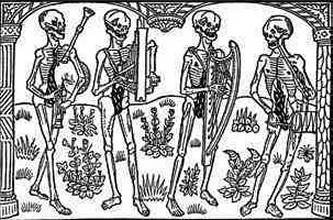
Traditionally, death has been quite visible to Catholics, and the saints are often depicted with skulls, by skulls, and at times embracing skeletons or before the Grim Reaper. At Requiem Masses (until about 40 years ago) priests wore black, to symbolize death, the shortness of life, and to remind us that our time is coming, though we know not when. To a modern Catholic, such a visage almost belongs to another religion. The first time I saw a requiem Mass with black vestments, I was still new to the Traditional Liturgy, and truthfully, it was something that almost contrasted with my experience of the liturgy in the Novus Ordo. There, for funerals they wear white vestments and release balloons as a sign the person is in heaven (which is blasphemous since the point of a funeral Mass is to pray for the soul because we don’t know where it is). Black vestments, 100% beeswax candles (a rubric for requiems), pictures in the missal adorned with skulls, all of these and the glorious Dies Irae were something I had never seen in 3 years of being Catholic, and it not only seemed like a relic, but it also seemed alien.

This is because it is alien to modern culture, and only within the Church’s classical Liturgical tradition East and West is the concept incorporated at all, with the exception of those priests who have brought it back into the Novus Ordo. The loss of the concept of death has also led to the loss of its fear, and its preparation. There was some idiotic shirt when I was growing up, which said “He who dies with the most toys wins.” Now, even from a non-religious standpoint, he who dies is just plain dead! He doesn’t get to take anything with him, neither money nor toys.

This became absolutely clear to St. Francis Borgia, a holy Jesuit whose feast we celebrated only a few days ago. He walked with the casket of Queen Isabella of Portugal, Charles V’s wife and mother of the future Philip II on procession. On the way it was opened, exposing her rotting flesh and the stench of her corpse. She was the married to the greatest monarch of all Christendom, the most renowned, the most revered.  She was seen as the ideal of a monarch, and also the incarnation of heavenly glory. When the flesh rotted from her face there wasn’t a bone’s difference between her and a peasant draped in rags. This thought was not lost on St. Francis Borgia, who contemplated the corpse when all others had run away due to the stench. He vowed never again to serve a master who should perish and rot, nor work for glory that will sit here on the earth when he rots, but rather, to serve the Lord of Heaven and Earth who alone shall not die. When his wife died, he renounced his titles and became a Jesuit.

Saints are often depicted with skulls to be a reminder of death. St. Charles Borromeo is said to have kept a skull on his desk, likewise Cardinal Baronius the great Church historian who inscribed into it an expression used by Carthusian monks when greeting each other “memento mori“. Our culture, while on the one hand exulting in death, be it in war, video games, murder, or the mass murder of our unborn children, fears it on the other. No one stops to think that the world will end, that they will end. First and foremost in this category, are the majority of baptized Catholics in our culture. Why do I mention that? Because our empirical experience can verify this. There is not enough thought of death for whatever reason one might gather. Instead, they are worried about ordering the house, investments, jobs, computers, internet, friends, parties, and in the back of their minds Mass on Sunday, and for a smaller segment, confession once in a while. Do they ever stop and think that they might die today? Might you not die from a massive heart attack as you read this? (God forbid)

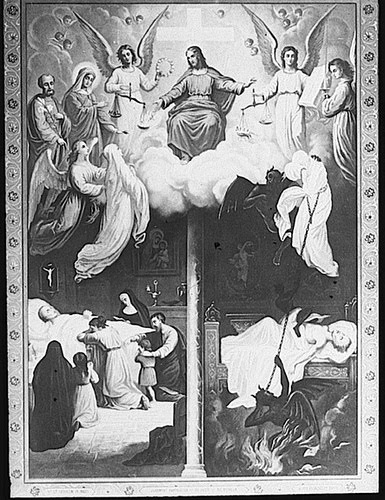
How many people are there, who not only delay a thought of death until it confronts them, but also, say idiotic things like “I’ll convert on my deathbed!” I can not tell you how many people, be they Catholics or Protestants, justify their evils by claiming they will convert on their deathbed? How many more non-believers who entertain some thought of afterlife, say “well, I’ll convert on my deathbed.” What if there is no deathbed? What if you die in your sleep, a ripe 45, thinking that you’ve got 50 more years? What if you die in a car accident, which is a good chance for Americans since more of us are killed by traffic incidents than by guns, disease and natural disasters put together! There is no time to stop and say as much as “Lord I’m sorry”, and if one dies in mortal sin he will go straight to hell.

St. Alphonsus Ligouri says on this subject:

The time of death is a time of storm and confusion. At that awful hour sinners call on God for assistance; but they invoke his aid through the fear of hell, which they see at hand, and not with true contrition of heart. It is for this reason that God is deaf to their cry; it is for this reason also that they will then taste the fruit of their wicked life. What they have sown they shall reap. Ah! it will not then be enough to receive the sacraments; it is necessary at death to hate sin, and to love God above all things. But how can he, then hate forbidden pleasures, who has loved them till that moment? How can he love God above all things, who has till then loved creatures more than he has loved God? (Preparation for Death, Consideration X)

To bring Catholics back to a holy consideration of death, we must rebuild a culture of holy death, where we present to men the reality of our death, and its cruel inescapable reality. The first step as always is through the re-establishment of sacred signs. By this I mean common requiem Masses, and common does not mean every day, but frequently in a parish. We need a return of black vestments, or at the very least, funeral Masses ought to be said in purple if not black, and white completely banned. The concept of penance and prayer for the dead is essential not only in forming a healthy eschatology but also in preparing the faithful to seriously contemplate their own deaths. How will you stand before your creator? God is merciful, but He will not be mocked, for He is also just.

Lastly, it should be preached upon as often as possible, and parents should follow the lead of the Church and help their children learn to practice preparation for a Holy death. “Oh that’s so morbid!” Yes. Yet if we consider the saints, or better yet, consider the blessed Fatima children. Our Lady showed them Hell and all of its torments. The Mother of God, so pure, so loving, showed to 3 children the terror and torment of hell! If she can do that, there is simply no good reason why we can not prepare our children for a holy death, which is far less dramatic than showing them hell. These are the building blocks by which we can recover the thought of a holy death in Catholic culture, and through it recover society for the Sacred Heart of Jesus, remembering always that this is not our true home, rather, it is a temporary journey to that blessed Patria which is our eternal resting place, to which we can take nothing with us.

Mors Peccatorum Pessima

Originally published 10 August, 2010

The saints tell us that the death of sinners is filled with problems. In this sense they do not mean sinners in the broad sense, because we are all sinners, rather sinners with respect to the unrepentant, those who have not yet turned away from their sins and more than likely don’t want to.

There is a aberrant idea today, that on one’s deathbed he is going to get all kinds of graces to convert and have sorrow for one’s sins. While it is possible, no such teaching exists in scripture and tradition. In fact it is the opposite. St. Jerome teaches: “I hold as certain that he who lived an evil life cannot have a good end.” The bible uses the expression “Mors peccatorum pessima” (Psalm XXXIII:22), the death of sinners is the worst. St. Thomas says concerning this:

Deinde cum dicit, mors peccatorum, ponit effectus divinae providentiae quantum ad malos: et circa hoc duo facit. Primo enim ponuntur pericula malorum. Secundo ostenditur quomodo ab his liberat sanctos suos, ibi, redimet.
Corporalis quidem haec est pessima in malis, quia mittuntur ad pessimum locum. Luc. : mortuus est dives, et sepultus est in inferno. item quia perdunt spem gratiae post mortem. (prover. 11) : mortuo homine impio, nulla erit amplius spes. mors ergo peccatorum pessima est, quia moriuntur in corpore et in anima. spiritualis.

Thus when he says the death of sinners, he places the effect of divine providence in such a manner toward the wicked, and concerning this he does two things. First he describes the perils of the wicked; second, it is shown how God liberates his saints from the wicked, at He shall redeem.
The bodily [death] is certainly the worst among the wicked, for they are sent to the worst place. As Luke says: the rich man died and was buried in Hell. The same [sinners] lose the hope of grace after death. As Proverbs 11 says: when the wicked man dies, there will be no hope. Therefore the death of sinners is worst of all, for they die in both body and soul. (Commentary Psalm 33)

St. Alphonsus teaches in his preparation for death:

How will the dying man, who has always lived in sin, be able, in the midst of the pains, the stupefaction, and the confusion of death, to repent sincerely of all his past iniquities ? I say sincerely, because it is not enough to say and to promise with the tongue: it is necessary to promise with the heart? (Book I, ch. 5)

On one’s death bed, the demons will appear and tempt a person with their most predominant fault or perhaps worse things, and if the sinner has not lead a life of grace and holiness there is ample material for one to be tempted. A very holy priest told me once a story from a nurse in a hospital, of an evil man who was brought there to die, and the nurses could tell he was evil just by the things he would say. Once the nurse looked in because she heard the man screaming in total fright, and saw a dark object standing in front of the man, almost like a void which light could not penetrate and immediately the man died. The demon had come to claim him, because when one lives a life of habitual sin the demons will come and claim their property.

St. Alphonsus teaches again from the same work:

The poor dying sinner will be assailed, not by one,but by many causes of distress and anguish. On the one hand, the devils will torment him. At death these horrid enemies exert all their strength to secure the perdition of the soul that is about to leave this world. They know that they have but little time to gain it, and that if they lose it at death, they shall lose it forever. The Devil is come down unto you, having great wrath, knowing that he hath but a short time (Apoc. xii, 12). The dying man will be tempted, not by one, but by innumerable devils, who will labor for his damnation. Their houses shall be filled with serpents (Isa. xiii, 21). One will say: Fear not; you will recover. Another: You have been deaf to the inspirations of God for so many years, and do you now expect that he will have mercy on you? Another will ask: How can you make satisfaction for all the injuries you have done to the property and character of your neighbors? Another: Do you not see that your confessions have been null, that they have been made without sorrow or a purpose of amendment? How will you now be able to repair them? On the other hand, the dying man will see himself surrounded by his sins. Evils, says David, shall catch the unjust man unto destruction (Ps. cxxxix, 12).

These sins, says St. Bernard, like so many satellites, shall keep him in chains, and shall say unto him: “We are your works; we shall not desert you” (Medit. C. 2). We are your offspring; we will not leave you; we will accompany you to the other world, and will present ourselves with you to the Eternal Judge. The dying man will then wish to shake off such enemies; but, to get rid of them, he must detest them, he must return sincerely to God. His mind is darkened, and his heart hardened. (ibid)

There is yet another story, far more haunting as it is educational, from a Catholic midwife in Germany. This was during World War I, of a case where a woman was brought to her who was bleeding inexplicably, and the horrific things this woman saw when she was dying.

The wife of the canteen proprietor had been brought to the hospital- in a high fever, half unconscious, delirious, bleeding. “Some woman’s trouble,” said the matron. At that time the sisters refused on principle to deal with such cases. It was forbidden by the rules of the Order.

Alas! yes a woman’s trouble [that is an arranged miscarriage]. As had happened so often of late. But the woman’s general condition pointed to very grave complications. It was not a normal miscarriage. There must be some cause for the high temperature. I racked my brains in search of a clue. These people had come to our village shortly before the War and had taken over a canteen. When the war industries were in full swing they had added a casino for the workers, and later they had opened a cinema… Of course the proprietor of the canteen made a lot of money. Why he was not called up for military service nobody knew. All sorts of stories were whispered about. Tales of secret uproarious nights behind closed shutters, of secluded little nooks and corners to which people could withdraw when they wished to be unseen; of guests from outside who frequented the place. There was a lot of talk, but not a word of anything good.

I have never seen the wife in Church-neither in the Catholic Church, nor in the Evangelical Hall for Worship, nor among the Jewish congregation which sometimes met in one of the schoolrooms.
There was no means of knowing whether I ought to send for priest or parson. The sick woman had nothing with her that afforded a clue to any religious interests; only powder, lipstick, eye-drops, nail file, comb, mirror- a dozen unnecessary things; and a card with a name and the words “healer and masseur,” and written below it in pencil “Successor of Dr. M” [who was discovered earlier to be a secret abortionist]. Then I knew that there was something at the back of this. I removed a large clot of black coagulated blood and with it the arm of a child about five months old. ‘Matron, you must get everything ready for an operation before the doctor comes,’ I said. ‘If there is any chance of saving her life, it will only be by an operation.’
Then followed a terrible night, the most terrible I have ever known; and some gruesome days and nights succeeded it. Yet I wished that my experience could have been shared by all those whom the devil ever tempts with thoughts of abortion.
A midwife is accustomed to so many things- to groans and screams, pain and anguish, blood and horror. Where other women would have long since fallen down in a faint or run away, we have to stay and do our work quietly, firmly and resolutely, as though it were not a living body we held in our hands and as though our own heart were not trembling and bleeding. But such an ed as that of this young woman of thirty I hope that I shall never again be called upon to witness.
The twelve strokes of the church clock sounded through the still warm summer night. It had been an oppressively hot day. All the windows had been flung open to let in the coolness of the night. As a rule, sick people like to hear the hour strike. But when this woman heard it, she stared at the door with eyes full of boundless horror; her gaze flickered in the wide-open eyes; her hair stood on end and she tried to leap out of bed and fling herself out of the open window. “Away-let me get away-” panted the pale lips. Beads of sweat stood out on her brow. It took all our strength to hold her down. Then she huddled herself under the blanket and cried and whimpered in terror and anguish…
Yet there was nothing there. Nothing. Not a shadow not a ray of light. The room was wrapped in peaceful semi-darkness. We turned on another of the lights, but the room almost dark, but then she was worse than ever. At length we had recourse to an injection [pain-killer].
We were very loath to do it, but we could not let the woman remain for hours in such a state of excitement. We were already worn out. We could not rid her of her delirious fancies; we did not know whence they arose; and our attempts to reason with here were quite fruitless.
For a time she lay back exhausted, line one dead. With her haggard, waxen face she might have been a woman of seventy. The the horror crept up to her again and she began to talk…
“Now…now they’re coming again… one after the other, one… two, three.. that one is quite big, almost full-grown…four…five…that one is still quite small….six…seven…eight.that one has his head torn off, how he’s carrying it in his hand, nine…ten…that one has lost his legs, but he’s still moving…he’s been cut in two and he’s bleeding…eleven…twelve…and now only an arm and a leg… What have you done with your head…and your other limbs? Why haven’t you any eyes?”

Suddenly she pulled up the blanket and pressed over her face. “No…no…no…go away…go away… you have no right to live…” and she fell back exhausted.
After a while she started again: “Can you hear them talking? Can you hear them… ‘we cannot see the eternal light…we cannot see the eternal light…give us your eyes mother! You have taken away our eyes, give us yours’. Can’t you hear them?…there…one two…three…” And again the terrible counting up to thirteen.
My heart stood still with horror as I suddenly grasped what it meant. Not, it was impossible. They must be mere fevered dreams, delirious fancies. But I could not rid my mind of the thought, and her last words confirmed it: an arm and a leg had so far come away from the child which had been criminally done to death in its mother’s womb. But that it should be the thirteenth….
“What do you want here…now…today? You are dead…you have never lived…I have no children…who sent you here? There…there…they’re all coming back…one…two…three…Can you hear them calling…can you hear them? ‘We cannot enter into eternal rest…we cannot enter into the eternal rest. You have robbed us of our peace…made us homeless…driven us out of our mother’s womb…you have stolen our rest…give us the eternal rest.’ And the eyes… the dreadful hollow eyes.”
The thin fingers of the dying woman pointed to the wall as she began to count once more”Two…four…six…go away…go away.” She stretched out against invisible shapes until she once more collapsed. But she could not rest. A new horror assailed her:
“There…there…one…two…three…bruised…naked…” and she shuddered as though overcome with loathing. “Don’t touch me… go away…away. Don’t you see anything…don’t you hear how they whimper and wail, how they sob and scream…there…and now again…’we have no garment of grace to cover our nakedness…no wedding garment for the eternal marriage feast…we are shut out…frozen…hungry…give us light…make us warm’… Can’t you hear anything? there…here…one…two…three…”
And suddenly, growing quite frantic again, she screamed out: “Go away…don’t touch me…let…let me go…they want to take my eyes…my heart…let me go…let me go…”
She thrust the Sister violently to one side. But fortunately at this moment the doctor arrived. The head of the child was pushed out with a stream of blood. A rapid diagnosis: immediate operation.
The result confirmed my expectation. The child had been cut to pieces in an attempt to remove it; the mother had received several injuries and peritonitis was already developing. What with this and the prolonged hemorrhage, the end might be expected the following day. Word was sent to the husband.
He took the news very calmly until he learned that legal proceedings would certainly follow [abortion was still against the law in Germany, and would remain so until the Nazis legalized it]. Then he too, began to storm-about lawyers, who had nothing better to do than to poke their noses into other people’s married life, instead of looking after their own. While he was cursing, the poor woman who was still partly under the influence of narcotic, began to count once more. The man ran away as though the Furies were after him.
The poor woman screamed and groaned for three days and three nights. Not even the strongest doses of narcotic could procure her rest and oblivion for any length of time. Again and again she saw her thirteen children who had been murdered in her womb come to her with their wailings and reproaches and entreaties. She never recovered consciousness sufficiently to enable us to try and bring her to repentance and guide her back to God, or to ease her of this dreadful torment by reminding her of God’s mercy and goodness. And yet her anguish and distress would not let her die.
After four days her mind suddenly cleared; or at any rate, so it appeared. We sent word to the priest to come once more; and we also sent for the husband. The priest came, but after he had spoken a few words she broke in:
“There are thirteen of them, yes. There is no need to ask…” and as he was to speak of God’s mercy, she said with a last effort: “Let me go…I want to go to hell…I want to pay back the dirty scoundrel for all eternity….” “Dirty scoundrel,” she repeated with her last breath as her husband entered-and with that she died.
All for the Love of Mothers, pg. 242-247

Our Lord spoke of this when he said: “Behold, the days shall come wherein they shall say: Blessed are the barren, and the wombs that have not borne, and the paps that have not given suck. Then shall they begin to say to the mountains: Fall upon us, and to the hills: Cover us. (Luke XXIII:28)

Mors peccatorum pessima

The emptiness of the “Poverty Gospel”

Originally published 30 November 2010

“The Poor, the poor!” This is almost a common mantra that we hear today from our Bishops. For that matter from all the social elites. Whenever a new Church is built, there is some idiot to say “shouldn’t this money be used for the poor?” Although I watched with great amusement as this was turned on Mahoney’s head when he built his monstrosity in LA.

Clamoring about the poor in such a way, especially about legitimate things such as building, or the dignity of the vestments, vessels and furnishings in a place where Holy Mass is offered, is frankly as old as Judas, who complained that the ointments with which Mary Magdalene anointed him might have been sold and given to the poor.

What drove this home for me was one time when I went to confession to a priest who regularly says the Novus Ordo. My confession had absolutely nothing to do with stinginess or lack of charity to my fellow man, but nevertheless he piped in with “don’t worry about that, but do remember that tomorrow is World Charity outreach Sunday, so examine your attitude to the poor and pray for Catholic Charities.” I’m not even sure what event he was really referring to, but nevertheless this was ridiculous. Firstly, this priest has no idea that I used to go to different cities to do homeless outreach, that on passing beggars if I’m not involved in some obligation I will actually buy them food and that my prayers generally consist of prayers for the impoverished. He has no way to know that of course, which is why he shouldn’t be making these kinds of admonitions. Perhaps remember to pray for Catholic charities might have been fine. Then there is of course a giant poster for the Campaign for Human development, which if you got all the priests of all the parishes in this country, I doubt you could find more than 10 who know of a parishoner, or just someone locally, who needed money and received it from the Campaign for Human Development, because in truth they give the money to cronies or to someone to fund abortion.

So now I’m being asked to re-examine my attitude toward the poor, who myself am well below the poverty line I might add, yet the Bishops meet twice a year in fancy hotels at a huge cost to bicker about the word “gibbet” or “consubstantial”, and then tell us to donate for the poor. Then they advocate garnering money for the poor, and take up a second collection (when they could free up millions of dollars by holding their meetings in Washington D.C. at the Basilica of the Immaculate Conception or rent out some college campus during their vacations). This is not to say the Bishops should take up no money from the faithful for the relief of poverty.

Yet the poverty Gospel is completely empty. The philosophy is to get more money and throw it at the problem (much like a government program). This, as experience has proven has done nothing for the poor spiritually let alone in society. At the end of the day you have just put a bucket under a leaking pipe without fixing the leak.

If the Bishops and priests were really concerned about poverty and the souls of the homeless, they would take a completely different and revolutionary approach. Help the poor.
If a man is homeless and he wants to get back on his feet, he cannot just walk into a place and get a job if he wants. Why? He walks in, if he’s able to get a resume printed at the library at all, it is going to show long gaps in employment. He will have difficulty showering, but even if he can manage that his clothes will be somewhat tattered and unpresentable. He can point to no place where he lives, and then the cat is out of the bag. He will not get hired.
Or someone who is very poor and has no or few job skills. He cannot afford to go back to college or to some kind of vocational training that can help him. But here comes Catholic charities “Here is some food for you.” And of course it is a week’s supply of macaroni and cheese, which has a nutritional value of about zero. You might have solved some hunger pains, but you still haven’t helped the poor.

If the Bishops actually meant help the poor rather than “give us more money so we can give it to the democrats and lobby to save the snow owls, or anything else non-controversial, they could set up a vocational center designed to get people off the street. It would just run on a few basic rules, no girlfriends, no drugs, and committing crimes will cause you to be kicked out. Then it can set upon vocational training in a trade, computers, etc. and when these people apply for jobs they can put down “I live here”, they can come in clean and presentable. Moreover those who run the center could work out business arrangements with local employers. Mass could be offered, and with various encouragements it could give the poor something to look forward to, not to mention something they truly need. This is exactly what Bl. Pope Pius IX did for poor homeless boys in central Italy when he was a priest, using his family fortune to set it up. Boys who were trained there were later held to be some of the best craftsmen in Italy, many taught by the holy Pope themselves!

This is just one of dozens of possibilities that are so innovative the status quo will not even look at them because of course, they cost money and bring in none (i.e. a real sacrifice) and they might solve something and take away an appeal. Such initiatives as these will not “solve” poverty, but they will provide opportunities for the poor, especially the homeless.

Heresy Matters….

How many times have you heard this?

All God really cares about is that you are a good person. Or God doesn’t really care about what you believe, just as long as you try to be good. Now would it really surprise you to know that these statements were made by Catholic school students who had 11 years of “Catholic” education? Probably not.

Many of us however, when we are met with the most common liberal/secular challenge are somewhat dumbfounded. Could God really damn someone to hell because they didn’t believe the right thing? So what if someone didn’t teach exactly the right thing?

If you want to really mess them up, just say yes, it is the least expected answer. Yes, if you do not profess the One, Holy, Catholic and Apostolic faith, you will not be saved. Obviously there are gray areas. Intention comes into play, so someone who teaches heresy without knowing and without correction, then of course, God takes intention into account.

Remove all gray areas for a moment. That is the biggest smokescreen used by liberals to muddy the waters of truth. Pure black and white, does right doctrine matter? YES.

The attempt to remove dogma and doctrine from the place of importance in religion is a modernism. If that was the case, and they didn’t matter, then Our Blessed Lord would not have wasted his time teaching theology, or preaching the resurrection, or for that matter rising from the dead. He would have merely taught people how to share, and probably voted Democrat.

However, our Blessed Lord was very much concerned with right teaching, and right belief.

And as Moses lifted up the serpent in the desert, so must the Son of man be lifted up: That whosoever believeth in him may not perish; but may have life everlasting. (John III:14-15)

But it doesn’t matter what you believe.

For if you believe not that I am he, you shall die in your sin. (John VIII:24)

But it doesn’t matter what you believe.

Enter in at the narrow gate: for wide is the gate and broad is the way that leads to destruction, and many there are who enter there. How narrow is the gate, and strait is the way that leadeth to life: and few there are that find it! (Matthew VII:13-14)

But hey, it doesn’t matter what you believe, the wide path is fine after all.

But though we, or an angel from heaven, preach a gospel to you besides that which we have preached to you, let him be anathema. (Galatians I:8)

Who was that Paul guy anyway? What did he know?

This is just starting with the Bible, let alone Church teaching! First there is either only one religion or no religion by logical necessity. The Bible might be right, or the Qur’an might be right, or neither might be right, but they can’t both be right. This applies to Christianity likewise. All Churches claiming to be Christian contradict each other, therefore they can’t all be right. Since no Church teaches the same thing, only one of them could be right. There is only one fold and one shepherd, not many.

The Catholic Church is the only Church to have maintained the same doctrine going back to the apostles. She has done this, against immense pressure in all times in History for a reason, because she is not a human institution, but a divine one which has men as her members. The heros of the faith, the martyrs, have not shed their blood by the gallon from Nero to Stalin so that they might teach people how to share, or be tolerant or to engage in ecumenical dialogue. They did so because they clung to truth, to the whole teaching of the Church, which is Christ Himself.

Ego sum vita, et veritas……

Our Blessed Lord said that he is the Truth (John XIV:10). He did not say a truth, but the truth. Truth is not a thing, but a who. When Pilate demanded to know what is truth, he did not realize that it was standing before him and his Roman seat of judgment. Thus when someone denies the truth, he denies Christ himself. This is why in the early Church heresy would result in such riots that imperial troops had to be sent in order to quell the fighting. Truth mattered! This is why the Church had convened councils to explain what was always and everywhere believed. At Nicea, the question of Arius had innumerable consequences. If Christ was not God, then that which they did at his command, namely the celebration of the Sacrifice of the Mass, would have been idolatry, since even if it did turn into his body and blood, you would be adoring the body and blood of a man. If Arius was right, we would not be worshipping the true God. However it is not sufficient to stop there and say yeah, but whatever you want to believe is fine. No! Because if you don’t believe in the truth, what kind of God are you worshipping? Is it Christ? If not, take to heart some scripture quotes above and ask yourself, does Jesus care about heresy?

The martyrs, the true Christians, who when push came to shove laid down their lives for God, did not do it for “their version”. They did it for the eternal and unchanging truth. Heresy, which comes from the Greek word hereseo (I choose) is a choice against the truth. It is always centered around a selfishness. All the early heretics are associated with the worst vices: the Judaizers denounced Catholics to Roman authorities, the Donatists lied, forged documents and murdered, the Arians bore false witness and destroyed people’s lives, the Albigensians and the Fraticelli used to seduce innocent virgins and nuns to sex by the reasoning that they would become more pure, or were so pure that the act could not be sinful. Heresy, as a denial of truth, disfigures the soul and makes it prone to vice. Worst of all, it separates one from the true worship of God. Material heresy on the other hand, that is the act of believing a heresy without knowing, has its ill effects slowed by good will. However it is not long before good will gives way, as other subtle activities of life are transformed by heretical thought. The modern world with all of its moral sickness, the world which has deprived men of productive property and made them slaves in factories and cubicles grew out of medieval heresies which denied the truth of Christ and the transforming power of his grace.

True doctrine on the other hand builds up true worship. As the ancient maxim goes, lex oriandi, lex credendi (The law of praying is the law of believing). The Nicene Creed in the original Greek is almost like a song, and was set to music very early by the title of Pisteo, as it is known by “Credo” in Latin. Its articles were theology woven in golden threads which the post Nicene fathers meditated on as their daily bread. The doctrine of the Councils through the ages, rather than chains restricting free thought, are liberating decrees freeing the mind from the deceit of error. The proof of this is in the fact that the doctrine of the Church comes from God not men. Giving assent to an authority other than ourselves removes from us both the decision and the pride inherent in creating one’s own doctrine. Rather than becoming our own lights of doctrine, we submit, not as Muslims do to an impersonal will of God, but to the very person of God, to virtue, to being transformed to be the light expounding His doctrine, not ours. This is something fundamentally different from every other religion in the world.