“And the church more or less shrugs and say, “Look, we don’t take our agenda from the polls. We don’t take our agenda from what the world is saying. Our agenda is given to us by the God who made us, and we must be faithful to him instead of what we’re– what we’re hearing’ from the world.””
-Cardinal Timothy Dolan (source)

Michael Voris, you can love him, or you can hate him, and some people do hate him. I would put down good money that the hierarchy does not care for him all that much. Yet recently, he kicked off a bit more of a response from defenders of the bishops’ failed leadership and policies.
For the record, I do not care all that much for Voris’ style. It speaks to some people and is probably good for them, but I don’t have time for bullet points, even when he’s right. I’m a theologian, I look up propositions in the manuals, in St. Thomas, trace their reasoning and source, and apply it to today’s problems. In this case, however, I feel he was right on the money, and his response is something that, frankly, every Catholic should feel. I am talking about Voris’ response to Archbishop Timothy Dolan’s decision to continue supporting and even lead the St. Patrick’s day parade, when that same parade has decided to allow practicing and proud homosexuals to march and display their banners, ostensibly in honor of St. Patrick.
In response to the decision, Dolan noted:
“I have no trouble with the decision at all,” Cardinal Dolan said at an evening news conference announcing his appointment as grand marshal. “I think the decision is a wise one.” (Source)
There are many other things we can note about Dolan, but Voris does it well himself:
Now, Voris uses some strong language, which is rather offensive to the church of NICE. He tells Cardinal Dolan that he is “in the grip of the devil”, and “wicked”. Well, strong as it is, it is not far off the mark. I think myself that it has come time to call out the type of things that are going on the Church for what they are, they are evil.

The big cheese defends the integrity and sacredness of the liturgy. [sic]
I recall the first time I became aware of who Cardinal Dolan was during his installation in Milwaukee after that godly loving sodomite, Archbishop Weakland, had produced so much destruction there. Dolan gave his first sermon wearing a cheese head.
Dolan came from the St. Louis diocese, and for a while was in charge of the North American College in Rome, until he was elevated to become the Archbishop of Milwaukee to replace good ol’ Rembert, known for his cathedral wreckovation and squandering hundreds of thousands of dollars of diocesan money to keep old boyfriends quiet. At first Dolan appeared to step into the mold of his predecessor, but then appeared more conservative. I suppose many breathed a sigh of relief that he wasn’t gay. While from all appearances he attempted to help abuse victims while in Milwaukee, and we should not doubt his legitimate charity and concern for them, there are a number of anomalies.
Not to take a story exclusively from the New York Times, I instead am going to what is available of documents that have been released. Interestingly, as the diocese filed for bankruptcy, Dolan at the same time asked for and received permission to move over $57 million dollars to a cemetery trust fund to hide it from victims. Thus in one courtroom they are arguing that they are bankrupt, and in another that they are not. When groups criticized Dolan for this he dismissed it as old falsehoods. Yet, how false was it? The documents proved this was true. Now, to be fair, if we were to put ourselves in Dolan’s shoes, we might look at the situation this way. The diocese has obligations to retiring clergy who did not commit horrible crimes, to charitable works, payment of staff, health insurance, and the legal obligation to maintain cemetaries? We want to protect that don’t we? Why should everyone else suffer on account of these monstrous clergy. Such an argument has its merits, if that is in fact the reasoning, but in light of what went on the demands of justice require it be set aside.
For, if it is a matter of paying diocesan obligations, one could require Weakland to start recuperating the vast sums he spent on his boyfriends, pinch pennies, eliminate waste, the types of things bureaucracies hate doing. It should be simple, indeed, to realize that those who have in fact been abused by priests deserve some kind of compensation, as a modicum of justice. There is one diocese in this country that never had these sorts of problems and that is Lincoln, Nebraska. The reason is, Bishop Flavin, who was extremely progressive btw, heard that two of his priests had abused children. He investigated it, found out it was true, defrocked them and handed them over to the civil authorities. Then he went to the families and said, ‘what can we do to make this right?’ No shuffling priests around, or ignoring victims, or hiding money in trust funds. And… Lincoln Nebraska has never had a sex abuse lawsuit.
While that logic seems ineluctable to us, it is a bit much for a post-Vatican II bishop, as is seen in conservative and liberal bishops alike. There are other irregularities.
Dolan claimed many times that he was not aware of any cash payments for clergy to get them to leave without fighting their laicization. Yet he was present in diocesan meetings when they talked about doing just that. (Source) Again, this is not the MSM attacking the cardinal, maybe some of their spin is, but the documents show he was aware, which is a bit reminiscent of Cardinal Law claiming he knew nothing about the commission set up in the wake of the Rudy Koss scandal, even though he chaired it. Again we have to put ourselves in the bishop’s shoes for a moment. Here is an easy solution, give the priests money up front to get out of town, and we can take care of this faster. After all, we are canonically responsible for providing for these priests. Yet let’s back track, just a bit.
While Canon law requires dioceses to materially support their priests, this does not hold to priests who are under serious penalties, or are in the process of being laicized. Moreover, the bishops have shown themselves quite willing and able to cut off priests whom they suspend for other reasons. While it could be Dolan, or whoever made the decision, thought it was more expedient, it ignores two things: a) Priests who rape children deserve a hefty pyre where they will meet a fiery end to this life, before a fiery beginning to the next, not hush money, b) the perception will be, and in fact is, that they are being given some type of bonus. If it weren’t for the very strange statute of limitations on child rape, they would be transitioning to a jail cell anyway, so the concern should be with making this right however much they can with the victims, not helping priests who are guilty of the most monstrous crimes against children find funding as they “transition to a new life”.
As the Cardinal Archbishop of New York and the most recent president of the USCCB, Dolan is remembered for leading the fight against the HHS mandate and re-iterating the Church’s opposition to civil unions. He has acquired a reputation as a jolly bishop, happily leading the Church along. Curious stains on that particular legacy are that the Archidocese of New York, under his leadership, actually paid for contraception coverage and had complied with state law (under protest), though it was now fighting the same requirement on the national level, and that he had established a homosexual parish, St. Francis Xavier Parish in Manhattan, while he is preparing to close down one of New York’s more beautiful Churches, also being the only one where a daily Traditional Mass can be found, namely Holy Innocents. (Source)
We might also add that as Dolan is leading the fight against Obama, he happily invites him to the Al Smith dinner and allows photos having fun with the most anti-life President in years. He could have done, as Pope Benedict did when Nancy Pelosi, met with him, to forbid photographs to at least avoid the appearance of scandal. Yet he did not.
What all of these things show about Dolan, is that he is a company man. Of course he is more concerned with paying out pedophile priests than victims, or using Obama’s assault on the Church to bolster the Bishops’ “authority” even though his own Archdiocese does the same thing. Like Bernadine, Weakland, Law, Grahmam, and many other of the most disgraceful bishops to ascend to the office, Dolan is a team player, though it must be admitted his crimes are nowhere near the stench of the Bishops named before him. The problem is team USCCB is not always team Jesus, particularly where Catholic moral considerations are concerned.
It is also well known that a significant number of Bishops are gay, or sympathize with active homosexuality, and what is worse a large number of priests are gay. So again, Dolan doesn’t want to rock the boat. At least O’Connor, though he was no paragon of conservative Catholicism, had the backbone to oppose active homosexuals appearing in the St. Patrick’s day parade as a self-identified group. Not so Dolan, the team player, which probably is part of the reason he said “Bravo” to an openly gay football player on Meet the Press (which is linked at the top). Go along with the world even though it is entirely at odds with the Gospel. This is the career that Dolan has displayed, behind the jolly veneer. He is not satan in disguise, he is not malicious (it would appear) or evil, he is a fallible man who is doing wicked things.
The authentic Catholic uprising
Enter Voris, with a stern, serious and loud defense of what a Bishop should be doing. He wasn’t the only one. While Dolan has previously organized the so-called “fortnight for freedom” and other defenses of so-called “religious liberty”, Monsignor Charles Pope, a priest who dared to criticize Dolan was silenced, even though his piece dealt with issues much wider than Cardinal Dolan. So much for religious freedom. Its all fine and good when utilized to make people vote Republican, but as soon as someone in any position of authority takes a second look at our Catholic leaders, it is shut down. Likewise anyone appearing to have any sway. Therefore it is no surprise that the lapdogs of the Bishops should take aim at Voris, who is not a priest, and not employed by a diocese. They managed to shut down Mother Angelica in the 90’s but today the technology has made control impossible.
Now Voris’ comments, while appearing to be a bit histrionic, are what any Catholic 100 years ago would have said about such a spectacle. I think he is exactly right, not because Dolan is having tea with the devil between 4 and 5, but rather, because in his desire to be a company man and please everyone, he has forgotten the role of a Catholic Bishop (especially one in his position as a prince of the Church) and has given scandal. Moreover, he has rejected the same criticism from sources he declares to be charitable.
Thus we should look at the work of one Deacon who particularly took Voris’ appraisal amiss. Deacon Ditewig, PhD, offers the following appraisal:
Where to begin? While reasonable people might certainly disagree with the actions of any bishop, just as one might with any leader, one must certainly stop there, without going on to try to infer motivation or motive. I am sure that if Cardinal Dolan were asked about these things, he would completely and fully reject all of these assertions, and with good reason. To lump together, as Mr. Voris does, sexual orientation and sexual activity is to miss an important distinction made in the teaching of the church. Nowhere has Cardinal Dolan ever sanctioned sinful behavior by anyone, nor does the record indicate that he has ever given anyone a “free pass” on sin of any kind. There is no substantiation of any kind for a claim that the Cardinal has lost his faith, or that he is not striving to provide for the cura animarum of the people of New York — all the people. To spring from a criticism of certain decisions into a full blown attempt to characterize another person’s intentions and motivations — much less that state of that person’s soul — is not only fatally flawed logic, it is seriously deficient in Catholic morality. (Source)
This is a bit shocking, actually, coming from a PhD. Firstly, Voris is not equating the sinful behavior with the orientation. Cardinal Dolan is fully pleased with being the grand marshal of a parade that will now include out and proud practicing homosexuals marching under their own banner, just as he has already approved Masses for the same. At this point we are beyond any question of orientation vs. behavior. Second, while in truth it is not a sin to “be gay”, so to speak, that is to have such an orientation, the said orientation is in fact disordered. That is why we must have compassion and prayer for homosexuals, not persecution. Yet, it doesn’t follow that we must approve of their behavior, particularly when they celebrate their behavior. I don’t think anyone would countenance the association for employers who defraud laborers, or the association of those who abuse orphans and widows celebrating their sins in a parade ostensibly made to honor St. Patrick. Why do we tolerate that for the other sin crying to heaven for vengeance?
What the good deacon here misses, is that the decision to allow out and proud homosexuals to march under their own banner in the parade, constitutes a celebration of their sins, not a mere acknowledgement of the fact that these people suffer under such inclinations. I knew a fellow that was gay in college, and we talked and he knew I wasn’t of the type that would hate him or judge him for having such inclinations. He was a pretty bright guy, but he suffered with it. I prayed with him, I didn’t judge him, as others might have, and he struggled a lot. That is not the type of person who is to be marching in the St. Patrick’s day parade. Rather it will be the type of people who need reproof for their behavior, not the tacit support of the Cardinal Archbishop of the diocese. That is just the problem. By continuing the parade, in all its normal debauchery, with this added, is in fact to give a tacit approval of this behavior. It would be different if it was a chapter of Courage, founded by the late Fr. Harvey, of Catholics, or anyone else, suffering under such an affliction hoping to overcome it. That would constitute not the slightest scandal or offense. Nevertheless, the good deacon continues. [my comments in red]
The last point I wish to highlight is the claim made in the crawler at the bottom of the video. It is an advertisement for a paid subscription to the site, which professes to be “100% faithful to the Magisterium.” I must confess that when I first saw that claim, while watching the video and its assertions about Cardinal Dolan and other “wicked bishops,” I laughed out loud. How a person could claim to be completely faithful to the teaching authority of the Church while at the same time denigrating those men whose ministry includes being authoritative teachers of that Magisterium is simply nonsensical. [Being authoritative teachers like when they approve Gay parishes to have Masses for practicing homosexuals! Even Alexander VI didn’t stoop so low!]
What are we to make of all of this? Let’s review some basics.
The Magisterium is not simply a “who”; it is a “what.” Magisterium refers to the teaching authority of the Church, a Church we believe guided by the Holy Spirit [Not absolutely, but rather protected in solemn definitions in faith and morals. There is nowhere in Catholic doctrine where we teach that the Church is guided in all her doings by the Holy Spirit, or was Pope Alexander VI guided in the banquet of chestnuts but I digress…]. Every person, in some way or another, and in the broadest sense of the term, participates in this teaching authority, constantly learning and sharing this faith. Think of parents, for example, teaching and forming their children in faith, as they are charged at baptism; they are part of the magisterium in this broad sense. [A very broad and non-theological sense! This is one of the biggest stretches I have ever seen, and it entirely confuses the Ecclesia docens with the Ecclesia discens, to the point where the proposition is incorrect…] But in a very specific and particular way, the highest human teachers in the Church are the College of Bishops, always in communion with each other and with the head of the College, the Pope [This particular formulation is problematic, because its ultimate conclusion is erroneous at best if not in fact heretical. He equates the college of Bishops with the Papacy itself, as though the Pope were merely a first among equals. The Pope is the highest human teacher, with or without the Bishops. After his personal office then come the college of Bishops, when they teach on a matter of faith and morals whether together or dispersed throughout the world. This is the great problem with post-Vatican II ecclesiology, it hopelessly pales in comparison to the careful and clear explications of pre-Vatican II tracts De Ecclesia]. Unless and until an authoritative judgment is made by the College (always in communion with the Pope), or by the Pope himself, that a bishop is no longer part of that College, then the bishop in question remains an authoritative teacher. [An authoritative teacher is different than the magisterium, but I’ll go into that later] It is not within the competence of someone else (like Mr. Voris, or myself) to judge when a bishop is no longer teaching authentic or faithful doctrine. [Actually it is, when said Bishop departs from what has always and everywhere been believed by the Church, if it is demonstrable and public]. In fact, I will go further and suggest that, if there should be a presumption of veracity and accuracy in presenting the Church’s teaching, that presumption goes to the bishops, not to anyone else. Put simply, Mr. Voris is neither qualified nor competent to make the judgments he is attempting to make.
It may or may not be the case that Voris is competent to make the claims he makes, but nevertheless, the Deacon is quite out in left field. Firstly Voris is criticizing prudential determinations, and calling on the Cardinal to step down. He is not declaring him a heretic or deposed. What Deacon Ditewig is setting up is a supremacy of the Bishops, quite contrary to the mind of the Church and the tradition. For, both in the Theological manuals, and in Vatican II’s document Lumen Gentium, #25, the Bishops are part of the Church’s infallibility when they teach together or are dispersed throughout the world in unison on an issue of Faith and morals. One Bishop’s prudential determinations do NOT make him a voice of the magisterium, not even under Vatican II. In fact, a Bishop’s role in the magisterium individually is very limited. Let’s continue with Dolan’s faithful defender.
Am I saying that bishops never make mistakes? Of course not! Bishops make mistakes just like the rest of us, and they also deserve the benefit of fraternal correction. Some bishops commit crimes and should be held accountable under civil, criminal and canon law [Like Cardinal Law, who committed purgery in a court of law (against the 7th commandment), and was rewarded with a nice job in Rome for it!]. But no one has appointed any of us to take the place of God in judging us all for our sins [Whatever Voris is doing, that is not it. This smacks too much of the infamous “who am I to judge?”]. Alone we will stand before God and take responsibility for the way we’ve lived our lives.
Let’s take just one example from the litany of complaints made by Mr. Voris, and analyze just how wrong he is. He condemns Cardinal Dolan for not publicly condemning Islam as “a heresy and a false religion”. While this may be what he believes, it is NOT what the Catholic Church teaches [Really?] (remember the claim that he is 100% faithful to the Magisterium?). What DOES the Magisterium of the Church teach about Islam?
Here’s some truly authentic magisterial teaching, found in Vatican II’s Dogmatic Constitution [please note that well — it is a DOGMATIC text, dealing with the most fundamental issues of faith and church] on the Church (Lumen gentium), #16: [I have to interject here, Pope Paul VI inserted a Nota Praevia to Lumen Gentium, making it clear that nothing was dogmatically defined unless otherwise noted. So, while we might remark on the novelty of a “dogmatic contitution” not declaring anything dogmatic, there is nothing from the extraordinary magisterium that binds Catholics to belief].
But the plan of salvation also includes those who acknowledge the Creator. In the first place amongst these there are the Mohamedans, who, professing to hold the faith of Abraham, along with us adore the one and merciful God, who on the last day will judge mankind.
Later, this thought is developed in the same Council’s Declaration on the Relation of the Church to Non-Christian Religions (Nostra Aetate), #3:
The Church regards with esteem also the Moslems. They adore the one God, living and
subsisting in Himself; merciful and all- powerful, the Creator of heaven and earth, who has
spoken to men; they take pains to submit wholeheartedly to even His inscrutable decrees, just as
Abraham, with whom the faith of Islam takes pleasure in linking itself, submitted to God. Though
they do not acknowledge Jesus as God, they revere Him as a prophet. They also honor Mary, His
virgin Mother; at times they even call on her with devotion. In addition, they await the day of
judgment when God will render their deserts to all those who have been raised up from the dead.
Finally, they value the moral life and worship God especially through prayer, almsgiving and fasting.Since in the course of centuries not a few quarrels and hostilities have arisen between Christians and Moslems, this sacred synod urges all to forget the past and to work sincerely for mutual
understanding and to preserve as well as to promote together for the benefit of all mankind social justice and moral welfare, as well as peace and freedom.In fact, even earlier — when talking about religion in general, the bishops of the Council (that “episcopal college” mentioned above) taught at #2:
The Catholic Church rejects nothing that is true and holy in these religions. She regards with sincere reverence those ways of conduct and of life, those precepts and teachings which, though differing in many aspects from the ones she holds and sets forth, nonetheless often reflect a ray of that Truth which enlightens all men.
When a person claims to speak with complete faithfulness to the Magisterium, then, we should expect that this person would be echoing these teachings, which Cardinal Dolan has certainly done. The Church does NOT teach what Mr. Voris teaches: that Islam is “a heresy and a false religion.”
Well, where to start? We could talk about the fact that he ignores all previous Church pronouncements, both through the unanimity of theologians and even former conciliar declarations concerning Islam, but we’ll stick with what Islam is and the philosophy of God. I will say that I have personally known Muslims who are good people. That is not the issue here. All Trads have issues with Vatican II, and I am no exception, but for the sake of argument I’m going to leave that behind. Vatican II says nothing here that contradicts what Voris is saying. The Church can indeed note those elements of the Islamic religion that are praiseworthy, in the realm of philosophy, but none of that changes the reality that nowhere does the Church acknowledge Islam as a true religion. That is the problem. If it is not a false religion, then it must be a true religion, because of the law of non-contradiction, two contrary positions cannot be true at the same time and in the same respect. Thus in the Qu’ran, Ibrahim (the Arabic spelling for Abraham) takes Ismael up to the mountain to sacrifice, while in the Bible Abraham takes Isaac up to the mountain to sacrifice. They might both be false, but they cannot both be true. Muslims may indeed worship one God, but that does not mean that their philosophy of God is the same as ours. In point of fact, if you look at the Qu’ran, Muhammad’s mother is depicted as a whore, Jesus’ mother is revered. Jesus is glorified more than Muhammad, and Jesus will judge all on the last day. Most of what Muhammad got into the Qu’ran is in fact from Christian heresy, and it is not without reason that St. John Damascene, a doctor of the Church, characterizes Islam as a Christian heresy.

St. John of Damascus: Just another pre-Vatican II misanthrope
“There is also the superstition of the Ishmaelites which to this day prevails and keeps people in error, being a forerunner of the Antichrist. They are descended from Ishmael, [who] was born to Abraham of Agar, and for this reason they are called both Agarenes and Ishmaelites… From that time to the present a false prophet named Mohammed has appeared in their midst. This man, after having chanced upon the Old and New Testaments and likewise, it seems, having conversed with an Arian monk, devised his own heresy. Then, having insinuated himself into the good graces of the people by a show of seeming piety, he gave out that a certain book had been sent down to him from heaven. He had set down some ridiculous compositions in this book of his and he gave it to them as an object of veneration.” (source)
St. John Damascene is just another self-righteous crusader ignoring the magisterium of course! The fact is the Church does not teach what the Deacon here is proposing, that Islam is not a heresy and a false religion. In the comment box, several people pointed out similar things to the deacon, and he remonstrated that he was simply worried about Voris’ threatening language. Yet, he makes this a primary point of questioning Voris, that he is not faithful to the magisterium, and uses this as part of his example. The fact is that Voris is exactly right when he says that Islam is a heresy. It would be a heresy for a baptized person to embrace, and in its doctrines it is a false religion. That doesn’t mean that the Church can’t make common cause with Islamic countries at the UN, for instance, to oppose population control and birth control measures. It doesn’t mean that we can’t point to what is true in Islam. But it doesn’t make Islam a true religion. If it is not a false religion, it must be a true religion, and if so, what in the world are we doing in the Church? It may be that Dolan’s earthly prudence is justified or it may not, but it certainly doesn’t have a basis in Islam being a true religion.
Nevertheless, let’s look at where the attack on Vorris is going, which I have seen on a few other websites too:
Finally, I want to return to the threatening language used by Mr. Voris when he refers to punishment that he thinks may happen to Cardinal Dolan after he dies, “or even before you die,” and when he issues his call for an “authentic Catholic uprising. I would refer Mr. Voris and anyone else who is interested to the following canons from the Code of Canon Law:
Can. 1372 A person who makes recourse against an act of the Roman Pontiff to an ecumenical council [note: such as Vatican II] or the college of bishops is to be punished with a censure.
Can. 1373 A person who publicly incites among subjects animosities or hatred against the Apostolic See or an ordinary [note: such as Cardinal Dolan] because of some act of power or ecclesiastical ministry or provokes subjects to disobey them is to be punished by an interdict or other just penalties.
It would be interesting to hear the opinion of a canon lawyer with regard to these canons as they might apply in this instance.
Now we need to make important distinctions. Firstly, I don’t know what the deacon is taking about with his reference to Canon 1372, since Vorris is not making an appeal to Vatican II against all the bishops of the world, gathered together or dispersed throughout the world. It is a total non sequitur. This canon is talking about those who engage in private judgment attempting to challenge authoritative acts of his magisterium or jurisdiction on the basis of a council. This is based on much older laws, originating in the debates of Renaissance humanists who wanted to reform the papal court on the basis of the Council of Constance, the provisions of which were not entirely accepted by subsequent Popes. 1373 is a bit more pertinent. Now, in 1373, the Canon is envisioning someone who incites subjects to disobey their bishop, or to actually hate him. What Vorris has done, by contrast, is to call on Catholics to oppose bad decisions of their bishop, and to refuse to cooperate with his bad actions. I’ll readily grant he could be more clear about the “Catholic uprising” he is calling for, but his words are clearly in the realm of the necessary opposition that Catholics can have to bad members of their hierarchy. An authentically Catholic uprising by its very nature would suggest something non-violent, prayerful, etc.
Again, Dolan is not evil because he is in secret liaisons with the devil, or because he has palmist readings, or writes meditations on tarot cards like Hans Urs von Balthasar, but because he has chosen human respect above his divine calling as a bishop. We should support Voris’ call for a Catholic uprising, by telling our shepherds we will not tolerate any more wishy-washy compromise, watered down doctrine and assaults on our liturgical tradition. We do need any more “Bravo’s” to the world. Nay, we need another bravo: Bravo Michael Voris!
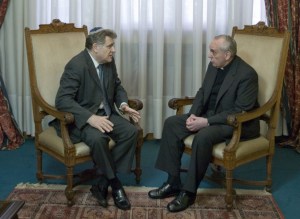 But is this some random statement from the Pope, off the cuff and without notes? Actually no, this is precisely what he believes. In 2010, a dialogue was published between then Cardinal Bergolio and Jewish Rabbi Abraham Skorka, titled On heaven and earth, on a wide range of issues. In that, Francis said the following [My emphasis in bold]:

 Athanasius Contra Mundum