Tag Archives: Theology

The Perpetual Virginity of the Dei Para: Virginity during Birth

The Nativity with St. Lawrence and St. Francis -Michaelangelo Merisi da Caravagio

The Nativity with St. Lawrence and St. Francis
-Michaelangelo Merisi da Caravagio

Thesis II

Beata Deipara cum ante partum Virginem fuisset, tum remansisset Virginem inviolatam in partu.

The Blessed Mother of God not only was a virgin before birth, but also remained an inviolate virgin even during birth.

In the first Thesis of this doctrine, we showed, irrefutably from the sources of our religion that Mary was a Virgin before birth. This point is not contended by Protestants, nor any true Catholic, but only by modernists, and those not of the Catholic faith.

Now we take up the second part of this dogma, which holds that the Blessed Virgin Mary was a Virgin during birth, which likewise carries the Note of de fide. This means that in the act of giving birth, Mary remained a Virgin, that is to say the physical quality that imparts Virginity remained in tact. Continue reading

St. Thérèse: Saint of the Little Way

St_ThereseLaundry“She is the greatest saint of modern times.” -Pope Pius XI

Pope Pius XI gave St. Thérèse one of the greatest titles in canonizing a saint. He declared her the greatest saint of our time, which suggests there is more to her life than walking about happily and strewing flowers.

Yet I often encounter Catholics who are deluded by this idea, who instead of understanding her great simplicity, think that Thérèse is merely a simpleton. Then there is another class who believe St. Thérèse represents the happy-go lucky, care free attitude to spirituality of the Novus Ordo. This is entirely incorrect either. Continue reading

Announcing: On the Marks of the Church by St. Robert Bellarmine now in print

On_the_notes_of_the_Church_front2This is one of the main reasons I have not posted anything in so long, the need to get the first book of the Bellarmine project complete! After going through all of my editor’s corrections, I had to do another read through, which takes a lot of time. Basically I am doing the work that in a traditional publishing company would be done by 5 or six different people, not just the translating, but post editing, corrections, cover, layout, and marketing. Now I am working on completing his Septuagesima Sermons, and then back to De Romano Pontifice. In the meantime I hope to return to semi-regular posting. Enjoy!

$15.99 Purchase on Amazon
$5.99 Kindle

St. Robert Bellarmine was not only the most prolific apologist of the 17th century, but of all time! Yet the loss of Latinity has relegated his valuable work to obscurity. Here at Mediatrix Press, we have proposed to change that.

Continue reading

The Perpetual Virginity of the Deipara

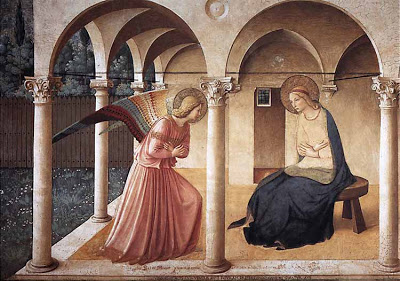
The Annunciation -Fra Angelico

The Annunciation
-Fra Angelico

As we approach the Nativity of our Blessed Lord, Jesus Christ, it is good to take up the doctrinal realities and teachings on the Virgin Birth, as it is the second great jewel in the crown of the Deipara. (NB: Deipara is the classical Latin theological term which translates the Greek Θεοτόκος, and is used in theology as opposed to Dei genitrix, which is normally used in Liturgy). We will proceed by unfolding three Theses of this doctrine and their proofs, namely that Our Blessed Lady was a virgin a) before birth  b) during birth  c) after birth. While c was historically denied by many protestants, in modern times both a and b are denied, even by some claiming to be Catholic.

Thesis I
Maria purissima virgo ante gignentem Christum fuit. (De fide)
(Mary was a pure virgin before the birth of Christ)

This part of the doctrine holds that the Mary was a virgin from her beginning and through the moment when the archangel St. Gabriel was sent to announce to her the mystery of the incarnation. This should be logical, since in terms of effects if this were not the case, it would be very hard to prove that Jesus was the incarnate God as opposed to having his origin in some man. Therefore it is one of the first and obvious places to attack if one were going to disprove the Incarnation, validating the principle that authentic Mariology lays the foundation for authentic Christology.

Scriptural Proof Continue reading

The Immaculate Conception and the Orthodox Tradition

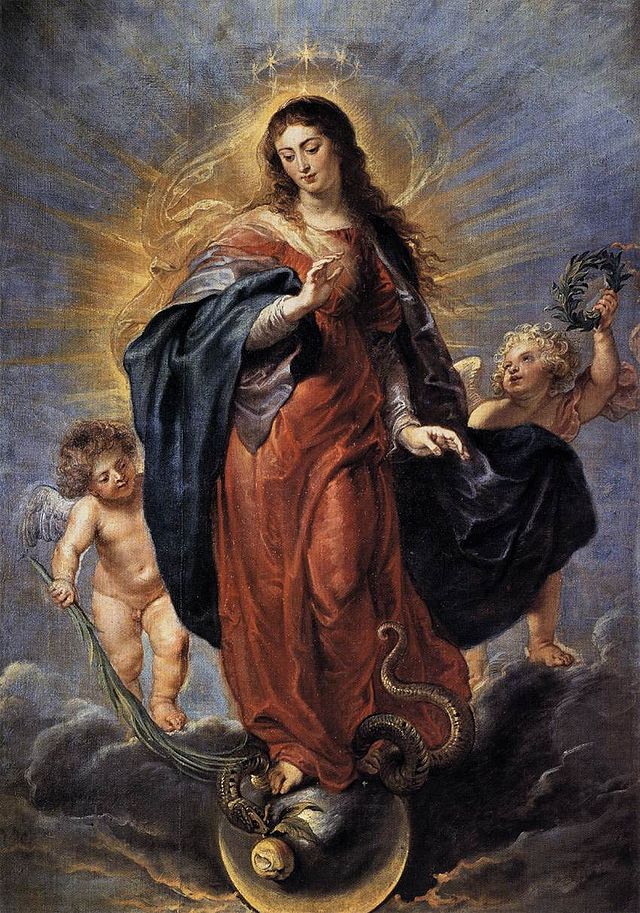
The Immaculate Conception -Peter Paul Rubens

The Immaculate Conception
-Peter Paul Rubens

The Immaculate Conception was formally declared as a dogma of the faith by Bl. Pope Pius IX in 1854 by a Solemn Definition with his document “Ineffabilis Deus“. Some people have gotten the idea that this came out of the blue, as it were, and elevated an old dispute into an article of faith, or created the liturgical celebration of it. This is actually not the case. Continue reading

Now is the hour to rise from sleep

I will salvage something from the Advent and Christmas sermons of St. Robert Bellarmine, which I announced just the other day will not be out this year, due to focusing on his other works. What follows is his sermon from the first Sunday of Advent, posted today to give place to the celebration of St. Andrew yesterday (as well as that I would rather not post on Sunday). NB: When he says briefly in the first line, that is to be taken in a 16th century sense of “brief”.

Sermon on the Epistle for the First Sunday of Advent
Given at the university of Louvain, 1571 (to the students)
Concio II (Opera Omnia)
St. Robert Bellarmine,
Doctor of the Church
Translated by Ryan Grant (see creative commons license for all questions about copying and citing)

Now is the hour we rise from sleep: now indeed, our salvation is nearer than when we believed. -Rom. XIII.

St.Robert-Bellarmine-2We will briefly explicate this beginning of today’s Epistle, by the Lord’s help: that which, in fact, is lead into one end according to the sense of the Apostle, but is adduced to another end by the Church; to be sure it has been proposed and also fittingly established. But what was proposed by Bl. Paul when he wrote, “Now is the hour we rise from sleep: now indeed, our salvation is nearer than when we believed”? The blessed Apostle wrote to the Romans, and also wished to wake them from the sleep of sin and from negligence, but he uses two arguments to carry this out, the second of which is from a due season; the other was taken up from the proximity of the end. How, indeed, if we should wish to wake someone, wouldn’t we say to him, “Hey you! Wake up!, it is time. For the dawn appears.” But what if he should be such a man from that lot which does not care much whether dawn should appear, but rather gladly sleeps until noon, then wouldn’t we say to him: “Hey you! Get up! The time is at hand to carry out a great business – namely lunch.” The Apostle Paul first exhorts the Romans in the same manner, that they should rise, because it is the hour of rising, for “Night has passed, and moreover, day approaches.” Therefore, because the time of that great meal, which is made in heaven, is near,: “Now indeed, is our salvation nearer, than when we believed.

Continue reading

St. Thomas on what to do if a member of the magisterium errs

thomas_aquinas_larger

Bene scripsisti de me, Thoma

“Because, as a man ought to obey a lower power in those things only which are not opposed to the higher power; so even a man ought to adapt himself to the rule in all things according to its mode; on the other hand, a man ought to adapt himself to the secondary rule in those things which are not at variance with the primary rule: because in those matters in which it is at variance, it is not a rule:

On that account, one is not to give assent to the preaching of a prelate which is contrary to the faith since in this it is discordant with the primary rule. Nor through ignorance is a subject excused from the whole: since the habit of faith causes an inclination to the contrary, since it teaches necessarily of all things that pertain to salvation.”1

Continue reading

Preface to De Romano Pontifice

In case anyone is wondering why I am not posting more regularly, it is because I have been hard at work on translating De Romano Pontifice. Today I am sharing an update, which I already placed on the go-fund me site, which is the full preface to the work.

It is still a work in progress, and the punctuation will be off, since when translating its natural to render the punctuation as you see it, then go back later and fix it. This isn’t so much to establish that I can do it for anyone I’m hoping will donate, as to give a preview of the work for those who have already donated (although if someone is on the fence about donating, I hope this convinces him of the former). You can read the preface here.

Aude Sapere 007 – The Bellarmine Project

Augustine_of_Hippo_Sandro_Botticelli

Download            Play in New Window

Today we talk about new publications I’m working on for Mediatrix Press, as well as the importance of the Bellarmine Project. Continue reading

St. Robert Bellarmine on judging a Pope

There are a lot of comments going about the internet attacking Cardinal Burke for his criticism of Pope Francis. Now in reality, Cardinal Burke’s criticisms have been mild, always minimizing Francis’ damage. Some have gone so far as to call Cardinal Burke Schismatic.

I wonder what they would have said about St. Robert Bellarmine, saint and Doctor of the Church, who said the following (to my knowledge, this has never been rendered into English before.

St. Robert Bellarmine makes an interesting comment in the famous chapter of De Romano Pontifice where he discusses the question of the loss of Papal office. It is in the article immediately before the one sedevacantists frequently use, namely in De Romano Pontifice, Bk II, Chapter 30:

“The third opinion is on another extreme, certainly, that a Pope cannot be deposed either through secret heresy, or through manifest heresy. This recalls and refutes Bishop Turrecremata (loc cit) [Bellarmine is noting in the previous point, citing this Bishop, where he rejects that a secret heretic can be judged] and certainly is an improbable opinion. Firstly, that a heretical Pope can be judged, is expressly held in Can. Si Papa dist. 40, and with Innocent III (serm. 2 de consec. pontif.) And what is more, in the 8th Council, (act. 7) the acts of the Roman Council under Pope Hadrian are recited, and therein contained, that Pope Honorius appears to be justly anathematized, because he had been convicted of heresy, which is the only reason permitted for inferiors to judge superiors. It must be noted, that although it is probable that Honorius was not a heretic, and that Pope Hadrian II was deceived from corrupt examples of the VI Council, and Honorius was reckoned falsely to be a heretic, nevertheless we cannot deny, in fact Hadrian with the Roman Council, nay more the whole 8th general council had sensed, in the case of heresy a Roman Pontiff can be judged. Add, what would be the most miserable condition of the Church, if she would be compelled to acknowledge a manifestly prowling wolf for a shepherd.”