Tag Archives: Theology

St. Robert Bellarmine Translation project

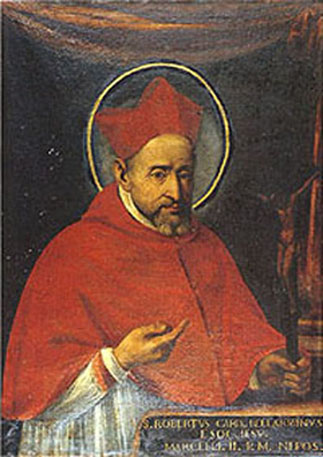
StRobertBellarmineI am currently raising money to translate St. Robert Bellarmine’s works into English (works which have never been in English). This is a daunting task and requires my full time energy. It also means acquiring the funds to pay for bills and food while doing this. So this is why I have decided to raise the money to maintain myself translating. The formal site is here.

Bellarmine is one of the most important theologians since the Council of Trent, and in the manuals on nearly any discipline Bellarmine is the most frequently cited (except in morals where St. Alphonsus is more commonly cited). Bellarmine lays down principles in theology, solves problems, and heavily quoted the objections of the contemporary Protestants. He was hugely fundamental to the work of Vatican I, and an opponent of absolutist monarchy. It is one of the tragedy’s of the loss of Latin in our educated culture that Bellarmine is not accessible to most, even to bright individuals. The goal of the project is to change that.

Continue reading

Aude Sapere 006 – Meet Archbishop Bruno Forte

Download                       Play in New Window

bruno_forte

Today on the Aude Sapere podcast, we will take a look at the author of the “homosexual passages” of the Synod’s mid-term report which have predictably rocked the headlines around the world. Continue reading

Vermeer: Christ in the House of Martha and Mary

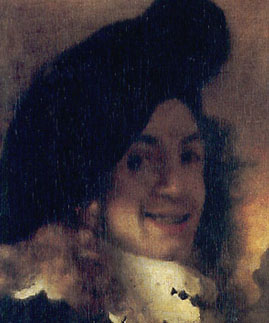
Jan Vermeer, Self Portrait

Jan Vermeer, Self Portrait

I have mostly covered art in Italy, and for good reason, Italy is seemingly unbeatable. Yet, there is another art tradition, whose Renaissance predates Italy’s, that might be the sole rival in classic European oil painting, and that is the Netherlands.

Previously, I talked a little about Rubens (here), but today we are going a little more north. While Rembrandt was trying to retrench himself in Amsterdam’s Jewish quarter, another artist was making his mark on Dutch history.

Jan Vermeer is a curious artist. Dutch, but Catholic, of moderate impact in the art market, yet remembered for his characterizations of Dutch life. In the case of Rubens we could say he is distinct from Rembrandt by his southern Flemish style, or his adherence to the Catholic faith, his vibrant colors, as opposed to Rembrandt van Rijn’s darker views, personal rather than mythological subjects, etc. But ultimately the difference between Rubens and Rembrandt is that Rubens gave the clients what they wanted, Rembrandt painted what he saw, the light of truth without the social graces to touch it up, and increasingly he displeased clients, most famously in his revolt of Claudius Silvius, originally destined for Amsterdam’s town hall. That same difference can be placed between Rembrandt and Vermeer. Vermeer knew how to paint to please his clients.

Interestingly, if we look back to what we said about artists previously, we noted that:
a) artists were craftsmen, who sometimes arose to a more noble bearing working for royalty, particularly in the 17th century
b) other artists where highly charged with political or philosophical ideas and made social and political commentary, as well as ending up in court frequently and are thus celebrated by modern art, albeit only in so much as they start the road to the collage of insanity that sells for millions in London, Paris and New York.

Therefore more has been written on Rembrandt than perhaps any other artist, even more than some who have made big come-backs recently such as Caravaggio or Tiziano. So while Vermeer’s art doesn’t hit the top, it is still fascinating for the techniques he uses with his brushes to capture the idea of what he is getting across. Obscure after his death (there were bigger things to worry about for a while, as we shall see), he was rediscovered in the 19th century and ranked among the masters of the Dutch Golden Age.

History

Lapis L'Azuli This stone, coming from Afghanistan, would be hammered down and purified into a blue pigment, and provides for the rich color blue in western art from the 14th century onwards.

Lapis L’Azuli
This stone, coming from Afghanistan, would be hammered down and purified into a blue pigment, and provides for the rich color blue in western art from the 14th century onwards.

It is not known precisely when Vermeer was born, but we do know he was baptized in the year 1632, into the Dutch Reformed Church in the city of Delft. This suggests he was already a few years old, between 8-10 by the Calvinist practices of the time. His father was part of the St. Luke’s guild and operated an art dealing business. It is certain that Vermeer was schooled in art, for, though there is no record of his having been abroad, nevertheless in later life he was one of two men in Delft who was considered an authority to identify Italian paintings. It is not known, however, at what point he took up active painting, but he appreciated bright colors, expensive pigments like lapis lazuli, and as a member of the St. Luke’s guild himself, he was influenced by the Antwerp school of art (Rubens, Caravaggio, etc.). It is perhaps Rubens’ influence that accounts for Vermeer’s use of bright colors, and the influence of Caravaggio’s works that accounts for Vermeer’s use of light and shadow. Yet, like Rubens, Vermeer takes what he found useful from other artists without becoming slavishly devoted to that style, like the networks of Caravaggisti. What Vermeer does well is the sacredness of ordinary things, which is fully within the Dutch spirit.

Holland’s art market at that time was an anomaly when considered in the context of the west of Europe. Normally painting was the provenance of the wealthy, and the trend was for artists to be increasingly noble, or at least seek knighthoods and honors. Baglione, the great rival of Caravaggio, was awarded a golden chain for his talents and was highly respected in his time (except of course, by Caravaggio). Bernini was made a Papal Knight, while his rival Borromini was made a knight of the Holy Cross. Valesquez was knighted by Philip IV of Spain, as was Rubens, who was also knighted by Charles I of England. Rubens’ pupil and later colleague, Van Dyck, was knighted by Charles I, and Jan Breughal, the son of Peter Breughal, received a title of nobility. The trend was nobility, the clients of artists were nobility, the Church, and though there was great competition for artwork, the majority of works were meant for the public to see in a set place, like a Church, to be the focal point of the community, centered around religion.

The problem of the nascent Dutch Republic is that it had no public religion. The great Churches were defaced, and they did not want art in their Churches, because that was to them idolatry. But, of every day things? Thus the Dutch began a celebration of their culture, which was at its height as a world power, and whose navy easily outnumbered Spain, France and England’s navy combined. The order of the day was to celebrate Dutch culture, but the problem was the number of artists far exceeded the demand, so figures like Frans Hals, or Rembrandt had their boom moments when people could not get enough of them, and their bust moments when people had seen enough. So what about Vermeer?

The Jesuit Church on Oude Langendiijk, Delft

The Jesuit Church on Oude Langendiijk, Delft

Vermeer married a Catholic girl in Delft named Catarina Bolnes in 1653. Her mother Maria Thins required of Vermeer that he become Catholic in order to marry her, and he did so. It is not entirely clear if at first he converted out of conviction or for the girl, but what is certainly clear is that once he had done so he became quite serious, and his art shows this in many ways. His new mother-in law was also considerably wealthier than Vermeer, allowing him the freedom to paint in exchange for a little work in her business. It is often thought that Vermeer painted for the schuilkerk, or secret Church, which was not far from his home in Delft and was run by the Jesuits. Much is made of the Dutch Republic’s famous ‘religious toleration”, but in point of fact it was a sporadic and uneven, depending upon the province. So while Haarlem offered full religious toleration, Amsterdam and Delft were more restrictive. The Mass was illegal in Amsterdam, for example, until the 19th century, but tolerated since a majority of the city’s population was Catholic well into the 17th century. Thus one famous schuilkerk was the Ons’ Lieve Herr op Solder (Our Lord in the attic), which served Catholics for 200 years. Delft was no different.

The Painting

Jan_Vermeer_Christ_in_the_House_of_Martha_and_MaryChrist in the House of Martha and Mary was painted in 1655-56, shortly after he was married. It is one of the earliest works to survive, and it is his only painting that is overtly on a religious theme. (In the future we’ll look at some other ones that recall biblical themes). The circumstances of the painting are not known, but it is thought to have been commissioned for a Church, possibly the schuilkerk in Delft. It is now in the National Gallery in Edinburg, Scotland.

Tintoretto_christ-in-the-house-of-martha-and-mary

Christ in the house of Martha and Mary -TintorettoThe thrust here shows Martha rebuking Mary, as opposed to Vermeer’s image of the two working together.

One of the things we see is the placement of the characters. We have the conforming of the biblical narrative, with Christ seated and Mary Magdalene at his feet, but what is unique about this piece is Martha’s placement. Older images of this scene show Martha a pace or two back, calling out for Mary Magdalene to do something. This takes a different approach, and Vermeer shows off his theological sophistication.

Martha is not here voicing her complaint about Mary’s seeming inaction, when in fact she is in contemplation of Christ. Instead Martha is assisting and contributing to Mary’s action. The placement of Martha next to Mary and Our Lord is meant to show the unity of Faith and Works, with Mary representing the former and Margaret the latter. The reason older artists treating this scene, particularly in the Italian renaissance, would not have considered it important to include Martha and Mary together was that the reformation hadn’t happened, or else wasn’t an issue (or you took the other view, such as in anti-papal Venice). Tintoretto’s Martha rebukes Mary, while Vermeer, a Catholic living in a country where Catholicism is against the law, and the official view of the majority of those in government, as well as in Delft, a Calvinist town has the false notion of faith and works to contend with. The Dutch cultural scene emphasizes work, but outside of its context of faith. Vermeer draws a complete union between the two, as culminating in the blessed Sacrament.

Jan_Vermeer_Christ_in_the_House_of_Martha_and_Mary_detailLook at that loaf of bread. This is not just the fruit of windmills grinding flour, this is a symbol of the Eucharist, as the fruit of faith and works. Notice the lines of symmetry, a technique from Italian baroque painting that Vermeer employs several times. If we follow diagonally from the bottom left, we arrive at Christ’s hand, which is in many ways the key to the painting, since it occupies the central place if we draw a diagonal line from any side. Yet here should begin from the left, for in doing so we come not merely to Christ’s hand, but even more to his index finger and thumb. Immediately above the these two fingers we find the bread. These are also a priest’s consecration fingers, and so the Eucharistic symbolism could not be more clear.  By faith and good works we live a life by which we can partake of the Eucharist, which is the fruit of a work, united to faith, effected by Christ acting in the person of the priest.

While our Lord is depicted in traditional Holy Land attire, Martha and Mary are dressed like Dutch maidens, one who could be expected to embroider in the parlor, and the other working in the kitchen. It is a device to merge the ancient with the modern into one fabric, that Christ is relevant today, or, we might say contrary to certain churchman, the Gospel is relevant today. It might also be a criticism of others who name their home “St. Martha’s” to emphasize works over faith, as certain people today do, though we won’t name them. Thus, a commentary on faith and works is set perfectly in the context of Dutch art of the golden age.

Epilogue

Vermeer had limited success and seems to have been happy to work for a limited number of clients. In 1672 he went mad, and his life went down hill, until he at last died in 1675, leaving his wife and children with debts. Immediately he was more or less forgotten, until the 19th century when he was rediscovered. Part of the reason for this, and why he went mad in 1672, is because that year was the catastrophic year for the Dutch Republic, which was a world-wide empire. The French and English signed the treaty of Dover (although it was secret in England), by which Charles II promised to help Louis XIV at sea, and convert to Catholicism, while Louis supplied him a subsidy and invaded the Dutch Provinces. William of Orange ordered all of the dykes and levies broken, so that the ocean would flood the countryside and halt the advance of the Dutch troops. It did that, but at a cost. Fortunes and livelihoods were ruined, Vermeer’s savings were wiped out, and even his mother-in-law was going down financially, as were many people all over the country. Thus in the aftermath in 1675, the Dutch had forgotten about many more recent painters, as they were trying to survive the tragedy.

We will look more at Vermeer in the future.

Doctrinal Treatise on the Assumption

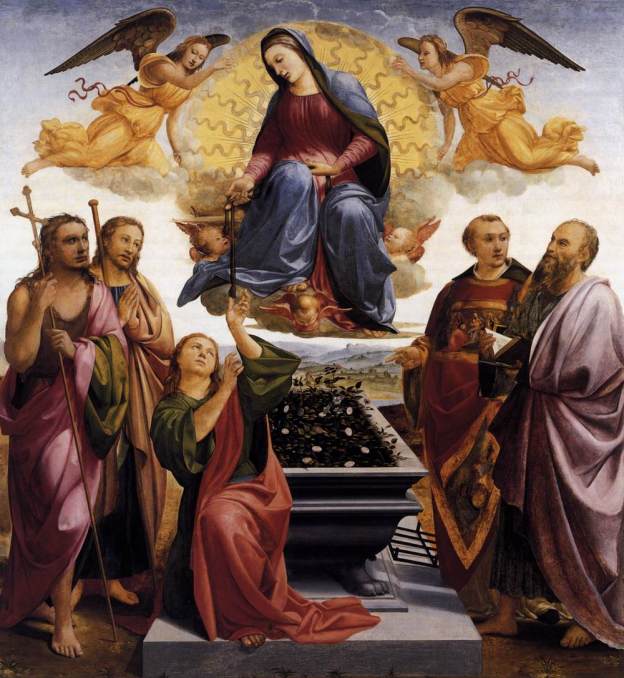
The Assumption, Granacci

Originally Published 15 August, 2010

The Assumption of the Blessed Virgin Mary is a dogma of the Catholic faith, solemnly declared as a dogma ex cathedra by Pope Pius XII in the document Munificentissimus Deus on 1 November 1950. This Dogma teaches formally that Mary, was assumed, body and soul into heaven at the end of her earthly life and that her body did not suffer corruption.

This dogma is among what are called the “negative prerogatives” of the Blessed Virgin, because they are lacking a certain defect. As the Immaculate Conception lacks original sin, so the Assumption lacks bodily corruption. We see also a strong connection between this doctrine and the Immaculate Conception which was also solemnly declared ex cathedra by the Pope, whereas the other Marian dogmas were confirmed by early councils. Pope Pius XII taught in his solemn definition:

“And, although the Church has always recognized this supreme generosity and the perfect harmony of graces and has daily studied them more and more throughout the course of the centuries, still it is in our own age that the privilege of the bodily Assumption into heaven of Mary, the Virgin Mother of God, has certainly shone forth more clearly.

That privilege has shone forth in new radiance since our predecessor of immortal memory, Pius IX, solemnly proclaimed the dogma of the loving Mother of God’s Immaculate Conception. These two privileges are most closely bound to one another. Christ overcame sin and death by his own death, and one who through Baptism has been born again in a supernatural way has conquered sin and death through the same Christ. Yet, according to the general rule, God does not will to grant to the just the full effect of the victory over death until the end of time has come. And so it is that the bodies of even the just are corrupted after death, and only on the last day will they be joined, each to its own glorious soul.

Now God has willed that the Blessed Virgin Mary should be exempted from this general rule. She, by an entirely unique privilege, completely overcame sin by her Immaculate Conception, and as a result she was not subject to the law of remaining in the corruption of the grave, and she did not have to wait until the end of time for the redemption of her body.”[1]

Moreover, the Fathers at the First Vatican Council, beseeched Bl. Pius IX for a solemn definition by drawing the same theological link with the Immaculate Conception in the Protoevangelium (which is Genesis):

“According to the Apostolic teaching [recorded in Rom. V,8; I Cor. XV, 24, 26, 54, 57, Heb. II, 14, 15 and other texts] when Jesus triumphed over the Ancient Serpent (Satan) He gained a threefold victory over sin and its effects, i..e concupiscence and death. Since the Mother of God is associated in a singular manner in this triumph with her Son, (Gen. III:15), which is also the unanimous opinion of the Fathers: we do not doubt that in the aforementioned [Scriptural] passage this same Blessed Virgin is pre-signified as illustrious by that threefold victory: over sin by her immaculate conception, over concupiscence by her virginal motherhood, and in like manner over hostile death by a triumphant resurrection similar to that of her son.”[2] In fact, had it not been so, as the theologian Joseph Pohle makes the observation that death would in fact have triumphed over Mary had she suffered bodily corruption.[3] Mary triumphs rather with her Divine Son and through His redemptive work over death completely.

The Death of the Blessed Virgin

While the dogmatic definition of Pius XII teaches that Mary was assumed body and soul into heaven, it does not teach explicitly on the manner by which Mary died. So the discussion about the death of the Blessed Virgin is not subject to the dogmatic definition per se. Based on this there are certain theologians who run around today saying that because Pius XII did not specifically address the manner of Mary’s death, that there is no proof that Mary died and thus claim she is immortal. At the time of the definition there were likewise some who pointed to it as proof of there position. The first one known to have suggested Mary’s immortality is St. Epiphianus, yet he does not deny it either and as Cardinal Baronius suggests, he was merely defending Mary’s virginity against impious heretics by saying Scripture does not even say if she died. There were some 4th century traditions holding to Mary’s immortality, and more recently the theologians Roschini and Gallus (pre-Vat.2) advocated this position. Roschini maintained, that since Munificentissimus Deus makes no mention of the death of the Blessed Virgin, the number of those holding to Mary’s immortality will increase.[4]

This is not the case however, as the common opinion of the Church provides a moral unanimity that Mary in fact died, and that those who claim otherwise actually deny the teaching authority of Tradition. The reason is, as Alastruey notes is that “[it] is immediately connected with the revealed truths concerning original sin and the general economy of the redemption of the human race. Therefore the question of the Virgin’s death is not a matter of opinion nor a pious belief which can be disputed freely; it is a firm and consistent teaching which should be venerated for its antiquity.”[5]

Moreover St. Ephrem (doctor of the Church) states explicitly that Mary was a virgin all her life and died a virgin. St. John Damascene points out that as her son did not refuse to die, neither did she. St. Andrew of Crete “She who made heavenly the dust of the earth laid aside the dust of the earth; she put aside the covering which she received through generation and returned to the earth what is of the earth.” St. John of Thessalonica says that the all-glorious Virgin Mother of God, after spending some time with the apostles until they by command of the Holy Ghost, had spread throughout the world to preach the gospel, left the earth by a natural death. St. Modestus of Jerusalem gave his first sermon on the death of the Blessed Virgin.[6] The Greek word used to describe the Assumption is κοίμησις, which means literally “falling asleep” and when used with reference to the end of someone’s life, as in English (eternal rest) it means death. This word not only appears in the Greek liturgy but is used by all the Greek Fathers to speak of the Assumption.

Furthermore, most theologians teach that Mary did in fact die. Merklbach calls it a certain teaching, lest the mother should be seen as greater than the son.[7] The Theologians Billuart and Novato treat the death of the Virgin as certissima.[8] Most other theologians, particularly Roman Theologians who treat the subject concur.

Moreover, Mary’s death is affirmed by the ancient liturgy of the Assumption in the Roman missal, which reads: This festival of the day, O Lord, being venerable to us, on which the holy Mother of God suffered temporal death, but still could not be kept down by the bonds of death who has begotten Thy Son our Lord incarnate from herself.”[9] An 8th century chant from the Chaldean Church likewise affirms: “Admirable in her mortal life, marvellous in her life-giving death, living she was dead to the world, dying she raised the dead to life. The apostles hasten to her from distant lands, the angels descend from on high to pay her honour due.”[10]

Yet, if Mary did in fact die, does this not mean that she was subject to original sin in some manner? No it does not in two ways. Firstly, Mary did not suffer corruption, so that if there was a temporary separation of body and soul, (the matter of death) her body did not rot in the grave, but as Our Lord’s remained inviolate so that when her soul reunited with it she was assumed straight to heaven. Secondly, though it was not necessary for Mary to die at all, since not being conceived with original sin, she was not subject to its affects, it was fitting.

Merklbach teaches further in his work on Mariology that: “Christ voluntarily subjected himself to the law of God commanding death, and also by his suffering and death redeemed the human race from sin, Mary also, having cooperated in the work of redemption, ought to, as Christ, suffer and die and also subject herself to the command of death.”[11] St. Albert the Great taught that Mary died from a longing of love so powerful that she could not bear separation from her Son and Saviour. While the exact manner of the death is unkown to us, it is clear that Mary did in fact die, and this death was completely fitting since it modeled the path our Lord took also.

The Dogma in Tradition

Sometimes Catholics who have no grasping of the Tradition will assert, as it is sometimes done for the Immaculate Conception, that there was no doctrine of the Assumption or no Mass for it and that the Pope just declared it ex cathedra. I once met a priest who argued that we could create new masses, after all there wasn’t a Mass for the Immaculate Conception or the Assumption prior to the dogmatic definitions. This however could not be further from the truth. In fact, some object to the dogma (including Protestants) claiming that since it was only declared in 1950 it can’t really be of tradition.

This dogma is not only very old liturgically, it is of ancient origin. Though good theological arguments can be presented in favor of this doctrine, it is primarily in Ecclesiastical Tradition that we have the most verification of the truth of this doctrine outside of the Solemn Definition of Pius XII.

East and West Fathers and Doctors of the Church supported it, from the 5th century on to the present. In the beginning there were several apocryphal stories, one which is most famous being that of Pseudo-Dionysius who claimed that all the apostles had gathered for Mary’s death, and the Church denied the authenticity or even condemned some of these over time. Yet, the continual faith in the Assumption has continued east and west in unbroken succession since the 5th century, which helps to prove that the sensus fidelium was not based on the apocryphal legends since it persisted when their authenticity was called into doubt. In the 6th century the Eastern Emperor Maurice had ordered the feast of the κοίμησις to be celebrated each August 15th in Constantinople, and just as so many Eastern Fathers (most notably St. Andrew of Crete and St. John Damascene) have preached in favor of the Assumption, so the Eastern Church even out of communion with Rome has maintained this feast. In 1672 at Jerusalem the Orthodox Churches confessed in a council “Though the immaculate body of Mary was locked in the tomb, yet like Christ, she was assumed and migrated to Heaven on the third day.”[12] St. Gregory of Tours had taught “The Lord commanded the Holy Body of the Blessed Virgin to be borne on a cloud to Paradise, where, reunited to its soul, and exulting with the Elect, it enjoys the never ending bliss of eternity.”[13] The writings in the East of St. Sophronius, St. Andrew of Crete, St. Fermanus and most preeminently St. John Damascene serve as foundational witnesses in the East, while this doctrine flowered in the West through the Latin Fathers and theologians, decoratively adorned in all the Western Liturgies, and wonderfully attested to in Pius XII’s document examining the Tradition on Our Lady’s Assumption. This is a sign for us that even when the Pope speaks ex cathedra, he is not making new doctrine, neither does he recklessly declare the opinion of the day, but prudently and eruditely examines all the factors, histories, traditions etc, and Pius XII shows us this in Munificentissimus Deus where does not cite only the theological arguments such as that presented at Vatican I, no matter how good it is, he carefully went over the whole tradition, because we are not a Church of the theological opinions in sway today, but a Church of tradition which believes what has always and everywhere been believed by those professing divine and Catholic faith.

[1] Munificentissimus Deus, nos 3-5

[2] Quum iuxta apostolicam doctrinam {Rom. V, 8; I Cor. XV, 24, 26, 54, 57; Heb. II, 14, 15) aliisque locis traditam triplici victoria de peccato et de peccati fructibus: concupiscentia et morte veluti ex partibus integrantibus constituatur ille triumphus, quem de satana, antiquo serpente, Christus retulit, quumque Gen. III, 15 Deipara exhibeatur singulariter associata Filio suo in hoc triumpho accedente unanimi SS. Patrum suffragio: non dubitamus quin in praefato oraculo eadem B. Virgo triplici illa victoria praesignificetur illustris adeoque non secus ac de peccato per immaculatam conceptionem et concupiscentia per virginalem maternitatem, sic etiam de inimica morte singularem triumphum relatura per acceleratam ad similitudinem Filii sui resurrectionem ibidem praenuntiata fuit. (Collec. Lacensis, vol. VII, pg. 869)

[3] Pohle-Preuss, Mariology, pg. 114)

[4] Roschini, Il Problema della morte di Maria SS. Dopo la constituzione dogmatica Munificentissimus Deus

[5] Alastruey, The Blessed Virgin Mary, vol. 1, pg. 253

[6] Encomium in B.V; PG, LXXXVI, 3280

[7] … “B. Virgo fuierit morti subjecta, ut Filio suo conformaretur, nec Matris potior quam Filii conditio videretur.” Merklbach, Mariologia, pg. 266

[8] Novato, De eminentia Deip. Virg. Mariae, II, c.8; Billuart, De myst. Christi, diss. 14, art1-2

[9] Veneranda nobis, Domine, hujus est diei festivitas in qua sancta Dei genitrix mortem subiit temporalem, nec tamen mortis nexibus deprimi potuit, quae Filium tuum Dominum nostrum de se genuit incarnatum.” (Migne, P.L., LXXVIII, 133)

[10] Gureranger, The Liturgical Year, vol. 13, pg. 388

[11] Christus voluntarie debebat se subiicere legi Dei mortem statuenti, atque passione sua et morte genus humanum a peccato redimere, Maria quoque, in opere redemptionis consociata, sicut Christus debebat pati et mori, atque mandato mortis se subiicere. Quod fecit consentiendo in hoc quod esset mater Dei-Redemptoris, Merklbach, Mariologia, pg. 267-268

[12] Pohle, Mariology pg. 116

[13] Dominus susceptum corpus sanctum in nube deferri jussit in paradisum, ubi nunc resumpta anima cum electis ejus exsultans aeternitatis bonis nullo occasuris fine perfruitur. Migne, P.L., LXXI, 708)
The Glory of Small “t” Tradition

One of the most disturbing things to me is the belittling of “t” Tradition by virtually every neo-conservative apologist. There is a current which runs in the neo-conservative mainstream to downplay the importance of the little traditions. This is done primarily when they incorrectly define them. One will say “Big ‘T’ Tradition stays the same always, and is of the utmost importance, but small ‘t’ Tradition is here today and gone tomorrow. It is not important and we shouldn’t get wrapped up in it.”

This is basically the position of the so-called mainstream of defenders of the New Rite, separated from historical Catholicism by the modernism pervading the Church since the Council. In a minute I will define what I mean by historical Catholicism.

Now, let us take a proposition, such as I have continually advanced, and will advance until I am put to death, that the Novus Ordo is inferior to the Traditional Rite. As soon as I say such a thing the aforementioned will claim that I am propagating a heresy. They will say that you can not say one Mass is better than another, Tridentine, novus ordo, Divine Liturgy are all fine and good and all equally pleasing to God. It doesn’t matter how we wrap the essentials, etc. etc. etc, blah blah blah. Boo hiss!

First of all, this is something which I would consider contrary to Catholic liturgical theology, namely minimalism. It is purely the minimalist approach to liturgy, and this is where the denial of small “t” Tradition flirts openly with heresy. It is the small “t” which protects, defends, reinforces and teaches the large “T” tradition. While it is technically true that you can eliminate the small “t” tradition and maintain the integrity of the faith, when you do eliminate it the faith begins to disappear. This is because man is not a pure spirit, he is a body soul unity, how the faith is presented to man determines the manner in which he receives it. We all accept that bad preaching, bad style, bad demeanor of the presenter can present a barrier to how one receives the grace of the Gospel. Almost any neo-con will accept that. However, be that as it may, when it comes to the liturgy they suddenly reject it. It suddenly doesn’t matter that a hideous neo-teric chalice is used in place of a beautiful Gothic chalice collecting dust in the sacristy, or crappy polyester vestments are worn with rainbows and/or hideous art on them. The apologists will tell us well, it isn’t the best, but it is still Jesus.

I just want to take them by the neck and say get a hold of yourself man with a thick Scottish brogue! What does a cheap polyester vestment say about the faith? How does it cheapen the faith? How does a glass wine claret used for sacred Communion weaken belief in the real presence?

Secondly, the main objection, that all liturgy is the same, fails to distinguish between the intrinsic nature of a thing, and its extrinsic nature. If we are speaking Intrinsically, then of course any valid Mass, that is a Mass which gives adoration to God the Father by making represent the one sacrifice of Calvary in an unbloody manner at the hands of the priest, is in fact the same. You can not have a valid Mass which is intrinsically evil, since the main object of the Mass, to offer adoration to God, is impossible. Yet the intrinsic is an inadequate dimension by which to judge liturgy in its totality, and to reduce it to such is minimalism which would be detestable to every age of Catholics until 1965. We must also consider liturgy offered in an extrinsic manner. What is the extrinsic? If the intrinsic refers to the liturgy in itself and what it accomplishes ipso facto, then the extrinsic is the manner in which it is accomplished.

A Tridentine Mass is offered, but rubrics are intentionally broken, portions of the liturgy are skipped wholesale, etc. Intrinsically, if you had a valid consecration, you had a valid Mass which accomplished its aim. Extrinsically, it is not as good and does not communicate as much grace as the same liturgy where the ceremonies are said correctly. Let us take another example: a liturgy said by heretics and schismatics with valid orders. Such a liturgy is said outside of communion with the Church and technically wrong. That impedes grace. Let us even take a Novus Ordo celebrated with obscene abuses. There is no shortage of idiots who will insist that there is no difference between that and a “reverent” novus ordo (which as far as I’m concerned is an oxymoron), because if done validly “Jesus is there”. Even if that is true, the grace which He imparts through the sacrament is impeded, it is not as powerful as one celebrated in union with the Church’s intention. Now there is yet another consideration to make, whether the rites in the Traditional Liturgy are more dignified and coming from apostolic tradition, better impart the faith than a liturgy created by a committee of left leaning priests and bishops in the late 60’s completely from scratch? I’ve never seen anyone try to claim that the new liturgy imparts more ritual than the old. Even if they were, a simple reading of text and rubric would smash such an argument.

Lastly, there is also more scripture found in the ordinary of the Mass in the Traditional Liturgy, the propers contain more scriptural usage all with their own chants, and essential teachings on sin, repentance and hell are not optional. Rituals call to mind the Jewish offerings of sacrificial animals, bringing sacrifice to the forefront, they represent Christ burdened with the sin of the world, and unmistakably condemn modern theology. The rites and the meaning they embody are superior to the Novus Ordo in every way, and consequently it is a better Mass in terms of the grace it imparts.

Some people will still say, “I like the Novus Ordo better”. Well there is nothing I can say about that, because what people like is subjective and not governed by objective principles of beauty and meaning. Some people like modern art, some people like rap music. To me it is all basically the same thing. If you look at the normal person at the Novus Ordo, not the exceptional case, you find people whose liturgy tells them nothing about the doctrine of Catholicism, but is tailored to make them feel good. Even in the Latin, if you have someone who understands Latin. If you look at the normal person at a Traditional Mass, not the exceptional case, you will find someone who at the very least understands what the Church teaches on major issues concerning his salvation, on his responsibilities toward his neighbor, and on the presence of his God at his liturgy. Every liturgical sign points to it, the kneeling, the adoration, the incense, the multiple signs of the cross, the reverence and beauty of everything required for each celebration. Small “t” tradition protects so-called big “T” tradition, and wherever the former is protected, the latter is upheld. Look at the eastern Catholic Church in our midst. The same cultural problems affect them which affect us, the same secularism, the same throw away culture, but not the same loss of doctrine and reverence for the Eucharist. Why? Because they have small “t” Tradition protecting their Apostolic Tradition.

This all brings me back to the original point of this post, namely what is that historical Catholicism which modern apologists seem disconnected from? It is characterized by a universal expression of “t” Tradition which had guarded and protected the true faith for over a thousand years. Very few real traditions had actually changed in that time, and for good reason, they protected the faith. People in every country were familiar with the universal “t” Tradition, whether French, or German, or Polish or Italian, or English, or Spanish, there was a universal “t” Tradition that was common to them all. The same was true of the Eastern Churches, and a Latin Rite observer could have seen the same traditions in the Eastern rite, even if they had a different form from the West.

I have read people claim they are not part of a “bloggersterium”, that they follow the Pope. I wonder if they would acknowledge the danger from the “apologeticsterium”? Let us look seriously. Who lives or dies by what someone writes on a blog? If anyone does he is an idiot. But there are people who conform their worldview to what this or that apologist writes. Consider those who remained completely in favor of the Iraq war, just as the mainstream of neo-conservative apologists were, when their hero, John Paul “superstar” condemned it? You get a situation where I, one of the late Pope’s critics, agree with him, and your ever faithful apologists opposed him! Yet no claims of disobedience arose, and when confronted with it they will ignore you or say they just cut the Pope some slack by not criticizing him. Seriously, is that not private judgment? To decide that the Pope’s consistent and impassioned pleas against the war have no merit because we trust our elected leaders? The same ones who enabled abortion contrary to the late Pope’s message of a gospel of life?

On the whole, I am perfectly willing and happy to acknowledge where apologists have done good, or even great work. Yet the ministry of lay apologetics is precarious at best. They are filling a void which our Bishops and Priests ought to be filling in terms of real and true teaching, but which the latter are happy to let someone else do. The problem and the danger, not unlike what everyone is always whining about with blogs, is when they get looked upon as a counter magisterium. Mind you, not when they try and usurp that for themselves If I’m wrong on a medium which requires patience and thought (while sighting sources), I can be corrected or refuted. What do you do about thousands of Catholics who don’t know any better and follow this disconnect from historical Catholicism that the self professed “mainstream” propounds? This is to me something highly problematic, even where the thinker is technically a good Catholic.