Tag Archives: Tradition

St. Robert Bellarmine on judging a Pope

There are a lot of comments going about the internet attacking Cardinal Burke for his criticism of Pope Francis. Now in reality, Cardinal Burke’s criticisms have been mild, always minimizing Francis’ damage. Some have gone so far as to call Cardinal Burke Schismatic.

I wonder what they would have said about St. Robert Bellarmine, saint and Doctor of the Church, who said the following (to my knowledge, this has never been rendered into English before.

St. Robert Bellarmine makes an interesting comment in the famous chapter of De Romano Pontifice where he discusses the question of the loss of Papal office. It is in the article immediately before the one sedevacantists frequently use, namely in De Romano Pontifice, Bk II, Chapter 30:

“The third opinion is on another extreme, certainly, that a Pope cannot be deposed either through secret heresy, or through manifest heresy. This recalls and refutes Bishop Turrecremata (loc cit) [Bellarmine is noting in the previous point, citing this Bishop, where he rejects that a secret heretic can be judged] and certainly is an improbable opinion. Firstly, that a heretical Pope can be judged, is expressly held in Can. Si Papa dist. 40, and with Innocent III (serm. 2 de consec. pontif.) And what is more, in the 8th Council, (act. 7) the acts of the Roman Council under Pope Hadrian are recited, and therein contained, that Pope Honorius appears to be justly anathematized, because he had been convicted of heresy, which is the only reason permitted for inferiors to judge superiors. It must be noted, that although it is probable that Honorius was not a heretic, and that Pope Hadrian II was deceived from corrupt examples of the VI Council, and Honorius was reckoned falsely to be a heretic, nevertheless we cannot deny, in fact Hadrian with the Roman Council, nay more the whole 8th general council had sensed, in the case of heresy a Roman Pontiff can be judged. Add, what would be the most miserable condition of the Church, if she would be compelled to acknowledge a manifestly prowling wolf for a shepherd.”

St. Robert Bellarmine Translation project

StRobertBellarmineI am currently raising money to translate St. Robert Bellarmine’s works into English (works which have never been in English). This is a daunting task and requires my full time energy. It also means acquiring the funds to pay for bills and food while doing this. So this is why I have decided to raise the money to maintain myself translating. The formal site is here.

Bellarmine is one of the most important theologians since the Council of Trent, and in the manuals on nearly any discipline Bellarmine is the most frequently cited (except in morals where St. Alphonsus is more commonly cited). Bellarmine lays down principles in theology, solves problems, and heavily quoted the objections of the contemporary Protestants. He was hugely fundamental to the work of Vatican I, and an opponent of absolutist monarchy. It is one of the tragedy’s of the loss of Latin in our educated culture that Bellarmine is not accessible to most, even to bright individuals. The goal of the project is to change that.

Continue reading

Celibacy, challenging the myths

 Originally published on the original Athanasius Contra Mundum, 10 October 2010.

Epigonius, Bishop of the Royal Region of Bullas, declares “With the rule concerning continence and chastity [which] was already discussed in a previous council, let the same be taught with more emphasis. Namely that there are the three ranks that by virtue of their consecration, are under the same obligation of chastity, i.e. the bishop, the priest, and the deacon, and let them be instructed to keep their purity.

Bishop Genethlius declares: As was previously said, it is fitting that the holy bishops and priests of God as well as the deacons, those who are in the service of the divine sacraments, observe perfect continence, so that they may obtain in all simplicity what they are asking from God; what the apostles taught and what antiquity itself observed, let us also also keep. 1

-Council of Carthage

In the midst of the clerical abuse scandal, one finds increasingly the call for an end to clerical celibacy. According to those claiming that celibacy should be optional, they argue that it is unnatural to be celibate and the requirement is too hard and that’s why we have the problem. Or, that celibacy psychologically unbalances the priest, and that is why he cannot keep away from young boys or women.

Of course we know at a purely natural level, these arguments are false since the percentage of those who molest children are as high (though under-reported) in religions where the clergy are married, and double or triple in education, law, medicine and social work, places where people can get married and there is no requirement which could psychologically unbalance them with respect to marriage. Now in law there are things which would psychologically unbalance anyone, but that is for another day. Thus it is not the mere fact that priests are as a class unmarried.

That however only illuminates what is not the problem. It tells us nothing of its source or its solution. There is something which you will find in common with teachers, lawyers and doctors who molest children and priests, namely it is an unmortified body, or more particularly addiction to sexual sin. The people who commit heinous acts like this are not suffering from a lack of sex, but from too much involvement in it!

There is a false belief today, that once you are married you can have at it and it is perfectly fine. Of course it is true that once married acts ordered toward the procreation of children, which are conducted with due regard for the end (i.e. no heterosexual sodomy) are good, but the failure to commit adultery does not constitute the virtue of chastity. Chastity is rather an interior virtue that mortifies your interior desires and frees one from the attachment to sexual pleasure. It doesn’t mean it is bad, but it means you are not attached to it, as should be the case with other things. The reason for this should be understood by any man who gets married, the desires don’t stop for other women just because you are now lawfully able to engage with one. Neither do attractions, affections, or the potential to be caught in pornography and self abuse. This is because the concupiscible appetite (that part of us that desires food and sexual relations) continues to move the will in that direction, until we have brought that part of us into line by mortification and detachment. When one does not engage in any sexual activity that is called continence, not chastity. Even spouses are required to remain chaste. Chastity simply has a different meaning for them because of their state in life.

Due to the fall, our concupiscible appetites are out of control. As Chesterton said, after the fall we are like a man who jumps on a horse and runs in all directions. Concupiscence, the inclination of our body toward sin, dwells objectively in the body. Grace may remedy it over time, if we are faithful, but it is not automatic. This is the principle error of Mr. West’s Theology of the Body, it gives one the idea that grace will conquer nature through the act of license with one’s spouse and constantly focusing on sexuality, in reality it is the opposite, we conquer concupiscence in this area by focusing on this only when it is proper and suitable. It does not mean you must live a Josephite marriage, but that you must be detached from the goods of marriage. The secondary end of marriage in the old manuals and catechisms was called “The Remedy for concupiscence”, and this did not refer simply to being able to engage in relations, because by itself that does not solve the problem. Rather, it refers to the whole course of married life which serves to mortify the senses of the spouses and move them toward holiness. A man in a state of matrimony is just as capable, if not more so, of committing heinous and evil sins against the 6th and 9th commandment. Now that you are allowed to consider your spouse under this aspect, it becomes tempting to judge someone who is not your spouse by this aspect. If the man is disordered, then this becomes a real problem. That the majority of sex abusers in history have been male should also serve to tell us something.

Now if we look to the clergy abuse crisis, let us also apply this. They say that the priest who has been chaste will not struggle in this area, because he does not have material in his imagination to fuel the flames, that is the fomes peccati. If he fails in this regard, he is going to have problems. If he has already come in with disorders, such as homosexuality or pedophilia, he is going to tend toward disordered behavior even if it never manifests itself. Due to the breakdown in the piety of the faithful prior to Vatican II and the lowering of standards even before the Council, plenty of unhealthy men entered the seminary. They were unhealthy for more than one reason, it is not just the abusers, but those who married their housekeepers and asked to be returned to the lay state (as in the case of one particular ex-priest I knew). The problem that caused the clerical abuse scandal, as well as all the scandals in this regard within and outside the Church, is too much sex, rather than not enough.

Rather, celibacy and clerical chastity are the crowning virtues of a priest by which he is conformed in body as well as the mark of ordination to Jesus Christ, who was perfectly chaste in this life. This is why the western discipline is superior to that of the other Churches, it more perfectly conforms the priest to Jesus Christ than a man who is married but abstains for a period before the liturgy. It can also be looked at in this way, the priest of the old testament is a type of the priest in the New Testament, and the fulfillment of biblical types is superior to what is in the old. In the old testament, the priest would be selected in a certain year to offer sacrifice in the temple, and a year prior to that he had to live apart from his wife. This is so he will be set apart to take part in the things of God. If that is true in the old law, how much more so in the new where the priest offers sacrifice every day (though in some traditions every week), that he should be continually set apart? In the Early Church, while converts who were married were ordained, the general witness is that they had to leave their wives and make a vow of continence. (a more complete treatment of the subject than can be produced here can be seen in The Apostolic Origins of Priestly Celibacy, by Cochini).

Many Patristic writers note that the one Apostle who was held in higher esteem than the others was John. Peter is higher than John because of his office, but John is held higher by his purity of life. The Fathers particularly saw a close relationship between Jesus and John based on his virginity:

St. Jerome declares:

“Yet John, one of the disciples who was said to be the youngest among the apostles, and whose faith in Christ started when he was a virgin, remained a virgin, and this is the reason that he was preferred by the Lord and leaned on Jesus’ breast.” (Adversus Jovinianum, PL23, 246b-c)

St. Augustine tells us:

“Among the commentators of the Holy word, several-and those were not men whose opinions we can hold in contempt-think that if Christ loved the Apostle John with a special love, it was because he had never been married and that from his earliest childhood he practiced the most delicate purity. There are no conclusive proofs in canonical Scripture; nevertheless, what seems to support such a feeling and demonstrate its aptness is that John was a figure of the heavenly life, during which no wedding would be celebrated.” (Tractatus in Evangelium Joannis, 124, 7

St. Paulinus of Nola

“Among his disciples he chose the youngest one so as to entrust his mother, as was fit to a virgin apostle.” (PL 61, 416a)

Proclus of Constantinople

The Apostle John received the principle and most eminent gift from God, virginity. And this is why the two sons of Zebedee were called ‘sons of thunder’. (PG 65, 730b, quoted in Patrology, study of the Greek Fathers)

Lastly, chastity is called by scholastic theologians the crown of all virtues, because without it you cannot attain to clarity in this life. Even the demons who tempt men to impurity are ashamed, because they remember how beautiful their natures were and themselves cannot stand the affront to them by tempting men to such low sins. Chastity orders the other virtues to a clarity devoid of carnal affections and it is easier to attain in one who is not married than one who is. This does not mean of course that everyone who is celibate is chaste, we have the obvious example of the 15th century, pre-Revolution France or of the last 40 years, and other periods where the lack of morals of the clergy are notable. One time St. Augustine appeared with St. Thomas, I believe it was to John of St. Thomas but I’m not sure (if someone who knows can enlighten me I’d appreciate it) to give a testimony to the importance of St. Thomas’ works, and he said that they were equal in glory except that in the splendour of virginity, St. Thomas was the greater.

In a certain sense, it is true that a certain aspect of celibacy is not a doctrine, that it is something that can be modified by the Church. This however does not mean that the Church ought to, or even can get rid of a discipline simply because the world or other elements think it should. St. Basil, witnesses for us that

Among the “doctrines” and the definitions kept in the Church, we have received some from the written teaching and we have obtained the other ones, secretly transmitted, from the apostolic Tradition. They all have the same validity with regard to piety as no one would doubt if he has any experience of ecclesiastical institutions; because if we attempt to do away with unwritten customs, by claiming that they have no great validity, we would unknowingly hurt the Gospel on its very essential points. (On the Holy Spirit)

Just because it can be changed doesn’t mean that it should, as Traditionalists well know. Who now are the agents of change? The world. Everyone in society thinks that the only ones who need to get married are priests. Yet, the stuck on stupid generation as I have termed it, will pass away and what then? As we see from the quotes from the Council of Carthage which head this post, the Early Church ordained married men but required of them perfect continence. It was a time when most who came to the faith were converts, or not all who came to the priesthood were unmarried and it was necessary for some years to ordain married men. Yet the early Church maintained celibacy. The Church has always insisted on it, as a means for chastity. Not the sole means of course, because by itself it is insufficient, but as the state in life combined with interior chastity in the soul to lead the priest to true clarity and true conformity with Jesus Christ. The end to the sex scandal is two things then, the double crown of charity and chastity. Chastity as has been said above, is necessary to attain to any vision in this life. Charity however, is among the faithful, and the priest who will love God above all the things in this world. Why among the faithful, that is the laity? Their prayers and mortification will lead to holy priests. There is a quote from St. John Eudes, though I’m still tracking down the source, which says “There is no surer sign that God is displeased with His people than to send them unholy priests.” Well, with the sacrilegious communions, rampant heresy, apostasy, moral failings and hypocrisy, is it no surprise? Or as the ancient maxim goes, we get the leaders we deserve. We need charity to offer to God fitting sacrifices for worthy priests. We need celibacy, to keep the priests separate from the things of this world so they can be holy priests. We do not need more priests, we need more holy priests especially in this time. Ending celibacy does not make one move toward that goal, in fact given our culture, it will move us further away from this goal. What is needed is for the Church to stay true to her age old traditions.

1: Epigonius episcopus Bullensium Regionum dixit: Cum praeterito concilio de continentia et castiate tractaretur, gradus isti treas qui constrictione quadam castitatis per consecrationem annexi sunt, episcopus inquam, presbyter et diaconus, tractatu pleniori, ut pudicitiam custodiant, doceantur.  Genethilius episcopus dixit: Ut superius dictum est, decet sacros antistes ac Dei sacerdotes nec non et levitas vel qui sacramentis divinis inserviunt, continentes esse in omnibus, quo possint simpliciter quod a Domino postulant impetrare, ut quod apostoli docuerunt et ipsa servavit antiquitas, nos quoque custodiamus.

Aude Sapere 006 – Meet Archbishop Bruno Forte

Download                       Play in New Window

bruno_forte

Today on the Aude Sapere podcast, we will take a look at the author of the “homosexual passages” of the Synod’s mid-term report which have predictably rocked the headlines around the world. Continue reading

The Battle of Lepanto

The Coronation of the Blessed Virgin.  -Peter Paul Rubens

The Coronation of the Blessed Virgin.
-Peter Paul Rubens

For the great feast celebrating Our Lady’s intercession at Lepanto, I offer the following:

This is a good talk on the battle.

Then there is dramatic video, which starts slow but gets better.

Lastly, here is a talk on G.K. Chesterton’s poem Lepanto. None of it produced by me. I would do more, but I have too much on my plate to do this topic justice. Please pray for me and my family.

New developments on the SSPX

fellayThere is a fascinating development last week in the ever unfolding saga of the Society of St. Pius X. Firstly, however, in the name of full disclosure, I need to point out that I worked in a Society school for 4 years, and I am well disposed towards them, albeit I do not agree with all of their positions. So whether you love the SSPX or hate them, at least appreciate the value of their position in the continuing crisis in the Church. People of good faith can disagree about them, and I do not agree with all of their theological positions, but that is another matter.

Now, we are often told that the SSPX is schismatic, disobedient, that they are not in communion, and one priest even argued they are worse than the satanists who offered a black mass in Oklahoma City [!]. I really wish I was making the last one up, but, alas. It is one of those curious things, even if we were to grant that the SSPX priests commit a sin when they say Mass (which I don’t), we need to ask how is a sin which the priest incurs personally, worse than the sacrilegious action that desecrates the host to offer it to the devil and curse everyone publicly? There is simply no comparison. Obviously, the Vatican does not see it that way, or else they would not have invited Fellay for another round of talks. It has long been patently obvious that the Holy See does not consider the Society “schismatic”, but merely disobedient, which in the post-Vatican II world, is nothing new.

Nevertheless, this interesting detail came out of Rome last week. Bishop Fellay met with Cardinal Müller, the prefect of the Congregation on Doctrine and the Faith, and moreover, with several other prelates. That a meeting happened doesn’t surprise me, but what was said on Rome’s side was quite surprising. The Communque from the Vatican Press Office said: “The SSPX are in a state of imperfect reconciliation.” The language has shifted from 2011. Then it was imperfect communion. Now its imperfect reconciliation, which implies they are in full communion (though in fairness the Vatican press release did not say that). I’m not sure what “imperfect reconciliation” is meant to mean exactly, though seemingly it would suggest a lack of formal faculties. On the, frankly, amazing website Rorate Caeli, there is an article where a French commentator opined:

“The canonical recognition of the SSPX, in case it took place in the times ahead, would not have anymore the appearance and interest of an earthquake that it would have had within the Church at the end of the Benedict XVI pontificate. On the other hand, it has paradoxically become much easier to accomplish, from the moment the current pope – it’s the least we can say – does not have the reputation of traditionalism that his predecessor did.” (Source).

It is a fascinating irony, that Francis, being more progressive to say the least, might be better able to reconcile the Society than Benedict was. It has also been suggested that Müller is trying to find common cause with his erstwhile opponents and seek aid in the clear division with Cardinal Kasper on marriage questions. It is amusing, that when Müller was chosen to be the new prefect of the CDF, there was widespread outcry amongst Trads and conservatives that he was a big liberal, that he had denied our Lady’s perpetual Virginity, and that he was another Tubingen modernist. Now, however, Francis has shifted the paradigm so far to the left, that Muller is the new conservative. The irony. Is Müller looking for friends amongst the SSPX? Is Francis more likely to reconcile the Society than Benedict? It is an interesting argument, but I find it lacking in a number of areas.

The last round of SSPX-Rome talks occurred while I was out of the Catholic internet world. I will say now what I would have said then: I’ll believe it when I see it. In the year 2000, being largely new to the Traditional movement and unaware of a lot of the wider history, there was talk of an SSPX reconciliation by Easter. The SSPX superiors were buzzing about it (particularly Fr. Schmidberger), insiders in Rome were talking about it, then it fell apart, entirely on Rome’s side. Then it was talked about heavily under Benedict’s reign, in 2006, 2009, and fatefully 2011. This last time was not just on Rome’s side, though there were clear machinations in that direction, rather on the Society’s side it provoked a small breakaway group which still operates today. Apart from those particular dates, there was constant buzzing on the subject about the SSPX making an agreement with Rome. It never came to pass.

Frankly, I do not believe it will come to pass under Francis either, for many reasons. Firstly, although Francis has left Summorum Pontificum largely intact (except for the FIs), he is obviously opposed to the restoration of traditionalism. When I was in Rome recently a priest told me that Francis was leaving Traditionalism alone because he feared giving a new impetus to it by attacking it outright. Whatever the truth of that, he has attacked traditional spirituality as “Pelagian”, “backward”, and a number of other things that I find personally offensive. If, in fact, I were to say that those who attend the Novus Ordo were “Pelagian” or modernist, or whatever demeaning name for their particular spirituality, there would be a chorus (of the handful who actually read me!) decrying the judgmentalism and arrogance of such a thing. We might say to Pope Francis “Who are you to judge”, but as we know that is a one way street. Not only will Francis not be very keen on “reconciling” a group he considers to be Pelagian, for the crime of offering a spiritual gift of rosaries, but even more, he would find serious opposition from his friends and advisers.

Moreover, Müller has been strongly opposed to the Society in the past, and there is no evidence that he has shifted his position. In fact, as Fellay noted in an interview following the meeting, “There is nothing new, in the sense that both our interlocutors and ourselves, we realize that doctrinal differences still exist—which had been made quite clear during the theological discussions in 2009-2011—and that because of this we were unable to sign the Doctrinal Preamble that the Congregation for the Doctrine of the Faith has proposed to us since 2011.” (Source) So, really nothing has changed. Like in past meetings, they still want to ring from the Society a positive confirmation of Vatican II, which is not going to happen. Even if Fellay were inclined to do so (I don’t think he really is) the Society would fall apart.

This brings us to our next point. A serious discussion of “fully reconciling” with Rome provoked such an outcry in the Society in 2011, that several priests broke away and tried to form their own “traditional SSPX”, or “resistance” or whatever they call it. Generally it goes by the latter name. They did this before Fellay actually signed anything, and before there was any real talk about accepting the doctrinal preamble. In some countries there was a very marked anger toward it, such as in France, but also in Asia. The resistance is interesting, having left their local SSPX churches, they meet in basements and community centers, and celebrate the exact same 1962 Missal that is celebrated in SSPX Churches (alas! if only they’d go back to the ’44), the preaching is more or less the same, there is no discernible difference from the SSPX. The Society didn’t even sign anything! There were rumors in that process that the main movers of the resistance in this country, Fr. Pfeiffer, would start a new society with Bishop Williamson as its head. The problem there, of course, was most did not know that Fr. Pfeiffer and Bishop Williamson do not get along. And I predicted that Williamson would just go to quiet retirement, which at the present he has done. Whether the resistance will fizzle out or not I don’t know, but a new round of discussions over the doctrinal preamble will open up the old wounds, and Fellay knows, better than anyone I think, that such a move would threaten the unity of the Society. That is largely the reasoning behind his clear statement that “we cannot sign”. So in the end it will not happen, at least under present conditions.

Don’t believe the media hype if anything should be suggested. We just need to pray that in God’s time, this all gets sorted out.

Correction: Above I had originally said: “The Holy See Press Office said the SSPX are in full communion but imperfect reconciliation.” That was the gloss from a priest in one of my sources, it was not what the Holy See Press office had in fact said. I corrected the paragraph above to reflect this.

Doctrinal Treatise on the Assumption

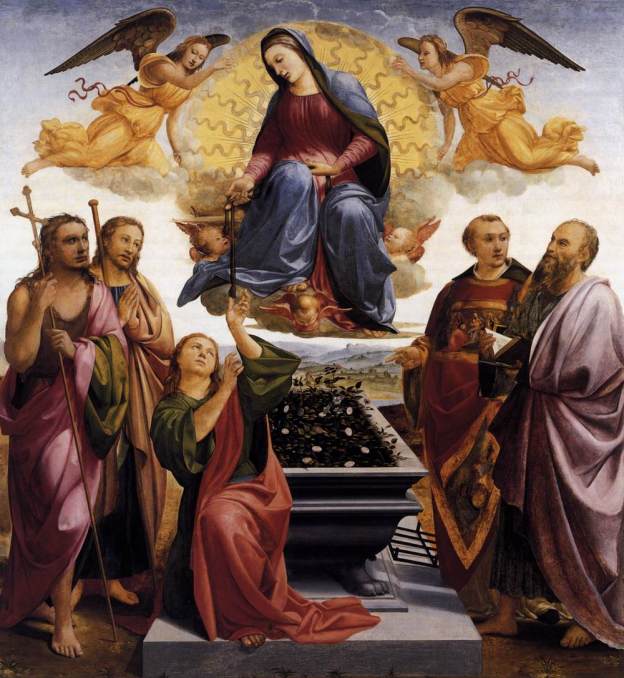
The Assumption, Granacci

Originally Published 15 August, 2010

The Assumption of the Blessed Virgin Mary is a dogma of the Catholic faith, solemnly declared as a dogma ex cathedra by Pope Pius XII in the document Munificentissimus Deus on 1 November 1950. This Dogma teaches formally that Mary, was assumed, body and soul into heaven at the end of her earthly life and that her body did not suffer corruption.

This dogma is among what are called the “negative prerogatives” of the Blessed Virgin, because they are lacking a certain defect. As the Immaculate Conception lacks original sin, so the Assumption lacks bodily corruption. We see also a strong connection between this doctrine and the Immaculate Conception which was also solemnly declared ex cathedra by the Pope, whereas the other Marian dogmas were confirmed by early councils. Pope Pius XII taught in his solemn definition:

“And, although the Church has always recognized this supreme generosity and the perfect harmony of graces and has daily studied them more and more throughout the course of the centuries, still it is in our own age that the privilege of the bodily Assumption into heaven of Mary, the Virgin Mother of God, has certainly shone forth more clearly.

That privilege has shone forth in new radiance since our predecessor of immortal memory, Pius IX, solemnly proclaimed the dogma of the loving Mother of God’s Immaculate Conception. These two privileges are most closely bound to one another. Christ overcame sin and death by his own death, and one who through Baptism has been born again in a supernatural way has conquered sin and death through the same Christ. Yet, according to the general rule, God does not will to grant to the just the full effect of the victory over death until the end of time has come. And so it is that the bodies of even the just are corrupted after death, and only on the last day will they be joined, each to its own glorious soul.

Now God has willed that the Blessed Virgin Mary should be exempted from this general rule. She, by an entirely unique privilege, completely overcame sin by her Immaculate Conception, and as a result she was not subject to the law of remaining in the corruption of the grave, and she did not have to wait until the end of time for the redemption of her body.”[1]

Moreover, the Fathers at the First Vatican Council, beseeched Bl. Pius IX for a solemn definition by drawing the same theological link with the Immaculate Conception in the Protoevangelium (which is Genesis):

“According to the Apostolic teaching [recorded in Rom. V,8; I Cor. XV, 24, 26, 54, 57, Heb. II, 14, 15 and other texts] when Jesus triumphed over the Ancient Serpent (Satan) He gained a threefold victory over sin and its effects, i..e concupiscence and death. Since the Mother of God is associated in a singular manner in this triumph with her Son, (Gen. III:15), which is also the unanimous opinion of the Fathers: we do not doubt that in the aforementioned [Scriptural] passage this same Blessed Virgin is pre-signified as illustrious by that threefold victory: over sin by her immaculate conception, over concupiscence by her virginal motherhood, and in like manner over hostile death by a triumphant resurrection similar to that of her son.”[2] In fact, had it not been so, as the theologian Joseph Pohle makes the observation that death would in fact have triumphed over Mary had she suffered bodily corruption.[3] Mary triumphs rather with her Divine Son and through His redemptive work over death completely.

The Death of the Blessed Virgin

While the dogmatic definition of Pius XII teaches that Mary was assumed body and soul into heaven, it does not teach explicitly on the manner by which Mary died. So the discussion about the death of the Blessed Virgin is not subject to the dogmatic definition per se. Based on this there are certain theologians who run around today saying that because Pius XII did not specifically address the manner of Mary’s death, that there is no proof that Mary died and thus claim she is immortal. At the time of the definition there were likewise some who pointed to it as proof of there position. The first one known to have suggested Mary’s immortality is St. Epiphianus, yet he does not deny it either and as Cardinal Baronius suggests, he was merely defending Mary’s virginity against impious heretics by saying Scripture does not even say if she died. There were some 4th century traditions holding to Mary’s immortality, and more recently the theologians Roschini and Gallus (pre-Vat.2) advocated this position. Roschini maintained, that since Munificentissimus Deus makes no mention of the death of the Blessed Virgin, the number of those holding to Mary’s immortality will increase.[4]

This is not the case however, as the common opinion of the Church provides a moral unanimity that Mary in fact died, and that those who claim otherwise actually deny the teaching authority of Tradition. The reason is, as Alastruey notes is that “[it] is immediately connected with the revealed truths concerning original sin and the general economy of the redemption of the human race. Therefore the question of the Virgin’s death is not a matter of opinion nor a pious belief which can be disputed freely; it is a firm and consistent teaching which should be venerated for its antiquity.”[5]

Moreover St. Ephrem (doctor of the Church) states explicitly that Mary was a virgin all her life and died a virgin. St. John Damascene points out that as her son did not refuse to die, neither did she. St. Andrew of Crete “She who made heavenly the dust of the earth laid aside the dust of the earth; she put aside the covering which she received through generation and returned to the earth what is of the earth.” St. John of Thessalonica says that the all-glorious Virgin Mother of God, after spending some time with the apostles until they by command of the Holy Ghost, had spread throughout the world to preach the gospel, left the earth by a natural death. St. Modestus of Jerusalem gave his first sermon on the death of the Blessed Virgin.[6] The Greek word used to describe the Assumption is κοίμησις, which means literally “falling asleep” and when used with reference to the end of someone’s life, as in English (eternal rest) it means death. This word not only appears in the Greek liturgy but is used by all the Greek Fathers to speak of the Assumption.

Furthermore, most theologians teach that Mary did in fact die. Merklbach calls it a certain teaching, lest the mother should be seen as greater than the son.[7] The Theologians Billuart and Novato treat the death of the Virgin as certissima.[8] Most other theologians, particularly Roman Theologians who treat the subject concur.

Moreover, Mary’s death is affirmed by the ancient liturgy of the Assumption in the Roman missal, which reads: This festival of the day, O Lord, being venerable to us, on which the holy Mother of God suffered temporal death, but still could not be kept down by the bonds of death who has begotten Thy Son our Lord incarnate from herself.”[9] An 8th century chant from the Chaldean Church likewise affirms: “Admirable in her mortal life, marvellous in her life-giving death, living she was dead to the world, dying she raised the dead to life. The apostles hasten to her from distant lands, the angels descend from on high to pay her honour due.”[10]

Yet, if Mary did in fact die, does this not mean that she was subject to original sin in some manner? No it does not in two ways. Firstly, Mary did not suffer corruption, so that if there was a temporary separation of body and soul, (the matter of death) her body did not rot in the grave, but as Our Lord’s remained inviolate so that when her soul reunited with it she was assumed straight to heaven. Secondly, though it was not necessary for Mary to die at all, since not being conceived with original sin, she was not subject to its affects, it was fitting.

Merklbach teaches further in his work on Mariology that: “Christ voluntarily subjected himself to the law of God commanding death, and also by his suffering and death redeemed the human race from sin, Mary also, having cooperated in the work of redemption, ought to, as Christ, suffer and die and also subject herself to the command of death.”[11] St. Albert the Great taught that Mary died from a longing of love so powerful that she could not bear separation from her Son and Saviour. While the exact manner of the death is unkown to us, it is clear that Mary did in fact die, and this death was completely fitting since it modeled the path our Lord took also.

The Dogma in Tradition

Sometimes Catholics who have no grasping of the Tradition will assert, as it is sometimes done for the Immaculate Conception, that there was no doctrine of the Assumption or no Mass for it and that the Pope just declared it ex cathedra. I once met a priest who argued that we could create new masses, after all there wasn’t a Mass for the Immaculate Conception or the Assumption prior to the dogmatic definitions. This however could not be further from the truth. In fact, some object to the dogma (including Protestants) claiming that since it was only declared in 1950 it can’t really be of tradition.

This dogma is not only very old liturgically, it is of ancient origin. Though good theological arguments can be presented in favor of this doctrine, it is primarily in Ecclesiastical Tradition that we have the most verification of the truth of this doctrine outside of the Solemn Definition of Pius XII.

East and West Fathers and Doctors of the Church supported it, from the 5th century on to the present. In the beginning there were several apocryphal stories, one which is most famous being that of Pseudo-Dionysius who claimed that all the apostles had gathered for Mary’s death, and the Church denied the authenticity or even condemned some of these over time. Yet, the continual faith in the Assumption has continued east and west in unbroken succession since the 5th century, which helps to prove that the sensus fidelium was not based on the apocryphal legends since it persisted when their authenticity was called into doubt. In the 6th century the Eastern Emperor Maurice had ordered the feast of the κοίμησις to be celebrated each August 15th in Constantinople, and just as so many Eastern Fathers (most notably St. Andrew of Crete and St. John Damascene) have preached in favor of the Assumption, so the Eastern Church even out of communion with Rome has maintained this feast. In 1672 at Jerusalem the Orthodox Churches confessed in a council “Though the immaculate body of Mary was locked in the tomb, yet like Christ, she was assumed and migrated to Heaven on the third day.”[12] St. Gregory of Tours had taught “The Lord commanded the Holy Body of the Blessed Virgin to be borne on a cloud to Paradise, where, reunited to its soul, and exulting with the Elect, it enjoys the never ending bliss of eternity.”[13] The writings in the East of St. Sophronius, St. Andrew of Crete, St. Fermanus and most preeminently St. John Damascene serve as foundational witnesses in the East, while this doctrine flowered in the West through the Latin Fathers and theologians, decoratively adorned in all the Western Liturgies, and wonderfully attested to in Pius XII’s document examining the Tradition on Our Lady’s Assumption. This is a sign for us that even when the Pope speaks ex cathedra, he is not making new doctrine, neither does he recklessly declare the opinion of the day, but prudently and eruditely examines all the factors, histories, traditions etc, and Pius XII shows us this in Munificentissimus Deus where does not cite only the theological arguments such as that presented at Vatican I, no matter how good it is, he carefully went over the whole tradition, because we are not a Church of the theological opinions in sway today, but a Church of tradition which believes what has always and everywhere been believed by those professing divine and Catholic faith.

[1] Munificentissimus Deus, nos 3-5

[2] Quum iuxta apostolicam doctrinam {Rom. V, 8; I Cor. XV, 24, 26, 54, 57; Heb. II, 14, 15) aliisque locis traditam triplici victoria de peccato et de peccati fructibus: concupiscentia et morte veluti ex partibus integrantibus constituatur ille triumphus, quem de satana, antiquo serpente, Christus retulit, quumque Gen. III, 15 Deipara exhibeatur singulariter associata Filio suo in hoc triumpho accedente unanimi SS. Patrum suffragio: non dubitamus quin in praefato oraculo eadem B. Virgo triplici illa victoria praesignificetur illustris adeoque non secus ac de peccato per immaculatam conceptionem et concupiscentia per virginalem maternitatem, sic etiam de inimica morte singularem triumphum relatura per acceleratam ad similitudinem Filii sui resurrectionem ibidem praenuntiata fuit. (Collec. Lacensis, vol. VII, pg. 869)

[3] Pohle-Preuss, Mariology, pg. 114)

[4] Roschini, Il Problema della morte di Maria SS. Dopo la constituzione dogmatica Munificentissimus Deus

[5] Alastruey, The Blessed Virgin Mary, vol. 1, pg. 253

[6] Encomium in B.V; PG, LXXXVI, 3280

[7] … “B. Virgo fuierit morti subjecta, ut Filio suo conformaretur, nec Matris potior quam Filii conditio videretur.” Merklbach, Mariologia, pg. 266

[8] Novato, De eminentia Deip. Virg. Mariae, II, c.8; Billuart, De myst. Christi, diss. 14, art1-2

[9] Veneranda nobis, Domine, hujus est diei festivitas in qua sancta Dei genitrix mortem subiit temporalem, nec tamen mortis nexibus deprimi potuit, quae Filium tuum Dominum nostrum de se genuit incarnatum.” (Migne, P.L., LXXVIII, 133)

[10] Gureranger, The Liturgical Year, vol. 13, pg. 388

[11] Christus voluntarie debebat se subiicere legi Dei mortem statuenti, atque passione sua et morte genus humanum a peccato redimere, Maria quoque, in opere redemptionis consociata, sicut Christus debebat pati et mori, atque mandato mortis se subiicere. Quod fecit consentiendo in hoc quod esset mater Dei-Redemptoris, Merklbach, Mariologia, pg. 267-268

[12] Pohle, Mariology pg. 116

[13] Dominus susceptum corpus sanctum in nube deferri jussit in paradisum, ubi nunc resumpta anima cum electis ejus exsultans aeternitatis bonis nullo occasuris fine perfruitur. Migne, P.L., LXXI, 708)

No conversions, really?

“Let, therefore, the separated children draw nigh to the Apostolic See, set up in the City which Peter and Paul, the Princes of the Apostles, consecrated by their blood; to that See, We repeat, which is “the root and womb whence the Church of God springs,” not with the intention and the hope that “the Church of the living God, the pillar and ground of the truth” will cast aside the integrity of the faith and tolerate their errors, but, on the contrary, that they themselves submit to its teaching and government. Would that it were Our happy lot to do that which so many of Our predecessors could not, to embrace with fatherly affection those children, whose unhappy separation from Us We now bewail.
Pope Pius XI
Mortalium Animos
“I’m not interested in converting Evangelicals to Catholicism. I want people to find Jesus in their own community. There are so many doctrines we will never agree on. Let’s not spend our time on those. Rather, let’s be about showing the love of Jesus.”
Papa Franciscus
Meeting and meal with assortment of Protestant ministers

Of all the silly things Pope Francis has said in his pontificate, this one really takes the cake. Principally, in the realm of prudence, but also because it raises questions about what he believes. In terms of magisterial teaching, it is null, so we don’t need to worry about that.

The greatest difficulty is in this: if you are an apologist, if you are laboring amongst evangelicals, or, whatever you like, working to convince them to return to the Catholic faith, whether you are a priest or a laymen, you may now be greeted with this: “But the Pope said we did not need to convert!” and “Who are you to judge!”

There are many reasons why this statement is fraught with all sorts of problems, but the biggest is that it is contrary to what the Church has always and everywhere believed. It also evinces a lack of the virtue of hope, and a lack of the virtue of charity.

There is a lack of hope, in as much as the Pope has already written off the work of the Holy Ghost, “We’ll never agree anyway.” No, never? What was St. Peter Canisius doing laboring away in Germany and Switzerland? Oh, they’ll never believe anyway, why bother. What was St. Francis de Sales doing, writing tracts and sticking them under doors, and fasting and praying for the conversion of the Calvinists? Oh, we’ll never agree anyway! Not at all. There is another matter, which is the virtue of charity. If the Catholic Church is the true Church, and, at least with respect to the ordinary means of salvation that we can see and know from revelation, there is no salvation outside the Church, then how is it charitable to say “I don’t want to convert you.” That’s like saying “I don’t love you.” It is a false charity to withhold from a man his salvation.
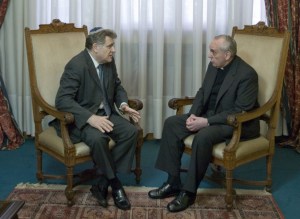
A-Buenos-Aires-le-dialogue-interreligieux-passe-par-l-amitie_article_popinBut is this some random statement from the Pope, off the cuff and without notes? Actually no, this is precisely what he believes. In 2010, a dialogue was published between then Cardinal Bergolio and Jewish Rabbi Abraham Skorka, titled On heaven and earth, on a wide range of issues. In that, Francis said the following [My emphasis in bold]:

“When I speak with atheists, I will sometimes discuss social concerns, but I do not propose the problem of God as a starting point, except in the case that they propose it to me. If this occurs, I tell them why I believe. But that which is human is so rich to share and to work at that very easily we can mutually complement our richness. As I am a believer, I know that these riches are a gift from God. I also know that the other person, the atheist, does not know that. I do not approach the relationship in order to proselytize, or convert the atheist; [!] I respect him and I show myself as I am… I do not have any type of reluctance, nor would I say that his life is condemned, because I am convinced that I do not have the right to make a judgment about the honesty of that person; even less, if he shows me those human virtues that exalt others and do me good.” (Pgs. 12-13).

Hence the Scalfari interviews. The curious thing about those, of course, is the Vatican Press office is more or less claiming that Scalfari is changing the Pope’s words, yet the Pope goes to Scalfari again and the Vatican website still promotes the interview. But the Pope’s words are being changed.

More problematic is the unqualified way he speaks of these things. It strikes your feelings, yeah we want to treat people with respect, which then eviscerates truth from your dealings. It is one thing to respect the people in your society, and treat them courteously. It is another, to be entirely unconcerned with their eternal salvation, as though God blesses unbelief. What is the Vatican II mantra, always going back to Scripture? That is largely just a vehicle to discard the Tradition. Congar’s argument is that all Tradition is contained in Scripture, so therefore Scripture has the sufficiency and the Tradition is at best an appendage which we don’t need to worry about, because its all in Scripture. It is also a good argument for discarding the Tradition, once one has judged that it is not in Scripture. But then Scripture itself is cast aside when it doesn’t fit in with the Vatican II meta-narrative, or the religion of feelings and good intentions. What does it say in Scripture?

“Si autem tu annuntiaveris impio, et ille non fuerit conversus ab impietate sua, et a via sua impia, ipse quidem in iniquitate sua morietur: tu autem animam tuam liberasti.
Sed et si conversus justus a justitia sua fuerit, et fecerit iniquitatem, ponam offendiculum coram eo: ipse morietur quia non annuntiasti ei: in peccato suo morietur, et non erunt in memoria justitiae ejus quas fecit, sanguinem vero ejus de manu tua requiram.”

If, however, you will have declared to the impious, and he will not have converted from his iniquity, and his impious life, truly he will die in his iniquity, and you however acquitted your soul.
But even if the just man will have been turned from justice, and committed evil, I will place a stumbling block in his presence, he will die because you will not have preached unto him, and he will die in his sin, and the just things which he did will be forgotten, but I will require his blood at your hand. EzechielIII: 19-20 (All translations from the Vulgate are mine)

Or Again:

Et accedens Jesus locutus est eis, dicens: Data est mihi omnis potestas in caelo et in terra:
Euntes ergo docete omnes gentes: baptizantes eos in nomine Patris, et Filii, et Spiritus Sancti:
Docentes eos servare omnia quaecumque mandavi vobis: et ecce ego vobiscum sum omnibus diebus, usque ad consummationem saeculi.

And coming, Jesus spoke to them, saying: “All power in heaven and earth has been given to me; going therefore, teach all nations; baptizing them in the name of the Father, and of the Son, and of the Holy Ghost; Teaching them to keep all things whichever I commanded you, and behold, I am with you all days, even to the end of the age.”
Matthew XXVIII: 18-20(My emphasis)

Or again:

Et dixit eis: Euntes in mundum universum praedicate Evangelium omni creaturae.
Qui crediderit, et baptizatus fuerit, salvus erit: qui vero non crediderit, condemnabitur.

And he said to them: Going into the whole world, preach the Gospel to every creature. Whoever will have believed and been baptized, he will be saved, but whoever will not have believed, he will be condemned.
Mark XVI: 16 (My emphasis)

These scriptural references should be clear, even if you are using a “Good News Bible” or whatever edition you can pick up at Barnes and Noble. Even absent the Tradition, where copious resources could be produced from every Church Father, and every Scholastic, every theologian, and every Doctor of the Church on the necessity for membership in the Church, the necessity of Faith for salvation and so many other doctrines implicitly defied by the Pope’s behavior toward atheists, the scripture clearly shows his behavior is contrary to Christ’s commands. So the Pope, is saying he is not at all concerned that the Atheist doesn’t believe, in spite of Our Lord’s very clear and grave words. Now obviously there is prudence, and many times I’ve been at that point, where you know if you push any harder you’ll lose the person, but you did try, and resort to prayer where argument fails. Francis wasn’t even talking about that, he’s talking about shirking the whole question altogether. “Who am I to judge?” Unfortunately there is the dread verse in Ezechiel: “I will require his blood at your hand.” It get’s even worse:

God makes Himself felt in the heart of each person. He also respects the culture of all people. Each nation picks up that vision of God and translates it in accordance with the culture, and elaborates, purifies and gives it a system. Some cultures are primitive in their explanations, but God is open to all people. He calls everyone. He moves everyone to seek Him and to discover Him through creation. In our case, that of Judaism and Christianity, we have a personal revelation. God Himself encounters us; He reveals Himself to us, He shows us the way and He accompanies us; He tells us His name, He guides us through the prophets. Christians believe, ultimately, that He manifested Himself to us and gave Himself to us through Jesus Christ. Moreover, throughout history, there have existed circumstances that created schisms and constructed diverse communities that have different ways of living Christianity, like the Reformation. We lived through a thirty year war and it shaped different faiths. It is very hard to accept and it was a disgraceful time, but that is the reality. God is patient, He waits, and God does not kill. It is man that wants to do so on God’s behalf. To kill in the name of God is blasphemy.” (On heaven and earth, pg. 19; my emphasis.)

Well, where do I start? This simply cannot be read as anything but modernism. For instance, it is one thing to say God uses all cultures to reveal his glory. This is true, and when Catholic missionaries brought the faith, for example, to Native Americans, or into the far East, they preserved the local populations’ culture and tradition, which worked in harmony with the Traditional Latin Mass that they also established. When, however, he says: “each nation picks up that vision of God and translates it in accordance with their culture”, this is, or at least appears to be, rooted in the modernist opinion that all religions are essentially different visions of God, and we’re all fellow travelers and that sort of nonsense. Yet, that pesky Bible again, says: “Quoniam omnes dii gentium daemonia; Dominus autem caelos fecit.” For all the gods of the nations are demons, but the Lord made the heavens. -Psalm 95 (96): 5.

Where we circle to the relevance with respect to the Pope’s statement to the Protestant ministers, is in the latter part of this quote. It really expresses the metaphysics of Francis’ philosophy of religion. “diverse communities that have different ways of living Christianity.” Well, what are we to make of this? In proper Catholic ecclesiology, there is no way of living Christianity, except by being Catholic, in the Latin right, or in one of the Eastern rites. There is only one Church, as is clear in the scriptures. To say that other communities have another way of living Christianity, is to hold that there is an anomalous Christianity, that can be done entirely differently by different groups, who only agree on essentials. What the Church has historically called the essentials is, well, a bit different from that. It might have benefitted the then Cardinal Bergolio to examine what his fellow Jesuit, St. Robert Bellarmine, doctor of the Church had said on that subject:
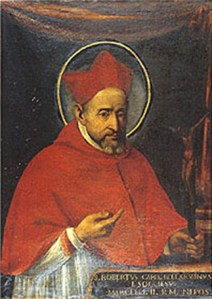
StRobertBellarmine“There is only one Church, not two, that body, both one and true is of men of the same Christian faith with respect to profession, and gathered in the communion of the same sacraments, under the rule of the legitimate shepherds, and especially of the one vicar of Christ on earth, the Roman Pontiff. It can easily be collected from such a definition, which men pertain to the Church, and those who doe not pertain to her. There are three parts of this definition. The Profession of the true faith, the communion of the sacraments, and the subjection to the legitimate pastor, the Roman Pontiff. By reason of the first part all unbelievers are excluded, as well as those who never were in the Church, such as Jews, Turks and Pagans; and also those who were in and left, as heretics and apostates. By reason of the second, catechumens and the excommunicate are excluded, because these are not admitted to the communion of the sacraments, as these are dismissed. By reason of the third, schismatics are excluded, who have both the faith and the sacraments, but are not subjected to the legitimate pastor, and therefore profess the faith and carry out the sacraments on the outside. All others however are included, even those who might be reprobate, criminal or impious.”1 (De Ecclesia Militante, bk III ch. 2, my emphasis)

Similar statements could be collected from every Theologian until the 1960’s. But no, this was not the religion of Cardinal Bergolio, and it would appear his doctrine has not changed.

Throughout this interview, Francis confesses he is “naive”. This is certainly clear with his historical analysis of the Thirty Years War. This war, from 1618-1648, is often described in popular history as a war between Catholics and Protestants in Germany. This is false, like other pop-history dates, such as assigning 1054 as the date of the Great schism between East and West, even though the Eastern Churches were all reconciled in 1099, and remained so until 1204, and came in and out of union until the 1300’s when the politics in the West caused various worldly Popes from continuing the effort of full reunion. Either way, the Thirty Years war saw Catholics and Protestants fighting on both sides of the conflict. When it broke out, it was when the Elector of the Palatinate, Frederick, was invited by the Bohemians (Czechs) who had revolted from the Emperor to become their king. This occurred after the famous “De-fenestration of Prague”. So, Frederick came, and became king, but was put under the Reichs’ ban, which essentially a deposition, that declared all his subjects freed from obedience to him, and made him an outlaw within the Holy Roman Empire. Frederick expected all the Protestant lords and elector’s to come to his aid, but instead they sided with the Emperor, mostly because they  wanted to grab some of his land. He also alienated his subjects by his strict Calvinism, which the Lutherans and Hussites did not accept. Later the conflict widened, with Catholics and Protestants on the emperor’s side, and Protestants on the other side. Then the French entered the conflict, and what’s more, induced Gustavus Adolphus, the Swedish king, to enter the war on the Protestant side. The French, though Catholic, assisted the Protestants in every way, just as they assisted the Lutherans in 1548 against Charles V, so now they assisted the Dutch against the Spanish, fought the Spanish, and sent troops to fight for Adolphus. Although my expertise in this conflict is more on the military side than the political side, it should be clear to anyone who studies it, that while religious considerations were important, politics and military glory were equally apart of this conflict. The security of states, the prominence of royal houses, these were all considerations at work in this conflict. It was not so much killing in the name of God, but in the name of kings, for worldly glory, and power.

The result, was an agreement for toleration in order to avoid more conflict, and was fully in accord with Catholic principles. It was devastating, it was a scandal, but it did not create “new religions”, or “new ways of being Christian”, it solidified those who had left the Church politically.

Ultimately, then, when the Pope told those Protestants that he didn’t want to convert them, and later, apologized to Pentecostals for the Church preventing their growth, this is not some off the cuff comment that he later regrets to make them feel good, this is really what he believes!

The conclusion, then, is that whenever Francis speaks, it is probably best to run to older works of theology approved by the Church at that time, or to read the Fathers of the Church. Pray, but don’t become despondent over it. Francis cannot change what the Church formally teaches, it isn’t possible. God will judge him, as He promised to judge Ezechiel, and it is our job to pray and refer back to the Church’s perennial teaching as the antidote to all the nonsense.

1  “Ecclesiam unam tantum esse, non duas, et illam unam et veram esse coetum hominum ejusdem christianae fidei professione et eorundem sacramentorum communione colligatum, sub regimine legitimorum pastorum, ac praecipue unius Christi in terris vicarii romani pontificis. Ex qua definitione facile colligi potest, qui homines ad Ecclesiam pertineant, qui vero ad eam non pertineant. Tres enim sunt partes hujus definitionis. Professio verae fidei, sacramentorum communio, et subjectio ad legitimum pastorem romanum pontificem. Ratione primae partis excluduntur omnes infideles tam qui numquam fuerunt in Ecclesia, ut Judaei, Turcae, Pagani; tam qui fuerunt et recesserunt, ut haeretici et apostatae. Ratione secundae, excluduntur catechumeni et excommunicati, quoniam illi non sunt admissi ad sacramentorum communionem, isti sunt dimissi. Ratione tertiae, excluduntur schismatici, qui habent fidem et sacramenta, sed non subduntur legitimo pastori, et ideo foris profitentur fidem, et sacramenta percipiunt. Includuntur autem omnes alii, etiamsi reprobro, scelesti et impii sint.”
The Glory of Small “t” Tradition

One of the most disturbing things to me is the belittling of “t” Tradition by virtually every neo-conservative apologist. There is a current which runs in the neo-conservative mainstream to downplay the importance of the little traditions. This is done primarily when they incorrectly define them. One will say “Big ‘T’ Tradition stays the same always, and is of the utmost importance, but small ‘t’ Tradition is here today and gone tomorrow. It is not important and we shouldn’t get wrapped up in it.”

This is basically the position of the so-called mainstream of defenders of the New Rite, separated from historical Catholicism by the modernism pervading the Church since the Council. In a minute I will define what I mean by historical Catholicism.

Now, let us take a proposition, such as I have continually advanced, and will advance until I am put to death, that the Novus Ordo is inferior to the Traditional Rite. As soon as I say such a thing the aforementioned will claim that I am propagating a heresy. They will say that you can not say one Mass is better than another, Tridentine, novus ordo, Divine Liturgy are all fine and good and all equally pleasing to God. It doesn’t matter how we wrap the essentials, etc. etc. etc, blah blah blah. Boo hiss!

First of all, this is something which I would consider contrary to Catholic liturgical theology, namely minimalism. It is purely the minimalist approach to liturgy, and this is where the denial of small “t” Tradition flirts openly with heresy. It is the small “t” which protects, defends, reinforces and teaches the large “T” tradition. While it is technically true that you can eliminate the small “t” tradition and maintain the integrity of the faith, when you do eliminate it the faith begins to disappear. This is because man is not a pure spirit, he is a body soul unity, how the faith is presented to man determines the manner in which he receives it. We all accept that bad preaching, bad style, bad demeanor of the presenter can present a barrier to how one receives the grace of the Gospel. Almost any neo-con will accept that. However, be that as it may, when it comes to the liturgy they suddenly reject it. It suddenly doesn’t matter that a hideous neo-teric chalice is used in place of a beautiful Gothic chalice collecting dust in the sacristy, or crappy polyester vestments are worn with rainbows and/or hideous art on them. The apologists will tell us well, it isn’t the best, but it is still Jesus.

I just want to take them by the neck and say get a hold of yourself man with a thick Scottish brogue! What does a cheap polyester vestment say about the faith? How does it cheapen the faith? How does a glass wine claret used for sacred Communion weaken belief in the real presence?

Secondly, the main objection, that all liturgy is the same, fails to distinguish between the intrinsic nature of a thing, and its extrinsic nature. If we are speaking Intrinsically, then of course any valid Mass, that is a Mass which gives adoration to God the Father by making represent the one sacrifice of Calvary in an unbloody manner at the hands of the priest, is in fact the same. You can not have a valid Mass which is intrinsically evil, since the main object of the Mass, to offer adoration to God, is impossible. Yet the intrinsic is an inadequate dimension by which to judge liturgy in its totality, and to reduce it to such is minimalism which would be detestable to every age of Catholics until 1965. We must also consider liturgy offered in an extrinsic manner. What is the extrinsic? If the intrinsic refers to the liturgy in itself and what it accomplishes ipso facto, then the extrinsic is the manner in which it is accomplished.

A Tridentine Mass is offered, but rubrics are intentionally broken, portions of the liturgy are skipped wholesale, etc. Intrinsically, if you had a valid consecration, you had a valid Mass which accomplished its aim. Extrinsically, it is not as good and does not communicate as much grace as the same liturgy where the ceremonies are said correctly. Let us take another example: a liturgy said by heretics and schismatics with valid orders. Such a liturgy is said outside of communion with the Church and technically wrong. That impedes grace. Let us even take a Novus Ordo celebrated with obscene abuses. There is no shortage of idiots who will insist that there is no difference between that and a “reverent” novus ordo (which as far as I’m concerned is an oxymoron), because if done validly “Jesus is there”. Even if that is true, the grace which He imparts through the sacrament is impeded, it is not as powerful as one celebrated in union with the Church’s intention. Now there is yet another consideration to make, whether the rites in the Traditional Liturgy are more dignified and coming from apostolic tradition, better impart the faith than a liturgy created by a committee of left leaning priests and bishops in the late 60’s completely from scratch? I’ve never seen anyone try to claim that the new liturgy imparts more ritual than the old. Even if they were, a simple reading of text and rubric would smash such an argument.

Lastly, there is also more scripture found in the ordinary of the Mass in the Traditional Liturgy, the propers contain more scriptural usage all with their own chants, and essential teachings on sin, repentance and hell are not optional. Rituals call to mind the Jewish offerings of sacrificial animals, bringing sacrifice to the forefront, they represent Christ burdened with the sin of the world, and unmistakably condemn modern theology. The rites and the meaning they embody are superior to the Novus Ordo in every way, and consequently it is a better Mass in terms of the grace it imparts.

Some people will still say, “I like the Novus Ordo better”. Well there is nothing I can say about that, because what people like is subjective and not governed by objective principles of beauty and meaning. Some people like modern art, some people like rap music. To me it is all basically the same thing. If you look at the normal person at the Novus Ordo, not the exceptional case, you find people whose liturgy tells them nothing about the doctrine of Catholicism, but is tailored to make them feel good. Even in the Latin, if you have someone who understands Latin. If you look at the normal person at a Traditional Mass, not the exceptional case, you will find someone who at the very least understands what the Church teaches on major issues concerning his salvation, on his responsibilities toward his neighbor, and on the presence of his God at his liturgy. Every liturgical sign points to it, the kneeling, the adoration, the incense, the multiple signs of the cross, the reverence and beauty of everything required for each celebration. Small “t” tradition protects so-called big “T” tradition, and wherever the former is protected, the latter is upheld. Look at the eastern Catholic Church in our midst. The same cultural problems affect them which affect us, the same secularism, the same throw away culture, but not the same loss of doctrine and reverence for the Eucharist. Why? Because they have small “t” Tradition protecting their Apostolic Tradition.

This all brings me back to the original point of this post, namely what is that historical Catholicism which modern apologists seem disconnected from? It is characterized by a universal expression of “t” Tradition which had guarded and protected the true faith for over a thousand years. Very few real traditions had actually changed in that time, and for good reason, they protected the faith. People in every country were familiar with the universal “t” Tradition, whether French, or German, or Polish or Italian, or English, or Spanish, there was a universal “t” Tradition that was common to them all. The same was true of the Eastern Churches, and a Latin Rite observer could have seen the same traditions in the Eastern rite, even if they had a different form from the West.

I have read people claim they are not part of a “bloggersterium”, that they follow the Pope. I wonder if they would acknowledge the danger from the “apologeticsterium”? Let us look seriously. Who lives or dies by what someone writes on a blog? If anyone does he is an idiot. But there are people who conform their worldview to what this or that apologist writes. Consider those who remained completely in favor of the Iraq war, just as the mainstream of neo-conservative apologists were, when their hero, John Paul “superstar” condemned it? You get a situation where I, one of the late Pope’s critics, agree with him, and your ever faithful apologists opposed him! Yet no claims of disobedience arose, and when confronted with it they will ignore you or say they just cut the Pope some slack by not criticizing him. Seriously, is that not private judgment? To decide that the Pope’s consistent and impassioned pleas against the war have no merit because we trust our elected leaders? The same ones who enabled abortion contrary to the late Pope’s message of a gospel of life?

On the whole, I am perfectly willing and happy to acknowledge where apologists have done good, or even great work. Yet the ministry of lay apologetics is precarious at best. They are filling a void which our Bishops and Priests ought to be filling in terms of real and true teaching, but which the latter are happy to let someone else do. The problem and the danger, not unlike what everyone is always whining about with blogs, is when they get looked upon as a counter magisterium. Mind you, not when they try and usurp that for themselves If I’m wrong on a medium which requires patience and thought (while sighting sources), I can be corrected or refuted. What do you do about thousands of Catholics who don’t know any better and follow this disconnect from historical Catholicism that the self professed “mainstream” propounds? This is to me something highly problematic, even where the thinker is technically a good Catholic.