
Battle of Blenheim, one of the decisive victories of the War of Spanish Succession
Today I take 6 questions which I have received, and with a few exceptions have already answered privately. Continue reading
Battle of Blenheim, one of the decisive victories of the War of Spanish Succession
Today I take 6 questions which I have received, and with a few exceptions have already answered privately. Continue reading
“And the church more or less shrugs and say, “Look, we don’t take our agenda from the polls. We don’t take our agenda from what the world is saying. Our agenda is given to us by the God who made us, and we must be faithful to him instead of what we’re– what we’re hearing’ from the world.””
-Cardinal Timothy Dolan (source)
Michael Voris, you can love him, or you can hate him, and some people do hate him. I would put down good money that the hierarchy does not care for him all that much. Yet recently, he kicked off a bit more of a response from defenders of the bishops’ failed leadership and policies.
For the record, I do not care all that much for Voris’ style. It speaks to some people and is probably good for them, but I don’t have time for bullet points, even when he’s right. I’m a theologian, I look up propositions in the manuals, in St. Thomas, trace their reasoning and source, and apply it to today’s problems. In this case, however, I feel he was right on the money, and his response is something that, frankly, every Catholic should feel. I am talking about Voris’ response to Archbishop Timothy Dolan’s decision to continue supporting and even lead the St. Patrick’s day parade, when that same parade has decided to allow practicing and proud homosexuals to march and display their banners, ostensibly in honor of St. Patrick.
In response to the decision, Dolan noted:
“I have no trouble with the decision at all,” Cardinal Dolan said at an evening news conference announcing his appointment as grand marshal. “I think the decision is a wise one.” (Source)
There are many other things we can note about Dolan, but Voris does it well himself:
Now, Voris uses some strong language, which is rather offensive to the church of NICE. He tells Cardinal Dolan that he is “in the grip of the devil”, and “wicked”. Well, strong as it is, it is not far off the mark. I think myself that it has come time to call out the type of things that are going on the Church for what they are, they are evil.

The big cheese defends the integrity and sacredness of the liturgy. [sic]
I recall the first time I became aware of who Cardinal Dolan was during his installation in Milwaukee after that godly loving sodomite, Archbishop Weakland, had produced so much destruction there. Dolan gave his first sermon wearing a cheese head.
Dolan came from the St. Louis diocese, and for a while was in charge of the North American College in Rome, until he was elevated to become the Archbishop of Milwaukee to replace good ol’ Rembert, known for his cathedral wreckovation and squandering hundreds of thousands of dollars of diocesan money to keep old boyfriends quiet. At first Dolan appeared to step into the mold of his predecessor, but then appeared more conservative. I suppose many breathed a sigh of relief that he wasn’t gay. While from all appearances he attempted to help abuse victims while in Milwaukee, and we should not doubt his legitimate charity and concern for them, there are a number of anomalies.
Not to take a story exclusively from the New York Times, I instead am going to what is available of documents that have been released. Interestingly, as the diocese filed for bankruptcy, Dolan at the same time asked for and received permission to move over $57 million dollars to a cemetery trust fund to hide it from victims. Thus in one courtroom they are arguing that they are bankrupt, and in another that they are not. When groups criticized Dolan for this he dismissed it as old falsehoods. Yet, how false was it? The documents proved this was true. Now, to be fair, if we were to put ourselves in Dolan’s shoes, we might look at the situation this way. The diocese has obligations to retiring clergy who did not commit horrible crimes, to charitable works, payment of staff, health insurance, and the legal obligation to maintain cemetaries? We want to protect that don’t we? Why should everyone else suffer on account of these monstrous clergy. Such an argument has its merits, if that is in fact the reasoning, but in light of what went on the demands of justice require it be set aside.
For, if it is a matter of paying diocesan obligations, one could require Weakland to start recuperating the vast sums he spent on his boyfriends, pinch pennies, eliminate waste, the types of things bureaucracies hate doing. It should be simple, indeed, to realize that those who have in fact been abused by priests deserve some kind of compensation, as a modicum of justice. There is one diocese in this country that never had these sorts of problems and that is Lincoln, Nebraska. The reason is, Bishop Flavin, who was extremely progressive btw, heard that two of his priests had abused children. He investigated it, found out it was true, defrocked them and handed them over to the civil authorities. Then he went to the families and said, ‘what can we do to make this right?’ No shuffling priests around, or ignoring victims, or hiding money in trust funds. And… Lincoln Nebraska has never had a sex abuse lawsuit.
While that logic seems ineluctable to us, it is a bit much for a post-Vatican II bishop, as is seen in conservative and liberal bishops alike. There are other irregularities.
Dolan claimed many times that he was not aware of any cash payments for clergy to get them to leave without fighting their laicization. Yet he was present in diocesan meetings when they talked about doing just that. (Source) Again, this is not the MSM attacking the cardinal, maybe some of their spin is, but the documents show he was aware, which is a bit reminiscent of Cardinal Law claiming he knew nothing about the commission set up in the wake of the Rudy Koss scandal, even though he chaired it. Again we have to put ourselves in the bishop’s shoes for a moment. Here is an easy solution, give the priests money up front to get out of town, and we can take care of this faster. After all, we are canonically responsible for providing for these priests. Yet let’s back track, just a bit.
While Canon law requires dioceses to materially support their priests, this does not hold to priests who are under serious penalties, or are in the process of being laicized. Moreover, the bishops have shown themselves quite willing and able to cut off priests whom they suspend for other reasons. While it could be Dolan, or whoever made the decision, thought it was more expedient, it ignores two things: a) Priests who rape children deserve a hefty pyre where they will meet a fiery end to this life, before a fiery beginning to the next, not hush money, b) the perception will be, and in fact is, that they are being given some type of bonus. If it weren’t for the very strange statute of limitations on child rape, they would be transitioning to a jail cell anyway, so the concern should be with making this right however much they can with the victims, not helping priests who are guilty of the most monstrous crimes against children find funding as they “transition to a new life”.
As the Cardinal Archbishop of New York and the most recent president of the USCCB, Dolan is remembered for leading the fight against the HHS mandate and re-iterating the Church’s opposition to civil unions. He has acquired a reputation as a jolly bishop, happily leading the Church along. Curious stains on that particular legacy are that the Archidocese of New York, under his leadership, actually paid for contraception coverage and had complied with state law (under protest), though it was now fighting the same requirement on the national level, and that he had established a homosexual parish, St. Francis Xavier Parish in Manhattan, while he is preparing to close down one of New York’s more beautiful Churches, also being the only one where a daily Traditional Mass can be found, namely Holy Innocents. (Source)
We might also add that as Dolan is leading the fight against Obama, he happily invites him to the Al Smith dinner and allows photos having fun with the most anti-life President in years. He could have done, as Pope Benedict did when Nancy Pelosi, met with him, to forbid photographs to at least avoid the appearance of scandal. Yet he did not.
What all of these things show about Dolan, is that he is a company man. Of course he is more concerned with paying out pedophile priests than victims, or using Obama’s assault on the Church to bolster the Bishops’ “authority” even though his own Archdiocese does the same thing. Like Bernadine, Weakland, Law, Grahmam, and many other of the most disgraceful bishops to ascend to the office, Dolan is a team player, though it must be admitted his crimes are nowhere near the stench of the Bishops named before him. The problem is team USCCB is not always team Jesus, particularly where Catholic moral considerations are concerned.
It is also well known that a significant number of Bishops are gay, or sympathize with active homosexuality, and what is worse a large number of priests are gay. So again, Dolan doesn’t want to rock the boat. At least O’Connor, though he was no paragon of conservative Catholicism, had the backbone to oppose active homosexuals appearing in the St. Patrick’s day parade as a self-identified group. Not so Dolan, the team player, which probably is part of the reason he said “Bravo” to an openly gay football player on Meet the Press (which is linked at the top). Go along with the world even though it is entirely at odds with the Gospel. This is the career that Dolan has displayed, behind the jolly veneer. He is not satan in disguise, he is not malicious (it would appear) or evil, he is a fallible man who is doing wicked things.
The authentic Catholic uprising
Enter Voris, with a stern, serious and loud defense of what a Bishop should be doing. He wasn’t the only one. While Dolan has previously organized the so-called “fortnight for freedom” and other defenses of so-called “religious liberty”, Monsignor Charles Pope, a priest who dared to criticize Dolan was silenced, even though his piece dealt with issues much wider than Cardinal Dolan. So much for religious freedom. Its all fine and good when utilized to make people vote Republican, but as soon as someone in any position of authority takes a second look at our Catholic leaders, it is shut down. Likewise anyone appearing to have any sway. Therefore it is no surprise that the lapdogs of the Bishops should take aim at Voris, who is not a priest, and not employed by a diocese. They managed to shut down Mother Angelica in the 90’s but today the technology has made control impossible.
Now Voris’ comments, while appearing to be a bit histrionic, are what any Catholic 100 years ago would have said about such a spectacle. I think he is exactly right, not because Dolan is having tea with the devil between 4 and 5, but rather, because in his desire to be a company man and please everyone, he has forgotten the role of a Catholic Bishop (especially one in his position as a prince of the Church) and has given scandal. Moreover, he has rejected the same criticism from sources he declares to be charitable.
Thus we should look at the work of one Deacon who particularly took Voris’ appraisal amiss. Deacon Ditewig, PhD, offers the following appraisal:
Where to begin? While reasonable people might certainly disagree with the actions of any bishop, just as one might with any leader, one must certainly stop there, without going on to try to infer motivation or motive. I am sure that if Cardinal Dolan were asked about these things, he would completely and fully reject all of these assertions, and with good reason. To lump together, as Mr. Voris does, sexual orientation and sexual activity is to miss an important distinction made in the teaching of the church. Nowhere has Cardinal Dolan ever sanctioned sinful behavior by anyone, nor does the record indicate that he has ever given anyone a “free pass” on sin of any kind. There is no substantiation of any kind for a claim that the Cardinal has lost his faith, or that he is not striving to provide for the cura animarum of the people of New York — all the people. To spring from a criticism of certain decisions into a full blown attempt to characterize another person’s intentions and motivations — much less that state of that person’s soul — is not only fatally flawed logic, it is seriously deficient in Catholic morality. (Source)
This is a bit shocking, actually, coming from a PhD. Firstly, Voris is not equating the sinful behavior with the orientation. Cardinal Dolan is fully pleased with being the grand marshal of a parade that will now include out and proud practicing homosexuals marching under their own banner, just as he has already approved Masses for the same. At this point we are beyond any question of orientation vs. behavior. Second, while in truth it is not a sin to “be gay”, so to speak, that is to have such an orientation, the said orientation is in fact disordered. That is why we must have compassion and prayer for homosexuals, not persecution. Yet, it doesn’t follow that we must approve of their behavior, particularly when they celebrate their behavior. I don’t think anyone would countenance the association for employers who defraud laborers, or the association of those who abuse orphans and widows celebrating their sins in a parade ostensibly made to honor St. Patrick. Why do we tolerate that for the other sin crying to heaven for vengeance?
What the good deacon here misses, is that the decision to allow out and proud homosexuals to march under their own banner in the parade, constitutes a celebration of their sins, not a mere acknowledgement of the fact that these people suffer under such inclinations. I knew a fellow that was gay in college, and we talked and he knew I wasn’t of the type that would hate him or judge him for having such inclinations. He was a pretty bright guy, but he suffered with it. I prayed with him, I didn’t judge him, as others might have, and he struggled a lot. That is not the type of person who is to be marching in the St. Patrick’s day parade. Rather it will be the type of people who need reproof for their behavior, not the tacit support of the Cardinal Archbishop of the diocese. That is just the problem. By continuing the parade, in all its normal debauchery, with this added, is in fact to give a tacit approval of this behavior. It would be different if it was a chapter of Courage, founded by the late Fr. Harvey, of Catholics, or anyone else, suffering under such an affliction hoping to overcome it. That would constitute not the slightest scandal or offense. Nevertheless, the good deacon continues. [my comments in red]
The last point I wish to highlight is the claim made in the crawler at the bottom of the video. It is an advertisement for a paid subscription to the site, which professes to be “100% faithful to the Magisterium.” I must confess that when I first saw that claim, while watching the video and its assertions about Cardinal Dolan and other “wicked bishops,” I laughed out loud. How a person could claim to be completely faithful to the teaching authority of the Church while at the same time denigrating those men whose ministry includes being authoritative teachers of that Magisterium is simply nonsensical. [Being authoritative teachers like when they approve Gay parishes to have Masses for practicing homosexuals! Even Alexander VI didn’t stoop so low!]
What are we to make of all of this? Let’s review some basics.
The Magisterium is not simply a “who”; it is a “what.” Magisterium refers to the teaching authority of the Church, a Church we believe guided by the Holy Spirit [Not absolutely, but rather protected in solemn definitions in faith and morals. There is nowhere in Catholic doctrine where we teach that the Church is guided in all her doings by the Holy Spirit, or was Pope Alexander VI guided in the banquet of chestnuts but I digress…]. Every person, in some way or another, and in the broadest sense of the term, participates in this teaching authority, constantly learning and sharing this faith. Think of parents, for example, teaching and forming their children in faith, as they are charged at baptism; they are part of the magisterium in this broad sense. [A very broad and non-theological sense! This is one of the biggest stretches I have ever seen, and it entirely confuses the Ecclesia docens with the Ecclesia discens, to the point where the proposition is incorrect…] But in a very specific and particular way, the highest human teachers in the Church are the College of Bishops, always in communion with each other and with the head of the College, the Pope [This particular formulation is problematic, because its ultimate conclusion is erroneous at best if not in fact heretical. He equates the college of Bishops with the Papacy itself, as though the Pope were merely a first among equals. The Pope is the highest human teacher, with or without the Bishops. After his personal office then come the college of Bishops, when they teach on a matter of faith and morals whether together or dispersed throughout the world. This is the great problem with post-Vatican II ecclesiology, it hopelessly pales in comparison to the careful and clear explications of pre-Vatican II tracts De Ecclesia]. Unless and until an authoritative judgment is made by the College (always in communion with the Pope), or by the Pope himself, that a bishop is no longer part of that College, then the bishop in question remains an authoritative teacher. [An authoritative teacher is different than the magisterium, but I’ll go into that later] It is not within the competence of someone else (like Mr. Voris, or myself) to judge when a bishop is no longer teaching authentic or faithful doctrine. [Actually it is, when said Bishop departs from what has always and everywhere been believed by the Church, if it is demonstrable and public]. In fact, I will go further and suggest that, if there should be a presumption of veracity and accuracy in presenting the Church’s teaching, that presumption goes to the bishops, not to anyone else. Put simply, Mr. Voris is neither qualified nor competent to make the judgments he is attempting to make.
It may or may not be the case that Voris is competent to make the claims he makes, but nevertheless, the Deacon is quite out in left field. Firstly Voris is criticizing prudential determinations, and calling on the Cardinal to step down. He is not declaring him a heretic or deposed. What Deacon Ditewig is setting up is a supremacy of the Bishops, quite contrary to the mind of the Church and the tradition. For, both in the Theological manuals, and in Vatican II’s document Lumen Gentium, #25, the Bishops are part of the Church’s infallibility when they teach together or are dispersed throughout the world in unison on an issue of Faith and morals. One Bishop’s prudential determinations do NOT make him a voice of the magisterium, not even under Vatican II. In fact, a Bishop’s role in the magisterium individually is very limited. Let’s continue with Dolan’s faithful defender.
Am I saying that bishops never make mistakes? Of course not! Bishops make mistakes just like the rest of us, and they also deserve the benefit of fraternal correction. Some bishops commit crimes and should be held accountable under civil, criminal and canon law [Like Cardinal Law, who committed purgery in a court of law (against the 7th commandment), and was rewarded with a nice job in Rome for it!]. But no one has appointed any of us to take the place of God in judging us all for our sins [Whatever Voris is doing, that is not it. This smacks too much of the infamous “who am I to judge?”]. Alone we will stand before God and take responsibility for the way we’ve lived our lives.
Let’s take just one example from the litany of complaints made by Mr. Voris, and analyze just how wrong he is. He condemns Cardinal Dolan for not publicly condemning Islam as “a heresy and a false religion”. While this may be what he believes, it is NOT what the Catholic Church teaches [Really?] (remember the claim that he is 100% faithful to the Magisterium?). What DOES the Magisterium of the Church teach about Islam?
Here’s some truly authentic magisterial teaching, found in Vatican II’s Dogmatic Constitution [please note that well — it is a DOGMATIC text, dealing with the most fundamental issues of faith and church] on the Church (Lumen gentium), #16: [I have to interject here, Pope Paul VI inserted a Nota Praevia to Lumen Gentium, making it clear that nothing was dogmatically defined unless otherwise noted. So, while we might remark on the novelty of a “dogmatic contitution” not declaring anything dogmatic, there is nothing from the extraordinary magisterium that binds Catholics to belief].
But the plan of salvation also includes those who acknowledge the Creator. In the first place amongst these there are the Mohamedans, who, professing to hold the faith of Abraham, along with us adore the one and merciful God, who on the last day will judge mankind.
Later, this thought is developed in the same Council’s Declaration on the Relation of the Church to Non-Christian Religions (Nostra Aetate), #3:
The Church regards with esteem also the Moslems. They adore the one God, living and
subsisting in Himself; merciful and all- powerful, the Creator of heaven and earth, who has
spoken to men; they take pains to submit wholeheartedly to even His inscrutable decrees, just as
Abraham, with whom the faith of Islam takes pleasure in linking itself, submitted to God. Though
they do not acknowledge Jesus as God, they revere Him as a prophet. They also honor Mary, His
virgin Mother; at times they even call on her with devotion. In addition, they await the day of
judgment when God will render their deserts to all those who have been raised up from the dead.
Finally, they value the moral life and worship God especially through prayer, almsgiving and fasting.Since in the course of centuries not a few quarrels and hostilities have arisen between Christians and Moslems, this sacred synod urges all to forget the past and to work sincerely for mutual
understanding and to preserve as well as to promote together for the benefit of all mankind social justice and moral welfare, as well as peace and freedom.In fact, even earlier — when talking about religion in general, the bishops of the Council (that “episcopal college” mentioned above) taught at #2:
The Catholic Church rejects nothing that is true and holy in these religions. She regards with sincere reverence those ways of conduct and of life, those precepts and teachings which, though differing in many aspects from the ones she holds and sets forth, nonetheless often reflect a ray of that Truth which enlightens all men.
When a person claims to speak with complete faithfulness to the Magisterium, then, we should expect that this person would be echoing these teachings, which Cardinal Dolan has certainly done. The Church does NOT teach what Mr. Voris teaches: that Islam is “a heresy and a false religion.”
Well, where to start? We could talk about the fact that he ignores all previous Church pronouncements, both through the unanimity of theologians and even former conciliar declarations concerning Islam, but we’ll stick with what Islam is and the philosophy of God. I will say that I have personally known Muslims who are good people. That is not the issue here. All Trads have issues with Vatican II, and I am no exception, but for the sake of argument I’m going to leave that behind. Vatican II says nothing here that contradicts what Voris is saying. The Church can indeed note those elements of the Islamic religion that are praiseworthy, in the realm of philosophy, but none of that changes the reality that nowhere does the Church acknowledge Islam as a true religion. That is the problem. If it is not a false religion, then it must be a true religion, because of the law of non-contradiction, two contrary positions cannot be true at the same time and in the same respect. Thus in the Qu’ran, Ibrahim (the Arabic spelling for Abraham) takes Ismael up to the mountain to sacrifice, while in the Bible Abraham takes Isaac up to the mountain to sacrifice. They might both be false, but they cannot both be true. Muslims may indeed worship one God, but that does not mean that their philosophy of God is the same as ours. In point of fact, if you look at the Qu’ran, Muhammad’s mother is depicted as a whore, Jesus’ mother is revered. Jesus is glorified more than Muhammad, and Jesus will judge all on the last day. Most of what Muhammad got into the Qu’ran is in fact from Christian heresy, and it is not without reason that St. John Damascene, a doctor of the Church, characterizes Islam as a Christian heresy.

St. John of Damascus: Just another pre-Vatican II misanthrope
“There is also the superstition of the Ishmaelites which to this day prevails and keeps people in error, being a forerunner of the Antichrist. They are descended from Ishmael, [who] was born to Abraham of Agar, and for this reason they are called both Agarenes and Ishmaelites… From that time to the present a false prophet named Mohammed has appeared in their midst. This man, after having chanced upon the Old and New Testaments and likewise, it seems, having conversed with an Arian monk, devised his own heresy. Then, having insinuated himself into the good graces of the people by a show of seeming piety, he gave out that a certain book had been sent down to him from heaven. He had set down some ridiculous compositions in this book of his and he gave it to them as an object of veneration.” (source)
St. John Damascene is just another self-righteous crusader ignoring the magisterium of course! The fact is the Church does not teach what the Deacon here is proposing, that Islam is not a heresy and a false religion. In the comment box, several people pointed out similar things to the deacon, and he remonstrated that he was simply worried about Voris’ threatening language. Yet, he makes this a primary point of questioning Voris, that he is not faithful to the magisterium, and uses this as part of his example. The fact is that Voris is exactly right when he says that Islam is a heresy. It would be a heresy for a baptized person to embrace, and in its doctrines it is a false religion. That doesn’t mean that the Church can’t make common cause with Islamic countries at the UN, for instance, to oppose population control and birth control measures. It doesn’t mean that we can’t point to what is true in Islam. But it doesn’t make Islam a true religion. If it is not a false religion, it must be a true religion, and if so, what in the world are we doing in the Church? It may be that Dolan’s earthly prudence is justified or it may not, but it certainly doesn’t have a basis in Islam being a true religion.
Nevertheless, let’s look at where the attack on Vorris is going, which I have seen on a few other websites too:
Finally, I want to return to the threatening language used by Mr. Voris when he refers to punishment that he thinks may happen to Cardinal Dolan after he dies, “or even before you die,” and when he issues his call for an “authentic Catholic uprising. I would refer Mr. Voris and anyone else who is interested to the following canons from the Code of Canon Law:
Can. 1372 A person who makes recourse against an act of the Roman Pontiff to an ecumenical council [note: such as Vatican II] or the college of bishops is to be punished with a censure.
Can. 1373 A person who publicly incites among subjects animosities or hatred against the Apostolic See or an ordinary [note: such as Cardinal Dolan] because of some act of power or ecclesiastical ministry or provokes subjects to disobey them is to be punished by an interdict or other just penalties.
It would be interesting to hear the opinion of a canon lawyer with regard to these canons as they might apply in this instance.
Now we need to make important distinctions. Firstly, I don’t know what the deacon is taking about with his reference to Canon 1372, since Vorris is not making an appeal to Vatican II against all the bishops of the world, gathered together or dispersed throughout the world. It is a total non sequitur. This canon is talking about those who engage in private judgment attempting to challenge authoritative acts of his magisterium or jurisdiction on the basis of a council. This is based on much older laws, originating in the debates of Renaissance humanists who wanted to reform the papal court on the basis of the Council of Constance, the provisions of which were not entirely accepted by subsequent Popes. 1373 is a bit more pertinent. Now, in 1373, the Canon is envisioning someone who incites subjects to disobey their bishop, or to actually hate him. What Vorris has done, by contrast, is to call on Catholics to oppose bad decisions of their bishop, and to refuse to cooperate with his bad actions. I’ll readily grant he could be more clear about the “Catholic uprising” he is calling for, but his words are clearly in the realm of the necessary opposition that Catholics can have to bad members of their hierarchy. An authentically Catholic uprising by its very nature would suggest something non-violent, prayerful, etc.
Again, Dolan is not evil because he is in secret liaisons with the devil, or because he has palmist readings, or writes meditations on tarot cards like Hans Urs von Balthasar, but because he has chosen human respect above his divine calling as a bishop. We should support Voris’ call for a Catholic uprising, by telling our shepherds we will not tolerate any more wishy-washy compromise, watered down doctrine and assaults on our liturgical tradition. We do need any more “Bravo’s” to the world. Nay, we need another bravo: Bravo Michael Voris!

The Contarelli chapel, San Luigi del Francese, Rome.
Author’s collection
The last time I took up Caravaggio’s works, we traced him running from Papal justice and then running from the Knights of Malta, while having painted the biggest painting of his career. In that post, I made allusions to Caravaggio’s devices in the Martyrdom of St. Matthew. Here I have chosen to unpack these for the feast of St. Matthew.

Author’s photo
History
Cardinal Mattheiu Cointrel was a French Cardinal, who had purchased a side chapel in the Church of San Luigi del Francese (St. Louis of the French), where a series of paintings and frescoes dedicated to St. Matthew were to be painted in his honor after his death. This Church, dedicated to St. Louis IX, was the focal point for Frenchmen living in Rome during the middle ages, and even today still has French speaking shops nearby. In point of fact, today it is still considered French territory.
As a side note, there is a pillar in the Church dedicated to the French soldiers who died while liberating Rome from Garibaldi in 1848.
Nevertheless, in 1599, Cointrel’s will had not been effected, in spite of the large sum of money left for the chapel that would bear his name (Italianized to Contarelli). After several artists had failed to produce work laid out in the terms of the will, the commission was won by an obscure Lombard painter with a short fuse, who was known as a client of Cardinal Maria del Monte, but had only recently risen from an obscure existence churning out portraits of heads for a Groat a piece, namely Michaelangelo Merisi da Caravaggio. If you want to get an idea of what a Groat was worth, we can look to Austria just prior to the introduction of the Euro, where they had “Groschen”, (which comes from the same linguistic root as a Groat), which was a plastic coinage that was more or less worthless. A Groat was about the same.
Now, however, with the unlikely award of the commission for the Contarelli chapel he would be projected into fame. Yet, Caravaggio would have to overcome significant obstacles to complete the commission. The difficulty for Caravaggio, the same difficulty which had afflicted more seasoned painters who had previously been tapped for this project, such as Giralomo Muzziano, is that the commission called for a historical painting reviving the intense historical drama of Raphael. Idealized saints, a historic holy land scene, angels on clouds, detailed preparatory drawings, careful study and imitation of anatomy, and many other things. For Caravaggio, who had taken up the persona of an artistic realism which celebrated the filthy muck of life, and made gods into men instead of men into gods, this was a huge challenge. But it is not only because he was at war with tradition, as some suggest. (For example, Simon Schama in his documentary series “The Power of Art”, suggests Caravaggio had no interest in producing such things). The way Caravaggio did things tended to precluded this, but both the contemporary evidence and the work he produced shows he was not above painting what is above, it is more about his particular abilities. He didn’t draw, he painted what he saw.
For instance, we’ll look at a few key early paintings.

The Cardsharps -Michaelangelo Merisi da Caravaggio
The Cardsharps is a great example of his style. As in all of Caravaggio’s paintings, x-rays have shown there are no pencil lines, and no conceptual drawings have ever been found. He looked and painted. What he gives us, is not merely a photograph by paint, he uses the brush to create distinctions, add drama, and make a point. The cardsharps is celebrated as poor uninitiated noblemam, about to be ripped off by Mr. Cardsharp and his pal. Yet there is a level of humor in this that goes beyond cards. A cheat like this would be rather obvious, and soon to be noticed. No one actually carries things out in this exact manner. It is celebrating instead, the world that Caravaggio lived with every day, being a poor Lombard painter with not too many prospects in a city that can break you in a second. 
Moreover, we can see it again here with the so-called “sick-Bacchus”. Its actually a self-portrait of the painter, painted when he was younger, so probably would have been done in a mirror. He gives us Bacchus, the god of wine, song, binges, youth and beauty. What he does is a complete contravention to the tradition, instead of taking a man and making him look like a god in paint, Caravaggio has taken a god and made him more like a man. Apart from looking like he is in need of Jeeves to come in after a long night of drinking, he looks deathly ill. His fingernails are dirty, and the grapes are rotten. The immortality of youth is drained, even inverted, into the mortality of disease. This is not a vision of paradise, but of reality, the reality which everyone he knows laboring away in the Ataccio, Rome’s embarrassing and dirty underbelly, deals with every day. This is the painting which caught the eye of Cardinal del Monte, and led him to invite Caravaggio to become part of his retinue. Yet, Caravaggio’s experience was in small paintings, with one model in a small space, not to large epic scenes with life-sized figures. His commission required him to paint on the Martyrdom of Matthew on the east side, and the Conversion of St. Matthew on the west side of the chapel. He began on the east side first, but, when it came to the idealized holy lands and the like of St. Matthew’s martyrdom, Caravaggio ran into quite the headache.
X-rays of the Martyrdom of St. Matthew clearly show Caravaggio attempted another sort of painting altogether, attempting to replicate the great scenes of Raphael. There is a text called the “Golden Legend“, a medieval lives of the saints, with stories, some apocryphal, some accurate, that had inspired christians for hundreds of years. Therein, it is told that St. Matthew converted a noble maiden in Ethiopia, Iphigeina, who was betrothed to the king, but now decided to live her life for Christ. In revenge the king ordered Matthew to be killed while he was saying Mass. According to Helen Langdon, Caravaggio’s original:
…began with a a composition in which the figures are comparatively small, occupying the foreground plane in the lower part of the canvas, and in which the action takes place in a grandiose setting of elaborate Renaissance architecture. At first the executioner stood in the center, sword raised, before an upright St. Matthew; to the right stood a nude recording angel, holding the Gospel, and pointing to heaven; in the foreground a soldier, seen from the back, divided the composition in two with the sharpness of a pilaster.” (Langdon, Caravaggio, A Life, pg. 172)
Since this is not what he produced for the chapel, we can only conclude that this didn’t work for him, or that, Caravaggio realized that what he was good at was not the work and style of the Renaissance, but something uniquely his own, and as a consequence, he needed to turn do something different to do it well. It is at this point that he turned to the other side of the wall, the conversion of St. Matthew. There, the light began to flicker.
The Conversion of St. Matthew
 What captures Caravaggio’s imagination here, is the circumstances of St. Matthew’s life. It is about a sinner, in a den of sin (a counting house, Telonium in the vulgate), and the subject (Matthew) is a shady dealer. Caravaggio is not just a thug who goes about at night with a sword and dagger abusing rivals, or having carnal relations with his more attractive female models. He is also very sophisticated, in spite of his low birth, and knew Latin at least well enough to read St. Bonaventure’s life of St. Francis (shown in his various works on the saint), the Golden Legend (which wasn’t translated into Italian at that time), and many works of classical literature. You would have to, to be in Cardinal Del Monte’s retinue, in the company of other painters, poets, musicians, philosophers, all renaissance men, all making up a renaissance court focused on the arts. We’ll see this especially with the martyrdom of St. Matthew.
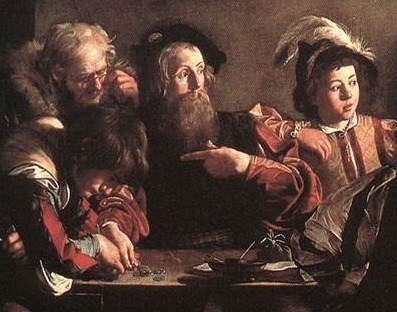
The genius here, the insight that seems so completely counter-intuitive, is that Caravaggio has given us less of Christ, and more of St. Matthew. It is a curious blend, on the one hand Matthew the sinner is depicted in some shady back alley tavern in Rome conducting his business, with those around him dressed as contemporaries (even reusing figures from the Cardsharps), but Christ and
Chi, Io?
St. Peter are dressed in biblical clothing. The light shines from above and behind Christ, like the light of the Holy Ghost, and Matthew’s reaction says everything without words: “Chi, Io?” (who me?) his finger cries out, pointing in stunned astonishment to himself. What, a holy prophet like you wants a lowly creature like me? No saints for this job. At least not yet.
Notice the two fellows to St. Matthew’s right, they do not even look up. On the one hand, we have the man with glasses. The light is right on him, but he doesn’t even notice. The device of the glasses illustrates here is that he is spiritually shortsighted, so much so that he cannot see the purity of the light. Then you have the man counting the money. He does not look up either, because the love of money is the root of all evil, and this man, attached as he is to his money, is so rooted in the world, he cannot look up at the light. There is an exaggeration of his posture, and it is not an accident. He is bowed down as if weighed down by a chain, and the vehicle of the light calls us back to Plato’s notion of the cave, wherein all humanity is chained and cannot escape, and a fire in the background makes shadows on the wall, which people think are real, but are not. The real light they can’t see, and when the philosopher tries to tell them, they do not believe him.
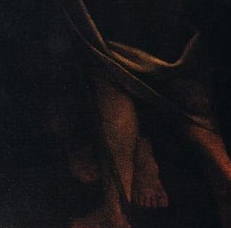 Then let’s look at two details about Christ that Caravaggio has included here. Firstly we see Christ’s foot in the bottom right. It is poised as to leave, yet he has only just gotten there. He already knows he has made his disciple, as if the power were effortless and overpowering, the light accomplished its effect as soon as he walked in. This leads to the second thing, that pointing hand. It is not a forcefully fashioned pointing as one would expect, a sort of “Hey you! Follow me, and I don’t mean on Twitter”. Rather, it is an effortless pointing gesture, as if the power flows through Christ with but a wave on his hand. This is also an aping of Michaelangelo Buonarotti’s Creation of Adam in the Sistine Chapel, yet not the gesture of God the Father, but of Adam, drawing the clear link between the first Adam whose sin lost for
  us our original paradise, and the work of Christ, the second Adam, who will take Adam’s place as head of the human race, whose redemptive work in the calling of his Apostles will win for us a new paradise. This gesture, moreover, would have been well known. The paintings of the Sistine Ceiling were even then among the most famous paintings in Christendom, everyone would recognize it. Caravaggio’s first name is Michaelangelo, he is showing everyone that he is the new Michaelangelo, and no mistake. Whether he intended that as the outset or it was an afterthought we can’t know. But it accomplished this affect, as we shall see.
With this revelation, that the painting is about a sinner, Caravaggio turned to the eastern wall, back to the Martyrdom that so vexed him in the beginning.
The Martyrdom of St. Matthew

The Martyrdom of St. Matthew
Michaelangelo Merisi da Caravaggio
It is said by some art historians that Caravaggio repeated the motif of a contemporary scene, this time using a back alley in Rome. This ignores the prominent altar in the middle. There is, moreover, a strange positioning of figures around the lower center point, which seems to descend into a pit of sorts. That is because this is actually a Baptismal pool. A basic look at architecture of Rome’s older churches would show that the early Christians baptized adults by immersion.
What Caravaggio has done is to further develop the theme of Matthew’s martyrdom told in the Golden Legend, instead of being after Mass, it is now in the context of a Baptism. This is not mere artistic license, as we shall see. The image is whirling and busy, almost strobe lit. First you have several naked figures, prominent amongst them is the assassin in the middle, several clothed figures on the sides, St. Matthew and his deacon and an angel. Let’s break this down.
We know this is a baptismal scene from the solitary candle on the altar (prescribed in the Traditional rite of Baptism, Traditional Catholics should notice), the naked figures about to be baptized in the pool, and the steps leading down to it. Moreover, as the intrepid, charismatic, scholarly and always informative art historian Andrew Grahm-Dixon has noted:
“The significance of the painting’s architecture was long unrecognized, for the simple reason that hardly any such baptismal chapels survived. But they were once a common sight in Italian Churches, especially in the north. In Rome, where baptism by aspersion was the general practice, stepped pools were not necessary. But in Milan, where they practiced the Ambrosian rite of baptism by full bodily immersion, such chapels contained a deep pool at the base of the altar. The liturgically precise Archbishop of Milan, Carlo Borromeo, writing his Instructiones fabricae et supellectilis ecclesiasticae, described an arrangement that closely corresponds to the setting of the Martyrdom of St. Matthew: ‘a baptistery should be in the center of the chapel. It should be eleven cubits wide and deep enough so that the descent to it from the floor of the chapel consists of at least three steps. By the descent and moderate depth it should resemble a sepulchre.’ It seems that Caravaggio painted the kind of baptismal chapel that he remembered from his childhood in Milan.” (Andrew Grahm-Dixon, Caravaggio: A life Sacred and Profane, pg. 200)
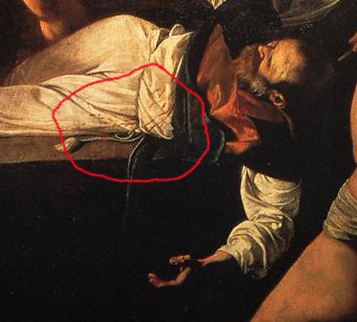 Grahm-Dixon has really hit the nail on the head, and he is the only person analyzing this painting to really get a sense of what is going on. We know (should know), that when one receives the sacrament of baptism, what he receives is death. The death of his old nature, and his being brought into the state of justification by sanctifying grace, into a new nature with Christ. Hence St. Paul says to be “put to death in Christ.” Death then, is the res tantum, the very thing conferred in Baptism, mystically and spiritually to our old nature born in original sin, and made living by sanctifying grace, inhering as a quality of the soul. Death in this world we will eventually meet, some sooner rather than later, and that death, if met in sanctifying Grace, Deo adjuvante, completes the work of Baptism.
This is what Caravaggio is working into this painting. If one looks at St. Matthew, the blood is squirting from his wound into the Baptismal pool. This is where Grahm-Dixon, in spite of his excellent grasp of theology (for a non-believer) makes an error of terminology. He calls this a “Baptism of Blood.” In a certain sense of course, this is true, but it is not what the theologians mean when they use that term. It is a handy in this context, provided that we keep the distinction from that which is meant by Theologians when they use this term, meaning someone with right faith who is martyred prior to his baptism, such as a Catechumen, of which there are several saints whom the Church has always celebrated. Here, what Grahm-Dixon is getting at, is that St. Matthew, now at the end of his life, is receiving the very thing conferred by baptism really in this world, death.
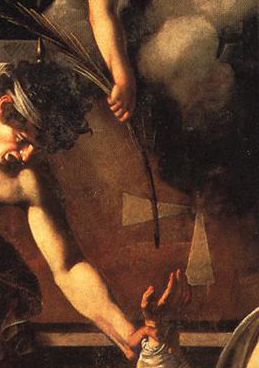 We can see an angel on a cloud, invisible to all but St. Matthew, lowering the palm to him. It is on an exact line of symmetry with Matthew’s hand, which on the one hand, is grasped by the assassin, but on the other, is reaching out to grasp eternal life. The angel on the cloud is also situated just above the cross, in an exact line of symmetry going down into the pool, as a sign that the graces of martyrdom flow from the graces of baptism, united in the blood that is being shed, in imitation of Christ who shed his blood on the cross.
Those catechumens recoil in horror, as the pagan assassin is obviously one who hid in their number and produced the sword to bring St. Matthew down. Those at the left run away, and the furthermost character is a selp-portrait of Caravaggio himself. What is often missed by most is that Caravaggio is here wearing a black garment over a white loin cloth, as though he were among the catechumens to be baptized, but is running away like the rest. As Grahm-Dixon, again, notes:
“The self-portrait, in this instance, reads like a mea culpa. If Caravaggio had actually been there, he suggests, he would have had no more courage than anyone else. He would have fled like the other, leaving the martyr to his fate. According to the logic of his own narrative, he remains unbaptized and therefore outside the circle of the blessed. He is a man running away, out of the church and into the street.” (Grahm-Dixon, loc. cit. pg. 202)
An anecdote from the artist’s later life would appear to justify that interpretation. Coming out of a Church in Naples, a priest offered Caravaggio some holy water, and Caravaggio asked what it was for. The priest replied “It washes away venial sins.” Caravaggio replied “That won’t do any good, all mine are mortal.” Either way there is one thing more we can draw from this. If one draws a diagonal line from the bottom right hand corner, one arrives at Caravaggio’s face in the painting. This is not just a sort of signature, but again, the artist attempting to prove himself as superior to his namesake. If we look at Michaelangelo’s Last Judgment in the Sistine Chapel, we can find the same detail.
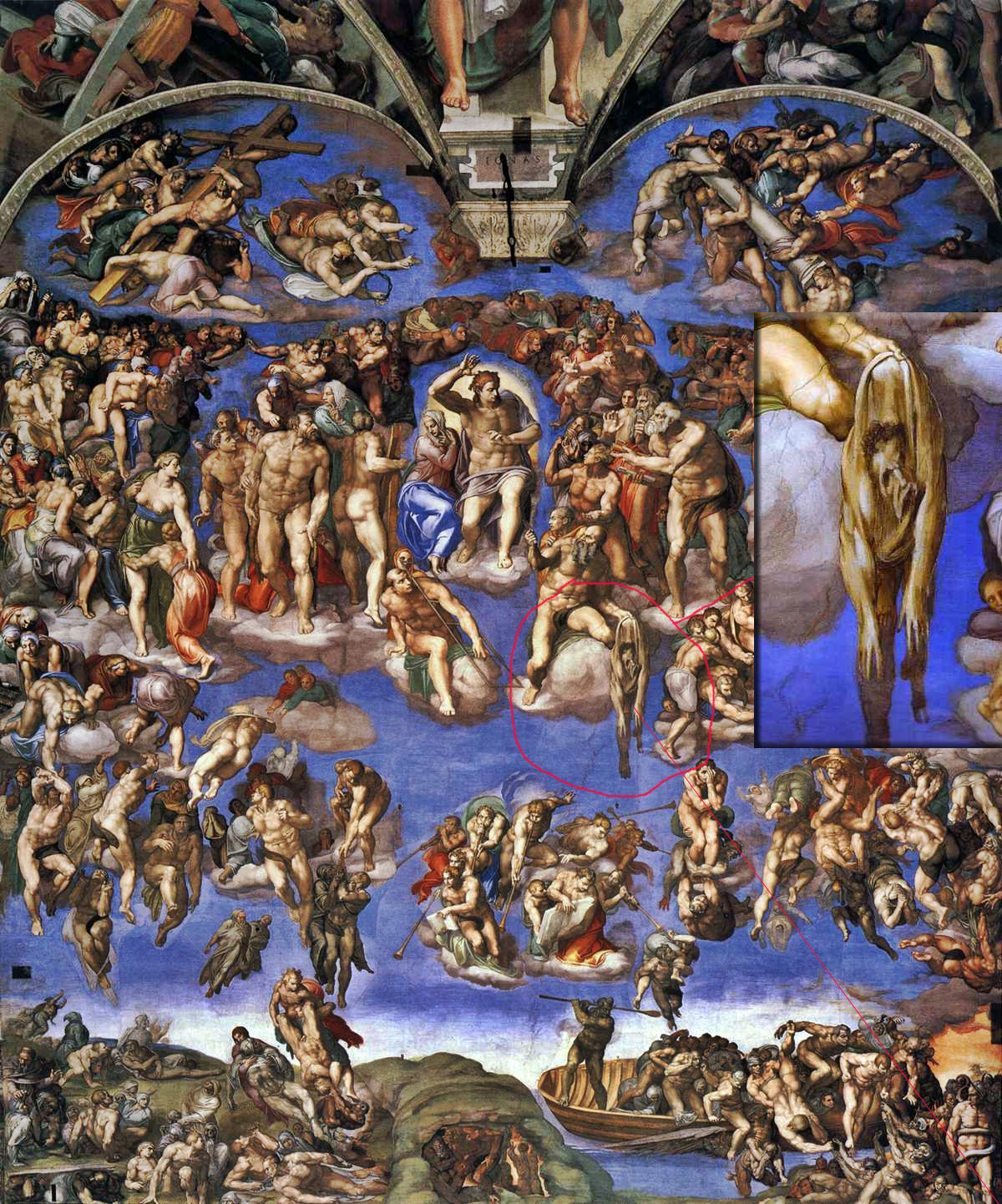
Michaelangelo Buonarotti Last Judgment If you follow a digonal line from the bottom right up, you will see Michaelangelo’s self portrait as a worn out skin.
When the paintings were unveiled they were an instant hit and propelled Caravaggio into immediate fame. It also got him immediate commissions and roused the jealousy and rivalry of other artists, particularly of his later biographer Giovanni Baglione. They also began the course of inspiring European art and would influence artists as far away as France and the Netherlands, as we see in how Rubens and Rembrandt adopted his style, although both were able to incorporate it into their styles without becoming slavish copiers of it. However in 1602 the executors of Cardinal Cointrel’s will had yet another set-back, in that the artist whom they had commissioned to carry out the altar piece had failed to produce anything, so they turned again to Caravaggio. We might notice that in the above paintings there are a lot of feet. Well, this had become an issue for Caravaggio, as he attempted frequently to include dirty feet to show the poverty of people in his paintings, but this was more and more being considered to be in bad taste. So when he prominently displayed St. Matthew’s dirty feet in the “Inspiration”, the painting was rejected and he had to do it again. The first attempt (which I do not have the rights to put up here) is preserved only in a photograph because it was in a museum in Berlin when it was blown up by the Allies during the second world war. (Thank you, by the way, US and UK, for obliterating so much priceless art in your mad rush to bomb all of Europe in the 40s). The second attempt, nevertheless, won their approval and was unveiled late in 1602.
The Inspiration of St. Matthew

St. Matthew and the Angel
-Michaelangelo Merisi da Caravaggio
The second Inspiration of St. Matthew is a more toned down version of the original. He presents Matthew the saint as a scholar, a long way from the rich and splendid origins in the Calling, listening attentively as the airborne angel dictates the verse as he copies it down. The feet moreover are in profile and not pointing at the viewer, and thus it pleased the executors of the Contarelli chapel, and it still hangs there today.
In a certain way, this work looks a lot like sculpture, particularly the figure of Matthew. There is less movement than in the other two pictures. This has much to do with the fact that the piece originally intended for the chapel back in 1599 was a marble relief, and thus Caravaggio has attempted to keep the spirit of the original intention. He maintained some of the austerity of his original, clearly gives St. Matthew an intellectual air. He wears a red pallium, which is similar to the pallium worn by philosophers in the 2nd century, and as he writes, the angel counts the verses, being at number two since Italians count starting with their thumb, even today.
There is an element in the way of biblical inspiration here that one can’t miss, namely the connection between the angelic inspiration and the human element. While I admire Caravaggio’s first attempt, (which again I can’t show you thanks to draconian copyright laws, although the photograph is reproduced in both books referenced in this article) ultimately it made Matthew too plebeian, unused to writing, which would not be the case for a tax collector who needed to keep special records, one for the government, and one for himself, the former being fixed, the latter showing his actual embezzlement. Depicting Matthew as a sage or philosopher in the Greco-Roman tradition actually helps convey the vehicle of biblical inspiration. Matthew had been with Christ, he had seen the events unfold which led to the formation of the Church, and he writes his account, with the angel’s directing, for in counting the verses the Angel is not necessarily telling him what to write, but guiding his writing in the direction of God’s providence with the aid of His inspiration.
Stepping back from the Contarelli chapel and taking it all in as a whole (as you reach in your pocket for more euros to feed the machine that keeps the lights on the thing), there is a sense of power and motion in these images, particularly in the Calling and Martyrdom of St. Matthew. It almost feels as though if you pushed the play button the figures would begin moving. This is no accident, it is one of the effects baroque artists sought to convey in their art, the illusion of movement, the figures coming back to life, and this had been the goal of oil painters since the time of Van Eyck, who in his Ghent altar piece painted Adam so realistic (for the standards of the 15th century) that it seemed as though Adam would begin to move. Van Eyck’s fame was such that Versari thought he had created oil paint, though this was not true, Van Eyck was the one to perfect the medium. Caravaggio took it to a new level, with his use of the light and darkness, chiarascuro, using the contrasts and the strokes of the brush to create a drama unfolding before you. Martin Scorsese, as immoral as he and his movies might be, got it right when he said that Caravaggio was the father of cinematography.

If you have seen the news about the Scottish Independence referendum and wondered, “How did Scotland get in the Union anyway? Why are they trying to leave?” Today we will trace the origins of Scotland’s inclusion in the UK, in all of the gory details. Join us, as we go from the Stuarts to Bonnie Prince Charlie.
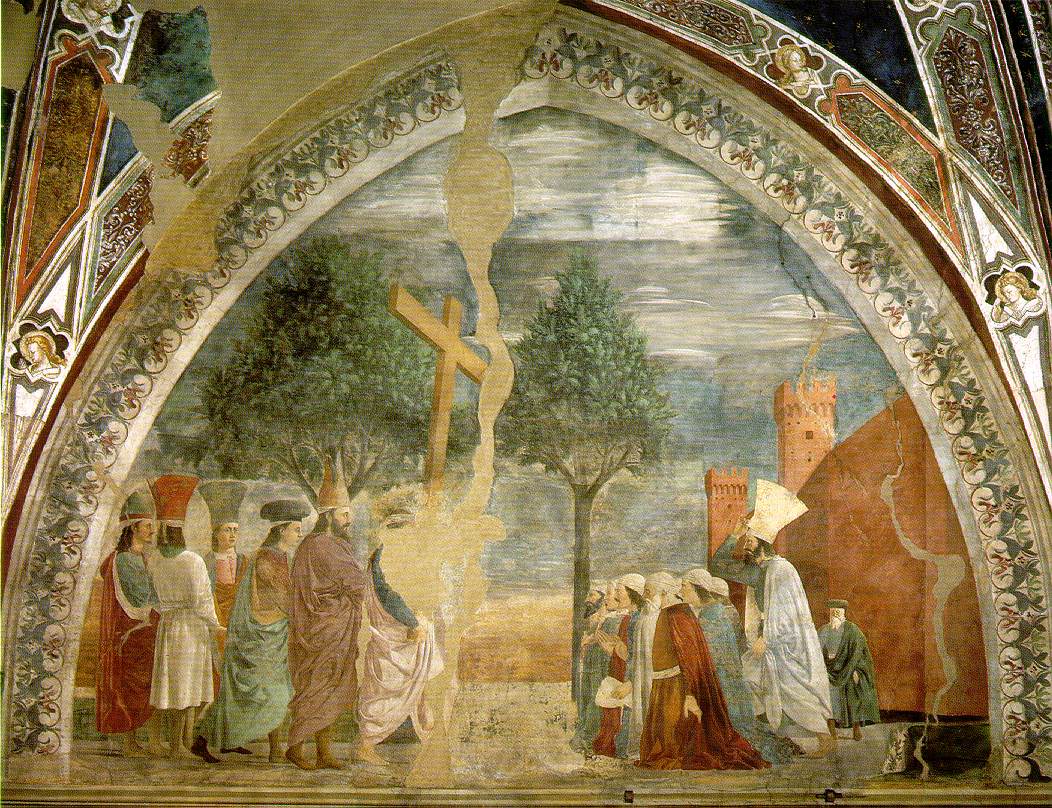
The Exaltation of the Holy Cross, by Antioniazzo Romano, Basilica di Santa Croce in Gerusalemme
Rewritten from a post by the same title on the Old Athanasius Contra Mundum, 14 September 2009.
Today is the feast of the exaltation of the Holy Cross, which is a distinct feast from the finding of the true Cross by St. Helena, which is commemorated in March. This feast, commemorates the victory of the Eastern Roman Empire over the Persians in the 7th century, and the recovery and return of the cross to Jerusalem. In most Traditional Missals there will be a short description of the event, that Heraclius, the Roman Emperor in Constantinople, could not enter the city with the cross because of some spiritual force which stopped him. When he asked the bishop, he was told that it was because he was dressed in kingly robes. To enter, he had to dress in rags, so as to not carry the cross into Jerusalem in a manner above our Lord who carried it in rags. After that he was able to carry the cross in.
However there is much more to this story, and the background history deserves to be told. In the year 570, the Roman Emperor in Constantinople, Maurice, supported Khusru, or Khusroes II (sometimes written Chosroes in western history books) to the throne in Persia, and gave Roman aid to his cause. (Roman here refers to what scholars call the “Byzantine empire”, but I use Roman generally speaking since it was the accepted term by which the Byzantines called themselves as well as what their enemies called them). Khusroes showed his gratitude by ending the war with Constantinople, and ceded to the Eastern Empire half of Armenia, which had long been disputed. After hundreds of years there was peace between Rome and Persia.
Then something else happened. In the year 602, The emperor Maurice was overthrown, and replaced by Phocas, a centurion who was selected by the troops present. He was little more than a monster, who murdered all of Maurice’s family save a few, was a rapist and a completely inept leader. He was entirely ineffectual against incursions by Avars, Slavs and assorted steppe peoples, emptied the treasury and brought the Eastern Empire to near destruction. He was unable to restore order when Monophysite mobs rose all over Syria and Egypt and killed orthodox bishops, replacing them with heretics.
Theodosius, a surviving member of Maurice’s family, escaped to Persia to Maurice’s friend and ally, Khusroes. What landed in his lap was a sequence of events few leaders could hope for. Politically, he could march on the Eastern Empire as Theodosius’ champion, much as Maurice had done for him. He could also use it to take control of a good chunk of territory, if not destroy the Roman Empire for good and reestablish ancient Persia, and on top of that Phocas was a murderer and a barbarous tyrant which appeared to give him the moral right. Best of all he had a pretender he could place on the throne loyal to him.
Though slow to get started, under Khusroes the Persians invaded the Levant and took every city from Antioch to Alexandria, including Jerusalem in 608. They took the true Cross from the basilica of the Holy Sepulcher, and brought it back with them to Persia, and were prepared to march on Constantinople. It appeared as if the Eastern Empire was to be destroyed. However, there was Africa, where St. Augustine lived and preached and which Justinian’s able general, Belisarius, had recovered a century earlier. Its general, Heraclius was a pious man, fully orthodox, and in 610 he set sail for Constantinople with an army, and an icon of Our Lady on the masthead of his flag ship. The coup was almost instant, everyone wanted Phocas gone, and he was killed by a mob.
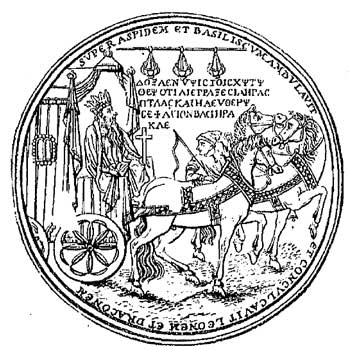
The reverse of a coin commemorating the Emperor Heraclius
Heraclius was crowned in the Church of St. Stephen and could now set on the task of saving the Empire. Phocas had ruined the treasury, and sunk the last gold in the Bosphorus to keep Heraclius from getting it. To fight the Persians, who now marched on Constantinople after three years of unbroken victory, Heraclius needed an army. The loss of Jerusalem had inspired temporary reunion of the Monphyistes, and inspired the Patriarch Sergius of Constantinople to offer to Heraclius all the gold available at that time in the Churches for equipping, feeding and transporting an army. For two years the emperor raised this army. Then in 622, he prayed at Hagia Sophia on Easter Monday then embarked with his troops and an image of Jesus Christ as the army’s banner to Asia Minor, where he won victory after victory and drove the Persians back. He made straight for Persia, preparing to devastate it. He made an alliance with a Mongol people, the Khazars, and with their troops and his own (plus reinforcements of troops which had broken a Persian siege of Constantinople when he was away) he swept into Mesopotamia with a huge force, and smashed Khusroes near the ruins of Nineveh. The latter fled and was killed in an uprising while hiding in the mountains. Peace was made with Persia, and the true cross was returned to Jerusalem, which Heraclius brought to Jerusalem himself. That is the principle event which is commemorated in the liturgy today.
It is worth noting, that in 625, while Heraclius was pursuing his strategy of going straight at the enemy to draw them off from the difficult to defend heart land of Anatolia, the Persians and a Steppe tribe called the Avars, jointly besieged Constantinople. With the army away in Persia, it looked disastrous, and the people prayed to the Blessed Virgin, carrying on vigils and prayers, Liturgies, and processions, and composing a hymn which remains in the Eastern Tradition even today, the Akathistos (Akathist) hymn. Suddenly a hurricane appeared and scattered the Persian fleet, while at the same time creating havoc in the Avar camp and led to their retreat. With the siege being broken, more Roman troops could join Heraclius in the East.
The Tradition is that the Emperor, upon arriving with the cross at Jerusalem, attempted to enter but found himself prevented by an invisible force. He could not enter the city. St. Zacharias, the patriarch of Jerusalem, informed him that he could not carry the cross which the king of kings carried in rags, while he wore kingly robes. Therefore Heraclius divested himself of his royal garments, and wearing a simple tunic he was able to bring the true cross into Jerusalem without any further obstruction.
Pope St. Leo the Great, in a sermon, wrote a marvelous Latin prose which is used in the Breviary today:
O admirabilis potentia Crucis! o ineffabilis gloria passionis, in qua et tribunal Domini, et judicium mundi, et potestas est Crucifixi! Traxisti enim, Domine, omnia ad te, et cum expandisses tota die manus tuas ad populum non credentem et contradicentem tibi, confitendae majestatis tuae sensum totus mundus accepit. Traxisti, Domine, omnia ad te, cum in exsecrationem Judaici sceleris, unam protulerunt omnia elementa sententiam, cum, obscuratis luminaribus coeli, et converso in noctem die, terra quoque motibus quateretur insolitis, universaque creatura impiorum usui se negaret. Traxisti, Domine, omnia ad te, quoniam scisso templi velo, Sancta sanctorum ab indignis pontificibus recesserunt, ut figura in veritatem, prophetia in manifestationem et lex in Evangelium verteretur.
If your Latin is a bit week I have rendered it here:
How amazing is the power of the Cross! O how unutterable is the glory of the Passion, in which is the Lord’s judgment-seat, and the judgment of the world, and the might of the Crucified one! You have drawn all things to yourself, o Lord! and although you spread out your Hands all the day unto an unbelieving and opposing people, nevertheless, the world has felt and owned your Majesty! Lord! You drew all things unto yourself when all the elements advanced one opinion on the curse of the Judaic crime, when the lights of the firmament were darkened, day turned into night, earth quaked with strange tremblings, and all God’s work refused itself to be of use to the impious. You drawn all things unto thee O Lord, because the veil of the Temple was rent in twain from the top to the bottom, the Holy of Holies itself slipped away from unworthy Priests, that the figure might be changed into truth, prophecy into realization, and the Law into the Gospel.
Epilogue
However, there is one more important facet to this story. Heraclius had returned to Constantinople, and the patriarch Sergius, bowing to pressure from those who thought Church riches ought not to have been given for worldly ends (no matter how necessary), demanded repayment of all the Church’s wealth in full. No man could have seen the firestorm about to come from Arabia, it appeared as if no enemy remained for the Romans to fight, with Persia having been completely laid low and reduced to a conquered nation which sent tributes to Constantinople. Thus it seemed wise to reduce the military apparatus to the same level of weakness it had prior to the Persian assault. There is a tradition, which the Muslims have preserved in the Al-Hadith, that Mohamed had written to Heraclius encouraging him to make the Romans subject to Islam, but all historians, including Islamic ones, agree that it post dates Mohamed and could not be genuine. Whatever the truth of that, no one expected the Arabs to break out of Arabia, and when they did do so, the Eastern Roman Empire was woefully unprepared. To make things worse, Heraclius in later life developed a phobia for water, and refused to cross the Bosphorus, but he did send a decent army to Syria which was subsequently defeated by the Arabs, when a sandstorm rose up. The rest, is another story.
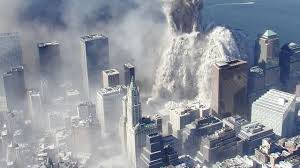
Today we give a basic overview of lingering issues concerning 9/11 and address the question: What is conspiracy theory? Have there been proven conspiracies before? Is 9/11 a conspiracy? More importantly, why should Catholics care about 9/11? Join us.
Recensio
Brief history of false flag attacks
Japanese blew up their own railroad to justify invading Manchuria
Operation Northwoods (With scans of de-classified documents)
Gulf of Tonkin a lie
Architects for 9/11 truth
Insider Trading on the morning of 9/11 1
2
Buildings burned longer than Twin towers
Twin towers were designed to survive impact by airplaines
WTC7
News says tower 7 fell before it fell
9/11 Families question official story
Debate on the Patriot Act
Biden takes credit for the Patriot Act
Elizabethan England was a police state
Portrait of Elizabeth with eyes and ears
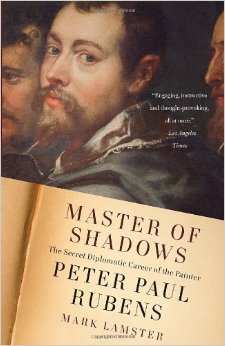 Today when we think of artists, we often think of emotionally or psychologically disturbed individuals, staking out radical positions, challenging authority, championing unpopular issues, or in general just being rebels. This however, is not what artists were in the 17 and 18th century, with the exception of notable figures like Caravaggio and Rembrandt, or we might add in the 19th century Van Gogh, who have, arguably, created the melancholy temperamental view of the artist.
Artists, historically, were viewed as craftsmen, who were given their talents by God to bring beauty and light into the world, to raise man up to God, by the medium of art. It is in the Netherlands that oil painting first became the supreme art by the genius of Jan van Eyck. It is in the Netherlands that an artist obtained nobility, fame, and wealth by respectability virtue and above all his devotion to the Catholic faith. That artist was Peter Paul Rubens.
There are a number of good works about Rubens’ art, and no biography can do without talking about it. However, Master of Shadows, by Mark Lamster, is about another, less known side of Rubens, not as painter, but as a diplomat and spy. He couldn’t have been born at a better time for it either. Spain and the nascent Dutch Republic were at war, and Spain, the greatest empire in the world, was on the losing side it seemed. The real losers were the inhabitants of the Spanish Netherlands (modern day Belgium) who were ruled by a foreign power that did not understand them, prevented from making peace with their Protestant neighbors, and their greatest city, Antwerp, turned into a ghost town on account of the Dutch blockade of the Schlect, the main river leading to it from the English channel. It was his native Flanders that Rubens loved, and he would devote his life to bringing it, and the rest of Europe, peace.
What is fascinating about this biography, is that we find Rubens continually involved with the great men of his time. Not just the Duke’s of Mantua, his first big patron, but the Spanish regents of the Netherlands, the Empress Maria and the Count of Lerma Philip IV’s chief counselor, Philip IV himself, the scheming Count Olivarez, the kind and upright general Spignola, and conversely, Marie de Medici, Chrales I of England, and many other contemporary artists and poets. He clashed swords, diplomatically speaking, with Cardinal Richelieu and won, he was knighted by Philip IV of Spain and also by Charles I of England. His correspondence was enormous, and his art production in the thousands of works, and even more copies of other great masters. What I have always particularly admired in Rubens, is his staunch Catholicism, married to his love of the pagan classics. Like Raphael or Michaelangelo in the 16th century, for Rubens, classical and mythological themes were often used as an expression of Christian virtue, and they saw no particular contradiction in it. This was of course, the luxury of a christian age that had survived and long since vanquished the old paganism. Nevertheless, that pagan inheritance is the key to understanding most of Rubens’ art, as well as his life.
Flemish by birth, in a city where one could speak either Flemish or French, Rubens chose to speak Italian, which at that time was the mark of an educated and intelligent man, as opposed to the 19th century where British culture popularized the Italian as thief and pirate.
What Lamster brings out about Rubens in this work is two-fold: a) His work ethic and discipline b) his moral integrity, manners and discretion. For instance, Rubens’ wife died while he was in his 30s, but he re-married in his 50s, and was celibate for the entire 20 years he was single. One of the reasons we know this, is because Richelieu wanted all dirt possible dug up on Rubens, because he knew that the later was a Spanish agent, but his vast spy network came out empty handed.
The work traces Rubens’ career, from birth in strained circumstances in Flanders, to his education at a grammar school, where he learned Latin and Greek, French and Italian. He then embarked for Italy, where he spent several years in the retinue of the Duke of Mantua, at the same time as the great composer Claudio Monteverdi was also composing for the duke. He busied himself with the normal jobs of a young artist, copying the great masters, and innovating his own techniques. He was heavily influenced by Caravaggio, and it is apart of Rubens’ genius that he was able to appropriate elements of Caravaggio’s painting, but not become a slavish copier as many of the continuators of the painter, the Caravaggisti, would later be known for. He went to Rome shortly after Caravaggio had been condemned in absentia for murdering Rannucio Tommasoni in a duel, and was able to acquire a number of commissions this way.
While in the Duke of Mantua’s retinue, he was entrusted with the job of bringing a number of paintings to Spain which were to be presented as a gift to the highly influential Duke of Lerma, the chief counselor to King Philip IV, at that time considered the greatest monarch in the world. In this first visit to the Spanish court, Rubens would be able to see up close the Spanish court and its workings, which would help him appreciate later how the Spanish work.

The Adoration of the Magi, -Peter Paul Rubens The painting was made to commemorate the 12 years truce between Spain and Holland.
While back at Rome, however, received news that his mother was dying, and hastened back to Flanders. He narrowly missed his mother’s passing, but was fortunate in that around the same time, the Spanish and the Dutch were celebrating the twelve years truce (circa 1609), and were the city council of Antwerp wanted a painting to commemorate the event. Lucky for them, they had a young painter who had already acquired fame in Italy. How better, than to have a son of Antwerp paint a work celebrating a truce which would free the city economically? Thus, Rubens painted the first of his works on the theme of the Adoration of the Magi.
The painting’s meaning is clear, the kings of the earth adore the infant Jesus, bearing gifts, the gifts are the fruits of the peace, presented to the prince of peace. A man in gold fabrics kneels before the Christ child, who represents the Spanish, the man in a simple red garment represents the Dutch Republic, rich but austere. One thing that has baffled art historians, is the presence of an oriental figure standing just behind the main action, wearing glorious blue robes. Many times in depictions of this scene, oriental figures are depicted like Europeans, or depicted looking somewhat dumb, or lacking majesty. Rubens dresses him in rich blue garments and with jewels. The reason for this, is he is depicting the gifts of the orient (at that time called the East Indies), which could now flow freely while the Spanish and Dutch are not fighting each other at every corner of the world.
The work was a hit, and launched Rubens onto the international stage. It was at this point that he was invited by the Empress Isabella, the Spanish regent of the Netherlands, to undertake diplomatic work for Spain. In spite of Rubens’ many duties, his busy life in his workshop, the constant demands for his work, he nevertheless through himself into this energy and alacrity. His decorum made him trusted by Isabella, even though he was seriously mistrusted by the Spanish court for being a commoner who “worked by his hands” (something despised by the old nobility, which looked at privilege and position as something more noble than work). Philip IV would rectify this by knighting him, but he nevertheless, could not escape the veneer of a mere workman in the eyes of the Spanish aristocrats, no matter how polished his manners and splendid his decorum.
Lamster’s narrative takes us into Holland, France, and even distant England, where Rubens painted the famous Apotheosis of King James which even today adorns the ceiling at Whitehall. It is here, that Rubens, solely through his tact, decorum and discretion, outwitted Richelieu’s over-reaching and tactless ambassador’s, and prevented an alliance of England and France against Spain. What is glorious about it, is if one is not familiar with history of this period, Lamster’s narrative is simple and explanatory enough that one does not feel lost or amiss following Rubens around Europe.
At the end of his life, Rubens gave up his stardom and ambassadorial life, to retire in Flanders where he married again. He began, at this juncture, to carry out a number of landscaping works, depicting a peaceful life at home. He had labored his whole life for peace, through his art, and through his perilous missions, and it was peace he most longed for now. The twelve years truce had lapsed, and the Dutch and Spanish would be at it until the end of the Thirty Years War. That war, so destructive and pointless, tore Europe apart and left millions in misery. Thus we have one of Rubens’ last works, a picture of the Flemish landscape.

Landscape with a rainbow. -Peter Paul Rubens
The shepherds and farmers sit at ease with their wives, another is playing music, within easy site of their habitations. Its an idyllic day, with the sun shining, yet a storm which provides a cool breeze. The reality is behind that rainbow is a terrible storm on its way. On this side of the rainbow, is Flanders as it ought to be, while on the other side, is the dark stormy reality of war, both religious and political. The sad thing is the history of the Spanish Netherlands would turn out as the image of the storm, not the peaceful scene in the country. Conquered alternatively by French and Dutch, it would not know peace until the modern era.
Rubens however, is one of the greatest of painters, but understanding his works requires, like with the renaissance masters, an understanding of both the Christian world and the classical tradition which gave them birth. Understanding Rubens the man, however, requires knowing his century, and “Master of Shadows”, is a fantastic biography to start with.
Last night I discovered the reason I got off of facebook with glee a few years ago, I made a simple remark on an academic question, and then the whole thing, by another response which I thought was rather insignificant, turned into a long and ranging debate, with none other than Mark Shea chiming in by means of his usual unhelpful way. I will get to him in a moment however.
The argument turned initially on reactions to the Unity of the Church. The whole thing is long and laborious, which I link here. First some preliminary notes.
I wrote an article for Faithful Answers last year, to which I am finally going to wrap up part ii (I feel like an Ent at times, it takes forever to do anything!), which sketched out the principles of what Extra Ecclesia Nulla Salus means, based on the Church’s theological tradition, from St. Thomas through Pius XII, with a number of translations of the manuals on the subject, though by no means exhaustive. The point of this was to illustrate:
There is only one Church
That Church is one in its Western and Eastern Rites
Outside of it there is no salvation, which means:
a) The ordinary means of salvation, by which we can have good hope of the salvation of a member of the Church who dies with the sacraments
b) Some hope for those who die outside the visible boundaries of the Church, based on God’s justice, true Charity, etc., since grace does indeed work outside the Church’s visible boundaries.
The argument on facebook came through the question of whether the Orthodox are in the Catholic Church, to which I argued (with the tradition) no, and two interlocutors argued yes. Thus it goes in this way.

In fact, the one break from previous councils (including Trent and Vatican I) at Vatican II that I find myself reluctant to agree with is the fact Vatican II does not appear to have invited the Eastern Orthodox bishops as full participants. Fortunately, the Melkites stood up and–in the words of the Ecumenical Patriarch of Constantinople at the time–acted as the voice of the Eastern Orthodox at the council.
So God looked after the situation.

What faith do you propose the Eastern Orthodox belong to? Islam? Judaism? Mormonism? Dawkinism?

In many ways it is like the division between Judah and Israel in the Old Testament. Certain arguments applied to surrounding nations are not applied to each other.

“Outside the Church there is no salvation”
846 How are we to understand this affirmation, often repeated by the Church Fathers?335 Re-formulated positively, it means that all salvation comes from Christ the Head through the Church which is his Body:
Basing itself on Scripture and Tradition, the Council teaches that the Church, a pilgrim now on earth, is necessary for salvation: the one Christ is the mediator and the way of salvation; he is present to us in his body which is the Church. He himself explicitly asserted the necessity of faith and Baptism, and thereby affirmed at the same time the necessity of the Church which men enter through Baptism as through a door. Hence they could not be saved who, knowing that the Catholic Church was founded as necessary by God through Christ, would refuse either to enter it or to remain in it.336
847 This affirmation is not aimed at those who, through no fault of their own, do not know Christ and his Church:
Those who, through no fault of their own, do not know the Gospel of Christ or his Church, but who nevertheless seek God with a sincere heart, and, moved by grace, try in their actions to do his will as they know it through the dictates of their conscience – those too may achieve eternal salvation.337
848 “Although in ways known to himself God can lead those who, through no fault of their own, are ignorant of the Gospel, to that faith without which it is impossible to please him, the Church still has the obligation and also the sacred right to evangelize all men.”338
It is this, they confess the faith of Christ and the full authority of the Church; and it behooves them to hold that as certain and fixed, which the Shepherds and Teachers of the Catholic Church have defined must be believed. The others, who do not listen to the Church, should be to you, as Christ himself said “As a heathen and a tax-collector.” Indeed he who refuses to have the Church as a mother, will not have God as Father.”
-Parvus Catechismus Catholicorum



 Athanasius Contra Mundum
